Tag Archives: Teacher

Fellowship, Conversation, and the Joy of Serving Middle School Students & Families

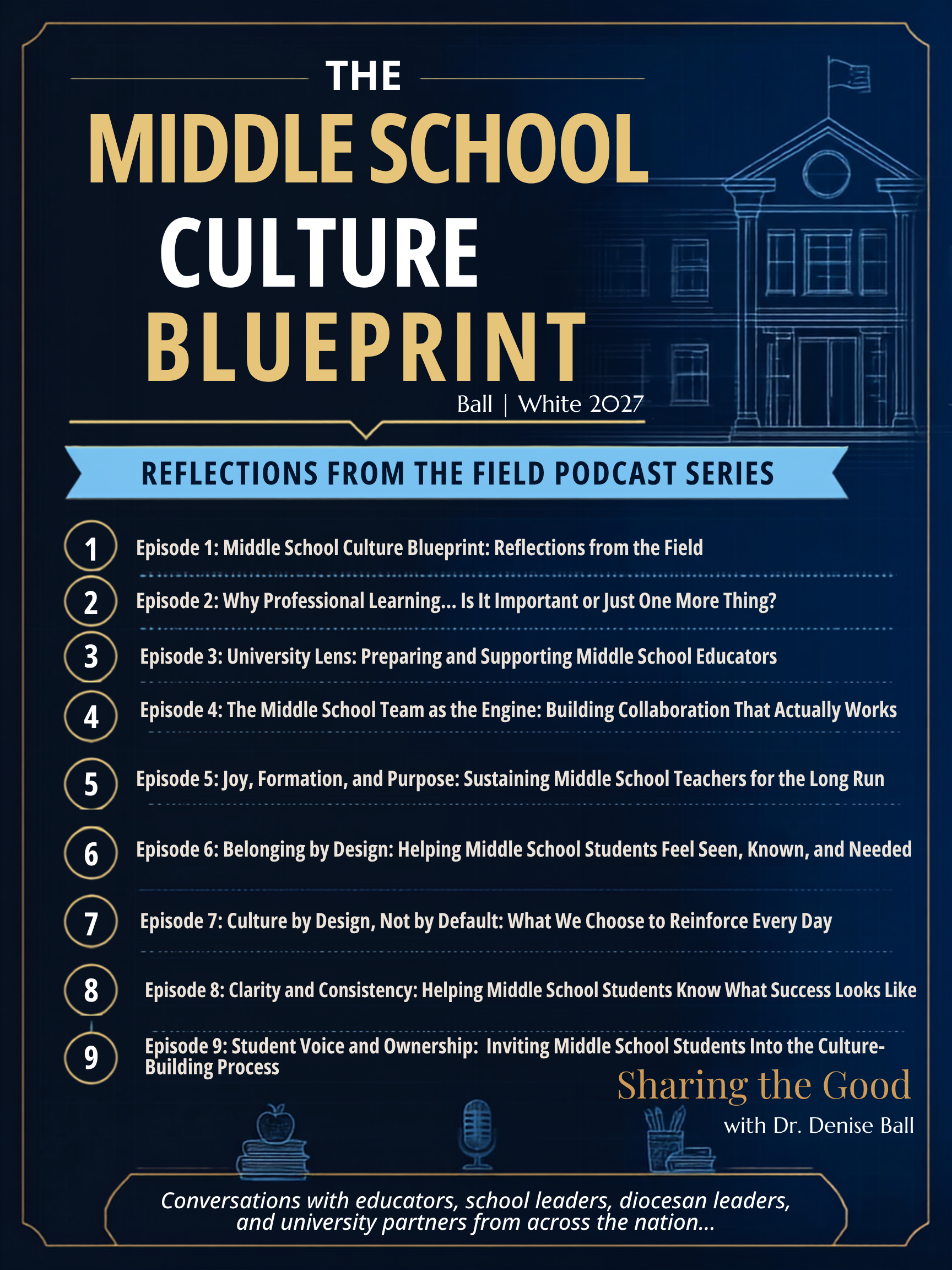
The Middle School Culture Blueprint series-Episode 1

One of the unexpected gifts of this season has been the opportunity to gather Catholic educators and leaders from across the nation in meaningful conversation. As Dr. LaTonya White and I continue our work on The Middle School Culture Blueprint, I have been provided a good opportunity to reflect on and be reminded that some of the most powerful professional learning happens when educators come together in fellowship, share what they are seeing in the field, and reflect honestly on what students and teachers need most. There is something deeply hopeful about bringing people together who serve in different schools and dioceses, yet carry the same commitment to helping students feel seen, supported, and loved.

The middle school years are so unique. Students are navigating understanding themselves, belonging, friendship, independence, emotion, peer pressure, and academic growth, often all in the same day. Those who serve middle school students understand that this work requires patience, humor, flexibility, structure, compassion, and joy. It also requires intentionality. What we do at the school level is so important. How we welcome teachers back, how we build routines, how we create opportunities for student voice, how we communicate with families, and how we support one another as teams all help shape the culture students experience.

This is why I am so grateful for the educators and leaders who have said yes to engaging in this conversation. They are not coming together to offer perfect answers. They are coming together to share reflections from the field, practical strategies, lived experience, and wisdom rooted in service. These conversations are supported by the literature that school culture is not built only through programs or plans. It is built in the daily interactions, team meetings, hallway moments, classroom routines, and faithful decisions made by educators who care deeply about the students placed before them.

Pulling educators together to share ideas is, quite honestly, fun. It is also cultivating joy in my own life. To listen to teachers and leaders speak with such love for their students, their colleagues, and Catholic education is a reminder that good is happening every day in our schools.

https://youtu.be/uMM1O_6Ygq8

When we create space for fellowship and conversation, we strengthen one another.

Fellowship reminds us that we are not doing this work alone. It is also a wonderful way to see how much wisdom already exists within the people serving on our campuses and in our diocesan communities.

I hope this work encourages school leaders to create similar spaces on their own campuses. Before the year begins, make time not only for logistics, but also for fellowship and table talk.

Invite teachers to reflect on what students need most. Ask teams what they want students to experience consistently across classrooms. Create room for laughter, honest conversation, prayer, and planning. When educators are given time to connect as people before they plan as professionals, the culture of the school is already being strengthened.

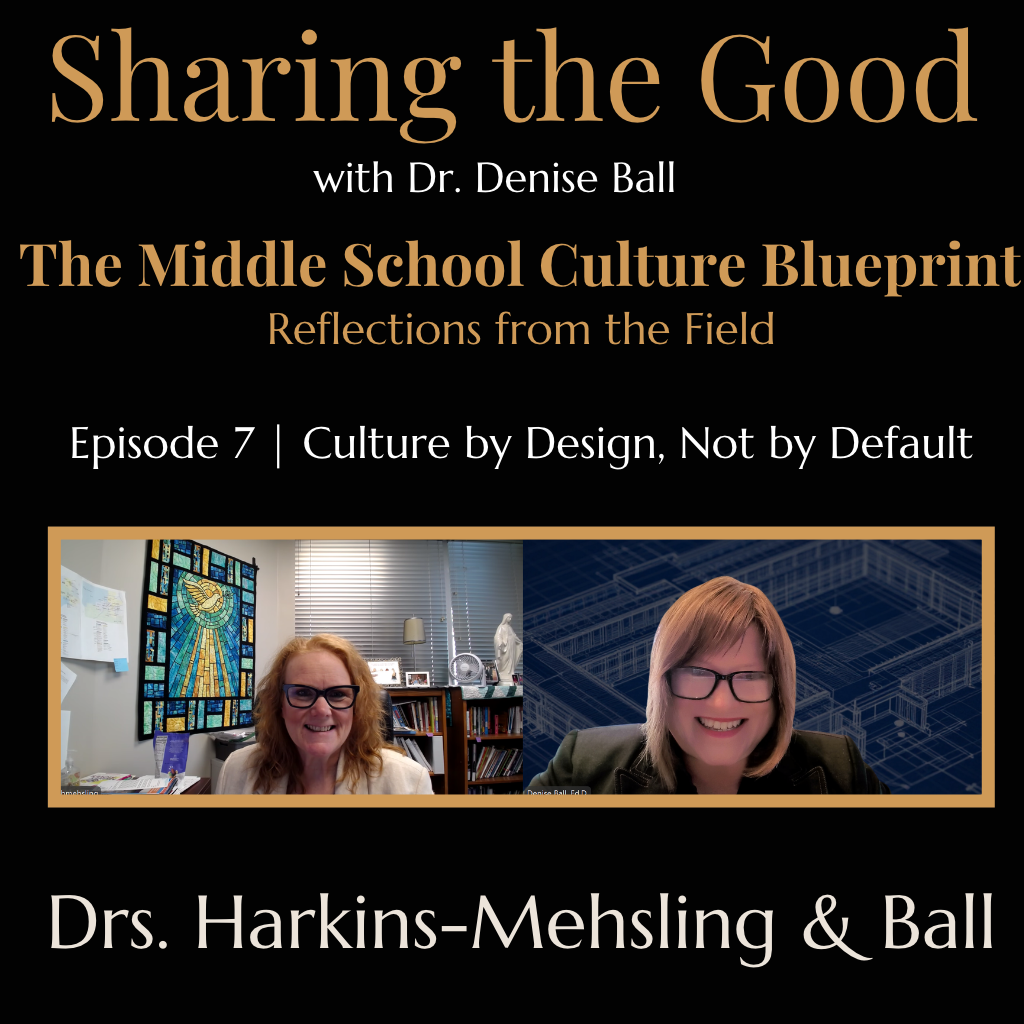
I am grateful to host this important conversation in Episode 1 of Middle School Culture Blueprint: Reflections from the Field: Creating a Positive Start to the 2026–2027 School Year. It is a privilege to welcome Dr. Nancy Baker, Mary Peters, Lynsie Reavis, Karina Lepkowski, and Tricia Florance as we reflect together on practical ways to support middle school teachers, students, families, and leaders. May these conversations continue to help us notice, name, and share the good happening in Catholic education.

You can also listen to these conversations anywhere you enjoy your podcasts.

May we continue to seek knowledge in all things,

Denise

Leave a comment

Filed under Educational Resources, The Middle School Culture Blueprint -Episode 1

An Educator Toolkit: 90 Positive Comments to Help Every Student Feel Seen, Valued, and Connected

Belonging Begins with the Words We Choose

Since 2012, I have shared resources via this Unlock the Teacher blog focusing on positive comments, praise, and how to create positive classroom environments with a reminder that words matter! Since that time, these posts have received more than 1.3 million views. This continued reach has reinforced something I have believed throughout my years in education, that teachers and school leaders are searching for practical language that helps them recognize the good in students.

Positive words can encourage students and strengthen relationships. Yet, as our understanding of school culture continues to grow, we are also invited to think more deeply about the messages our words communicate.

Our comments can do more than acknowledge appropriate behavior, completed work, or academic performance. They can communicate:

  • I see you.
  • I value your ideas.
  • Your voice matters.
  • You are capable of growth.
  • You are an important member of this community.
  • You belong here.

School connectedness exists when students believe that the adults and peers in their school care about them as individuals and care about their learning. This sense of being valued, supported, and included is associated with stronger engagement, attendance, academic outcomes, and overall well-being.

Relationships are not built only through large programs or special events. They are shaped through daily interactions: the greeting at the classroom door, the response to a student’s question, the note written on an assignment, the conversation following a mistake, and the words chosen when a student takes a risk.

Research on relationship-centered classrooms emphasizes the importance of authentic affirmation, active listening, student agency, and opportunities for young people to know that their voices are taken seriously.

Student voice is more than allowing students to speak. It includes providing meaningful opportunities for them to influence their learning, make choices, offer feedback, participate in decisions, and see that their contributions can lead to action.

This updated educator toolkit offers 90 positive comments organized around nine dimensions of belonging. The statements can be adapted for:

  • Daily classroom conversations
  • Written feedback
  • Student conferences
  • Report cards and progress reports
  • Notes or messages sent home
  • Family conferences
  • Advisory periods
  • Morning meetings
  • Restorative conversations
  • Celebrations of student growth

These comments are not intended to become generic scripts or empty praise. They are starting points. The most powerful affirmations are sincere, specific, timely, and connected to something an educator has genuinely noticed.

1. Welcoming Every Student

  1. I am glad you are here today.
  2. Your presence adds something important to our classroom.
  3. You are an important member of this learning community.
  4. There is a place for your ideas in this classroom.
  5. I appreciate the energy you brought into the room today.
  6. I noticed that you came in ready to participate and contribute.
  7. Your experiences help our class learn and grow.
  8. You do not have to know every answer to belong in this classroom.
  9. Thank you for bringing your ideas, interests, and questions with you.
  10. Our classroom community is stronger because you are part of it.

2. Recognizing Identity and Voice

  1. Your perspective helped us see this topic differently.
  2. Thank you for sharing an idea that was important to you.
  3. You expressed your thinking with honesty and confidence.
  4. Your experiences give you insights that can help others learn.
  5. I appreciate how clearly you explained the reasoning behind your opinion.
  6. You asked us to consider something we had not discussed before.
  7. Your voice helped shape the direction of our conversation.
  8. You found a meaningful way to communicate your ideas.
  9. You advocated for yourself respectfully and clearly.
  10. Your contribution showed that there can be more than one valuable way to understand a topic.

3. Encouraging Effort and Growth

  1. I can see the growth you have made since you began this work.
  2. You used feedback to strengthen your thinking.
  3. You tried a new strategy when your first approach did not work.
  4. You asked for the support you needed to move forward.
  5. You stayed engaged even when the work became challenging.
  6. You set a goal and took meaningful steps toward reaching it.
  7. You are learning how to recognize which strategies work best for you.
  8. You took ownership of your learning today.
  9. You made a thoughtful choice about how to improve your work.
  10. Your progress shows what can happen when you remain open to learning.

4. Affirming Curiosity and Courage

  1. Your question helped deepen our learning.
  2. You were willing to say that you did not understand, and that took courage.
  3. You respectfully challenged an idea and encouraged us to think more carefully.
  4. You took an academic risk by sharing your thinking before you were certain that you for trusting our class.
  5. You followed your curiosity and discovered something new.
  6. You explored more than one possible answer.
  7. You made a connection that helped bring this concept to life.
  8. You were open to revising your thinking when you encountered new information.
  9. You asked for evidence instead of simply accepting an answer.
  10. Your curiosity helped make today’s learning more meaningful for everyone.

5. Strengthening Collaboration

  1. You made room for another person’s voice.
  2. You listened to understand, not simply to respond.
  3. You built upon a classmate’s idea in a respectful way.
  4. You helped your group identify a path forward.
  5. You disagreed respectfully while remaining open to another perspective.
  6. You asked a question that encouraged someone else to participate.
  7. You used your strengths to support the work of the group.
  8. You accepted responsibility for your part of the team’s work.
  9. You noticed when the group needed encouragement and offered it.
  10. You helped your team move forward without taking over the work.

6. Recognizing Kindness and Care

  1. You noticed that someone needed support and chose to help.
  2. The care you showed helped another person feel valued.
  3. You included someone who might otherwise have felt left out.
  4. You treated another person’s ideas with dignity and respect.
  5. You chose kindness even when the situation was difficult.
  6. You helped create a space where someone felt comfortable asking a question.
  7. You offered a sincere apology and worked to repair the relationship.
  8. You celebrated someone else’s success without taking attention away from them.
  9. Your words helped another person feel encouraged.
  10. You showed empathy by trying to understand how someone else might be feeling.

7. Building Responsibility and Trust

  1. I can depend on you to follow through on your commitments.
  2. You completed the responsibility you accepted.
  3. You made a responsible choice, even when no one was reminding you.
  4. You used your time in a way that supported your learning.
  5. You took care of our shared space and materials.
  6. You were honest about what happened and helped us find a solution.
  7. You recognized when you needed assistance and asked for it.
  8. You accepted responsibility for your choice without blaming someone else.
  9. You came prepared and ready to contribute.
  10. You used your independence while also knowing when to seek guidance.

8. Supporting Resilience and Reflection

  1. You paused to think before deciding what to do next.
  2. You did not allow one difficult moment to define the rest of your day.
  3. You changed your approach when you realized something was not working.
  4. You identified what you needed in order to begin again.
  5. You recognized a challenge and made a plan for addressing it.
  6. You gave yourself time to learn instead of expecting immediate perfection.
  7. You used a mistake as information for your next step.
  8. You returned to the work after feeling frustrated.
  9. You were patient with yourself while learning something new.
  10. You reflected honestly on your choices and identified how you would respond differently next time.

9. Creating Classroom Community

  1. Your actions helped make our classroom more welcoming.
  2. You helped create a space where others felt comfortable participating.
  3. You contributed an idea that improved our classroom community.
  4. You invited others to help make a decision.
  5. You reminded us of the expectations we created together.
  6. You helped our class solve a problem in a fair and respectful way.
  7. You shared a strength or talent that enriched our learning.
  8. You helped us recognize and celebrate someone else’s growth.
  9. You made a choice that supported both your learning and the learning of others.
  10. You showed through your actions that everyone has something meaningful to contribute.

Moving From Praise to Partnership

Positive comments become even more powerful when they invite students to recognize their own growth. Instead of ending the interaction after an affirmation, educators can add a reflective question.

For example:

  • You stayed engaged even when the assignment became difficult. What helped you keep going?
  • You made room for another person’s voice. What did you notice about the group after you did that?
  • You tried a new strategy when the first one did not work. How did you decide what to try next?
  • Your perspective helped us see the topic differently. What gave you the confidence to share it?
  • You advocated for yourself respectfully. How might you use that skill in another situation?

These questions move the conversation from adult approval to student reflection. As an educator, you are identifing something meaningful, and the student is invited to name the choices, strategies, and strengths that contributed to the outcome.

Over time, this approach can help students develop the language to say:

  • I know how I learn.
  • I can make thoughtful choices.
  • I can ask for what I need.
  • I can contribute to my community.
  • I can grow.

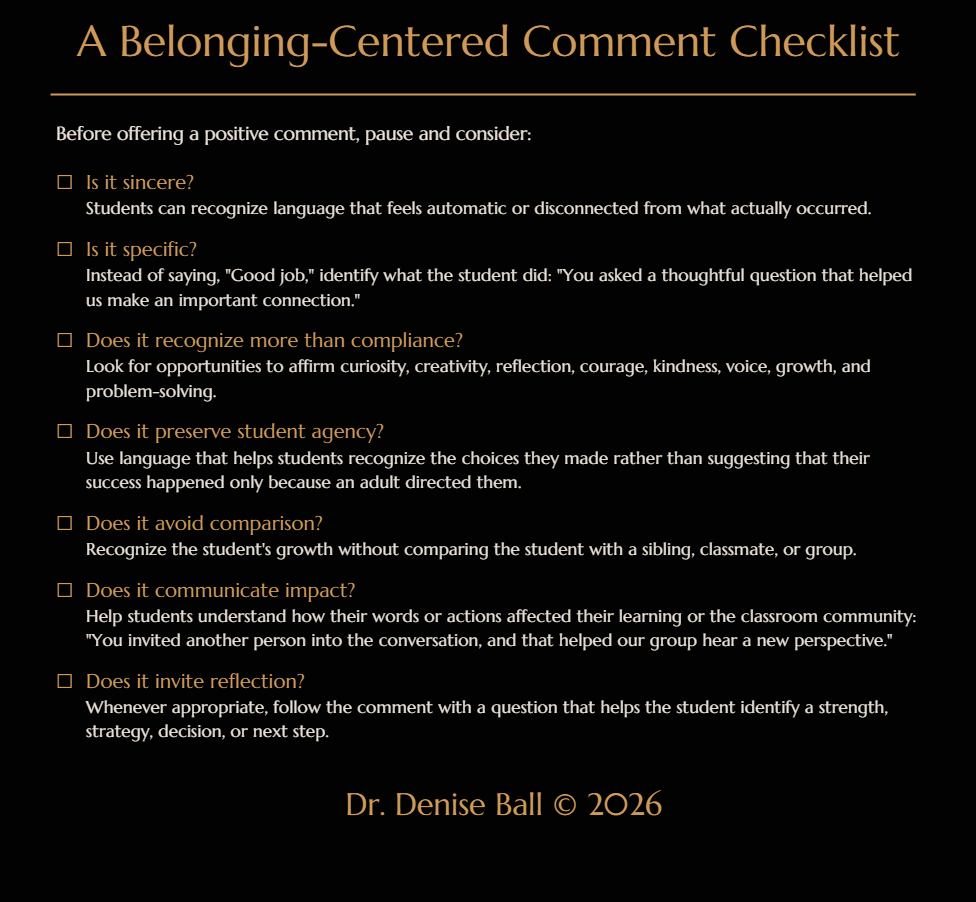
A Belonging-Centered Comment Checklist

Words Help Shape Culture

Positive language does not mean ignoring mistakes, avoiding difficult conversations, or removing accountability. Belonging-centered classrooms maintain clear expectations while communicating that a student’s mistake does not remove the student from the community.

Students need to hear more than what they should stop doing. They also need language that helps them understand what they are doing well, how they are growing, how their choices affect others, and how they can contribute.

There will always be a need to redirect behavior, offer correction, and establish boundaries. The question is whether students also hear:

-I believe you can make a different choice.

-You are still an important member of this community.

-Let us think together about what happened.

-What do you need to move forward?

-How can you help repair the situation?

-I am here to help you begin again.

The language educators use becomes part of the environment students experience each day. A carefully chosen comment may appear to be a small gesture, but to a student, it can communicate something much larger:

My teacher sees me. 

My ideas matter.

I am capable.

I have choices.

I can make a difference.

I belong here.

As educators prepare classrooms, develop lessons, establish routines, and welcome students into a new year of learning, may we also prepare the language we will use.

Belonging is strengthened one interaction at a time.

When we train our eyes to see the good, amazing things happen.

May we continue to seek knowledge in all things,

Denise

References and Additional Resources

Ball, D. M. (2012, July 22). 100 positive comments to utilize when referencing student behavior. Unlock the Teacher.

Centers for Disease Control and Prevention. (2024, November 18). School connectedness helps students thrive.

Hernández, L. E., Darling-Hammond, L., & Nielson, N. (2024, November 21). Cultivating relationships in secondary classrooms: Practices that matter. Learning Policy Institute.

Regional Educational Laboratory Pacific. (2025). Including voice in education: Addressing equity through student and family voice in classroom learning. Institute of Education Sciences.

Leave a comment

Filed under Words Have Power

When Shared Mission Becomes a Shared Walk

Why Fellowship is Essential with Karina Lepkowski, Principal, Most Holy Trinity

Fellowship is more than networking. It is more than collaboration around a project, committee, or a professional learning day. Fellowship is what happens when trust is built over time, shared mission becomes a shared walk, and colleagues become the trusted voices we return to because we know they will listen, encourage, challenge, and help us see more clearly.

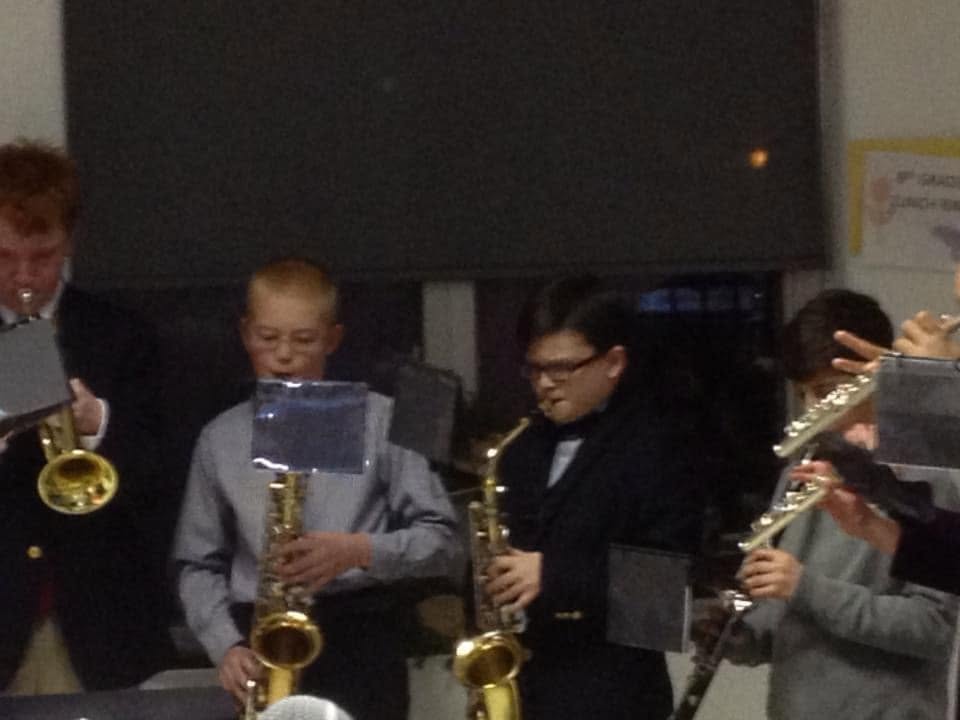
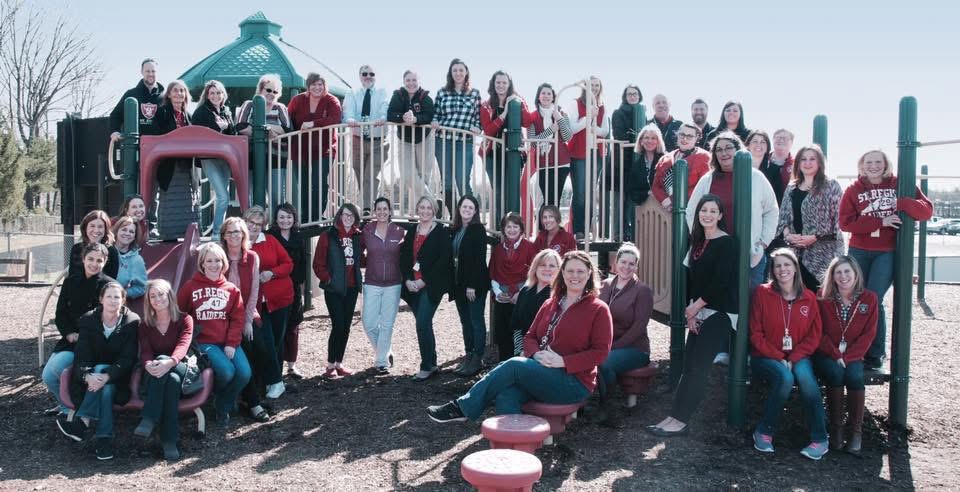
Today, I had the joy of meeting with Karina Lepkowski, Principal at Most Holy Trinity Catholic Academy in the Archdiocese of Detroit. Karina and I have been collaborators for 14 years. She served on my team at St. Regis Catholic School, we have worked together on committees, and she has led sessions for professional learning days I developed for the Archdiocese of Baltimore. Over the years, our professional paths have crossed in many meaningful ways. But perhaps one of the most treasured parts of our story is this: Karina introduced my son to music and taught him how to play the alto saxophone. His love of jazz and the gift of having music in his heart will last him a lifetime. For that, I will always be grateful to this amazing educator, and I am honored to call her a friend now.

About Karina

Karina Lepkowski is a distinguished Catholic educator and graduate of the University of Notre Dame’s Alliance for Catholic Education (ACE) Mary Ann Remick Leadership Program. As a member of Cohort 18, she earned a Master of Arts in Educational Leadership and has continued to serve Catholic education with dedication, wisdom, and heart. Her leadership and service were also recognized by the Catholic Foundation of Michigan, which honored her with an Amazing Catholic Educator Award.

A Servant Leader

While these accomplishments speak beautifully to Karina’s professional impact, what I value most is the way she leads through relationships. She is the kind of educator and leader who listens deeply, shares generously, and reminds others that the work of Catholic education is strengthened when we walk alongside one another.

As Karina and I caught up and discussed projects we are working on, I was reminded of something important. Educational leaders need trusted voices. We need people who understand the work, who know the heart behind the work, and who can offer honest insight because the relationship is rooted in care. These are the colleagues who help us process ideas, sharpen our thinking, and stay grounded in mission. They remind us that leadership was never meant to be a lonely road.

Research continues to affirm what many of us have experienced in our own leadership journeys. Strong professional learning is collaborative, sustained, and grounded in reflection. Darling-Hammond, Hyler, and Gardner (2017) found that effective professional development creates opportunities for educators to share ideas, collaborate in job-embedded ways, and build communities that can positively influence the culture and instruction of a school or system. Similarly, research on collective teacher culture points to the importance of shared goals, supportive colleagues, collective efficacy, and belonging as important dimensions of a healthy school culture.

This is why fellowship matters. When leaders intentionally build relationships of trust and professional friendship, they strengthen the culture around them. Fellowship helps us become better listeners. It helps us ask better questions. It gives us space to pause, reflect, and renew. It also helps us remember that the work of education is deeply human. Behind every initiative, every professional learning session, every school improvement goal, and every strategic plan are people who need encouragement, connection, and belonging.

In my own research on teacher retention, school climate, leadership, collaboration, and culture emerged as important areas of focus in understanding how educators experience their work and what helps them remain committed to the mission (Ball, 2023). Positive school culture is not built by accident. It is formed through intentional relationships, shared purpose, and the daily decision to walk alongside one another.

As educational leaders, we often spend time developing strategic muscles: planning, decision-making, problem-solving, communication, and execution. These are important. However, I would share that research supports that we also need to be just as intentional about building the muscle of fellowship. Collective teacher culture is strengthened through shared goals and values, collective efficacy, supportive colleagues, belonging, and job satisfaction, all of which remind us that trusted professional relationships are central to healthy school communities (Skaalvik & Skaalvik, 2021). Who are the trusted voices we call when we need to think out loud? Who helps us see the good when the work feels heavy? Who reminds us of who we are and why this work matters?

The summer weeks offer a beautiful invitation to pause and reach out. Send the text, make the call, or schedule the coffee. Technology offers us the wonderful ability to connect via Zoom, Meet, FaceTime, etc. We really have no excuse not to engage with the technological tools at our fingertips today. I encourage you to reconnect with the colleague who has walked part of the journey with you. Take time to say thank you to the person who helped shape your leadership, your school community, or even your family in ways that will last a lifetime. Gratitude has a way of lowering our stress levels and refocusing our lens to see the good all around us.

When we make time to walk alongside one another, we build the kind of school culture where others can do the same.

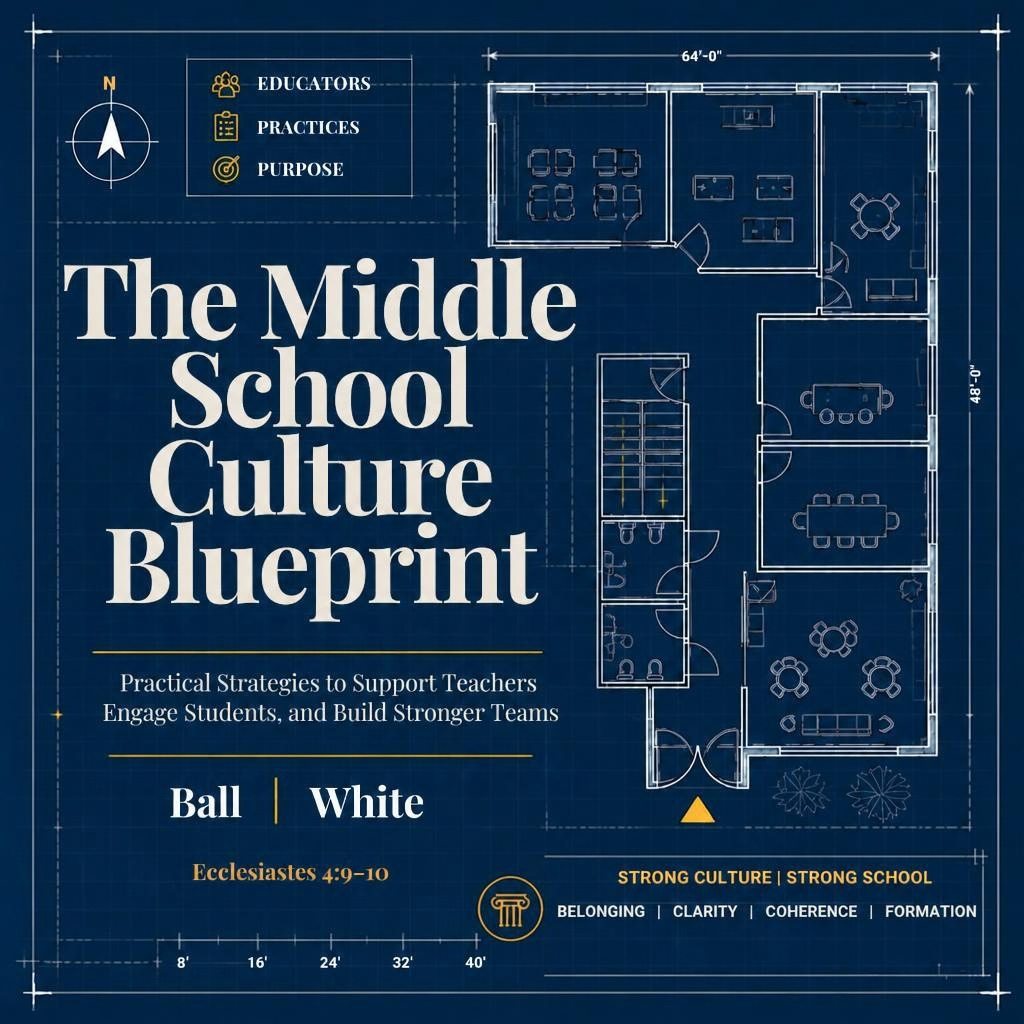
This year, my research has continued to center around school culture and team development. In my two latest projects, When We Train Our Eyes to See the Good, Amazing Things Happen and The Middle School Culture Blueprint, which I am co-authoring with Dr. LaTonya White, I have been reflecting deeply on the gift of fellowship and why it matters so much for educational leaders. If you would like to share your thoughts, please send me a message or leave a comment. I welcome the feedback and insights.

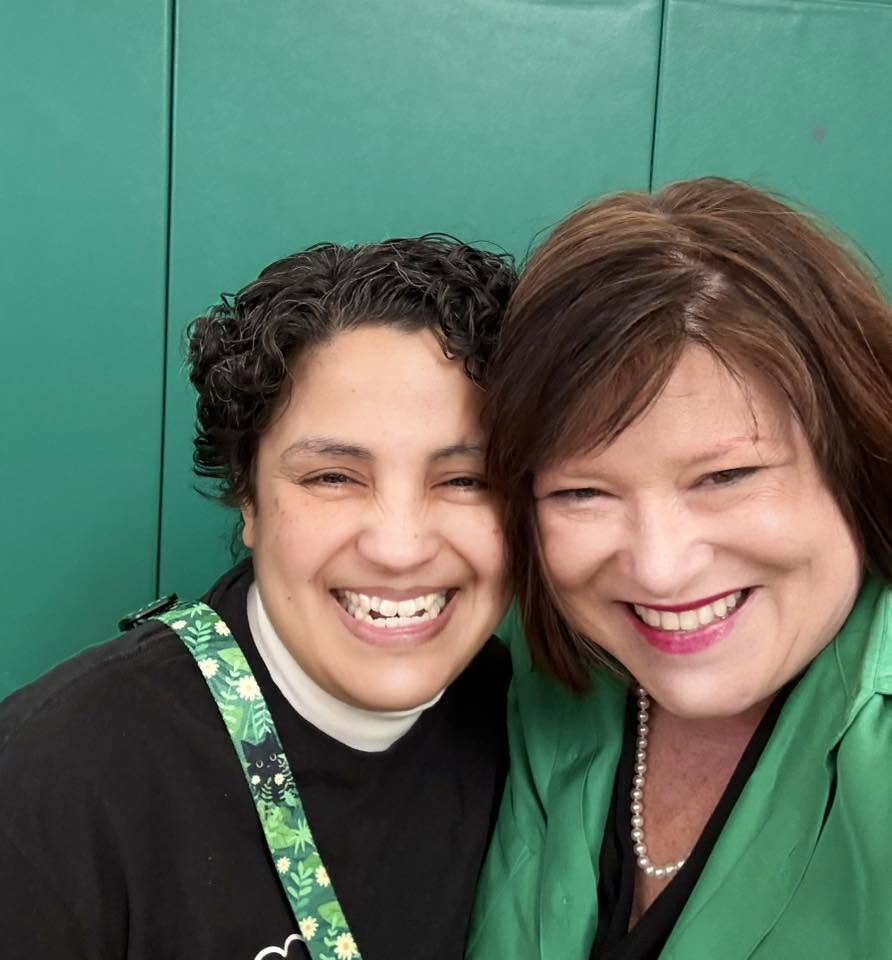
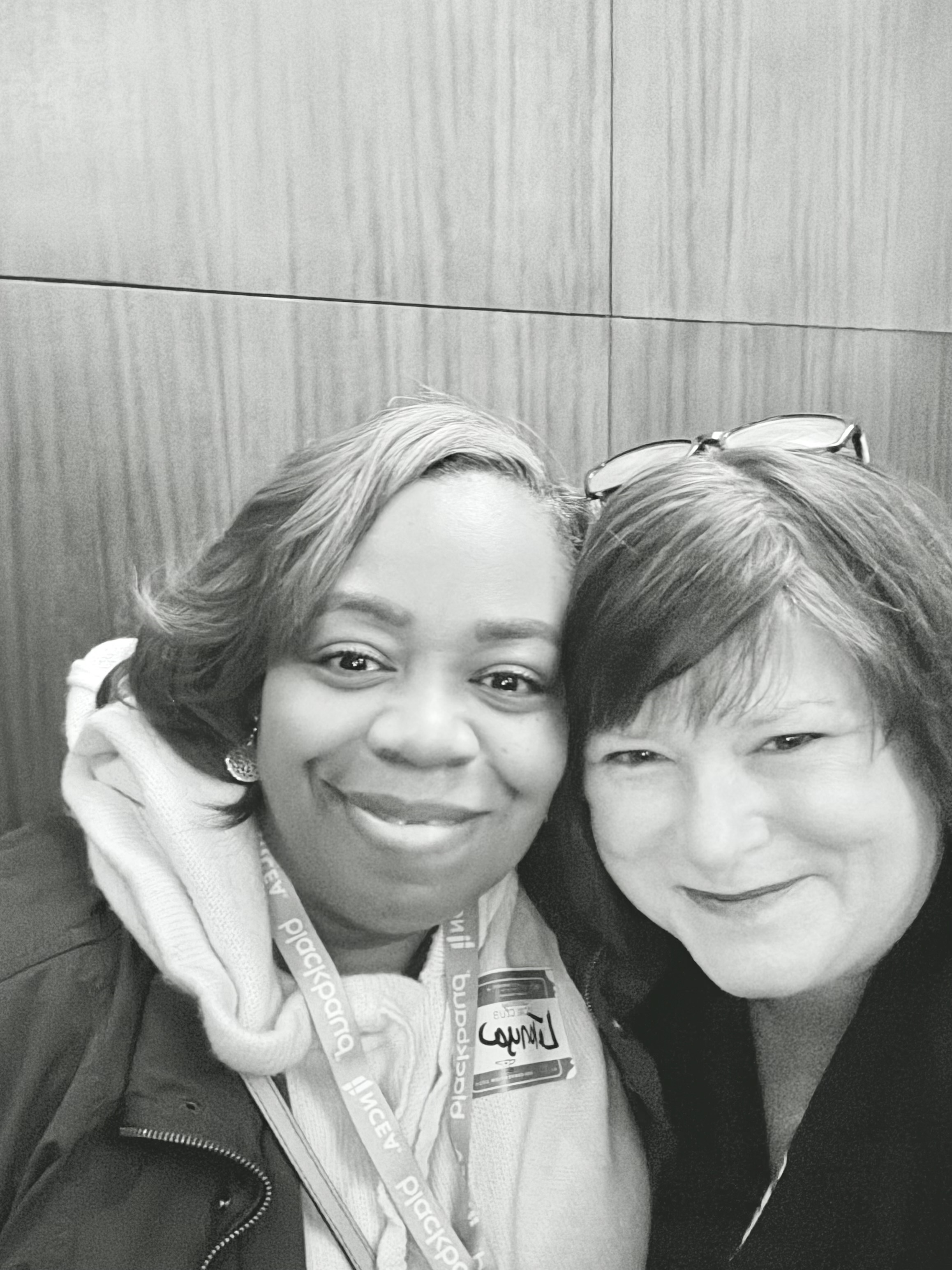
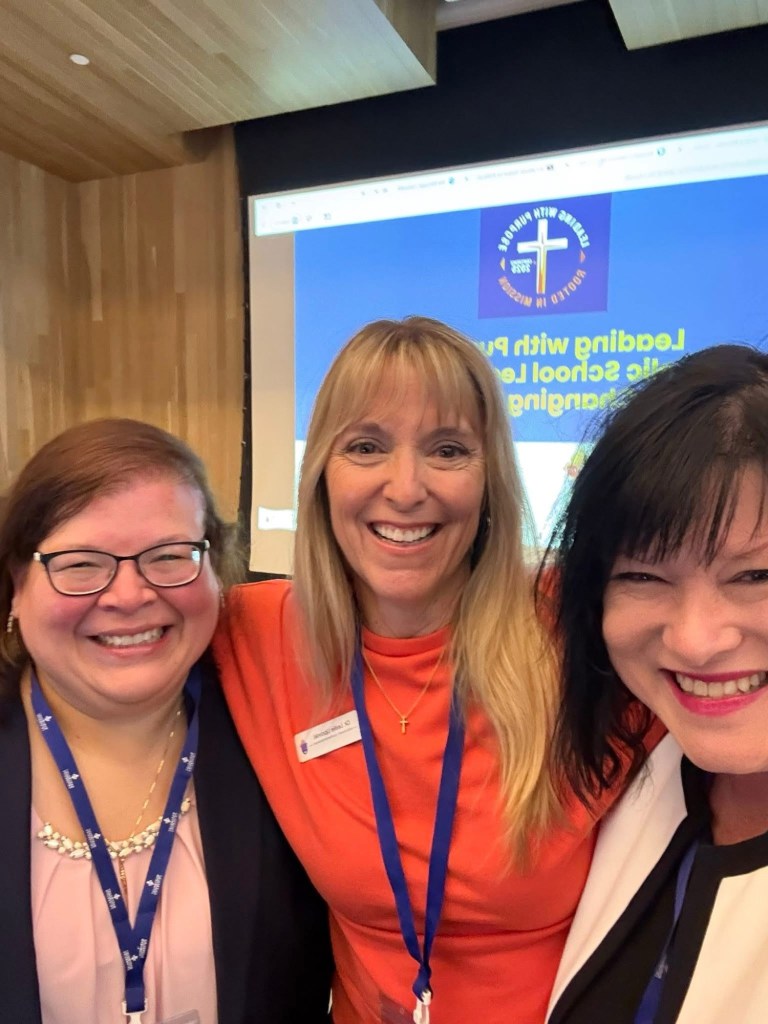
Dr. LaTonya White and Dr. Denise Ball, National Catholic Leadership Convention 2026

May we continue to seek knowledge in all things,
Denise

References

Ball, D. M. (2023). Improving teacher retention within Archdiocese of Washington schools [Doctoral dissertation, Liberty University]. Liberty University Scholars Crossing.

Darling-Hammond, L., Hyler, M. E., & Gardner, M. (2017). Effective teacher professional development. Learning Policy Institute.

Skaalvik, E. M., & Skaalvik, S. (2021). Collective teacher culture: Exploring an elusive construct and its relations with teacher autonomy, belonging, and job satisfaction. Social Psychology of Education, 24, 1389–1406.

United States Conference of Catholic Bishops. (2011). New American Bible, Revised Edition.

Leave a comment

Filed under Educational Resources

Strengthening Schools Through Partnership: The Role of Universities in Teacher Retention

Across the country, school leaders are navigating one of the most persistent challenges in education today: retaining talented, mission-driven educators. While much of the conversation centers on compensation, workload, and policy, one of the most underutilized and high-impact resources sits right beside our schools…our university partners.

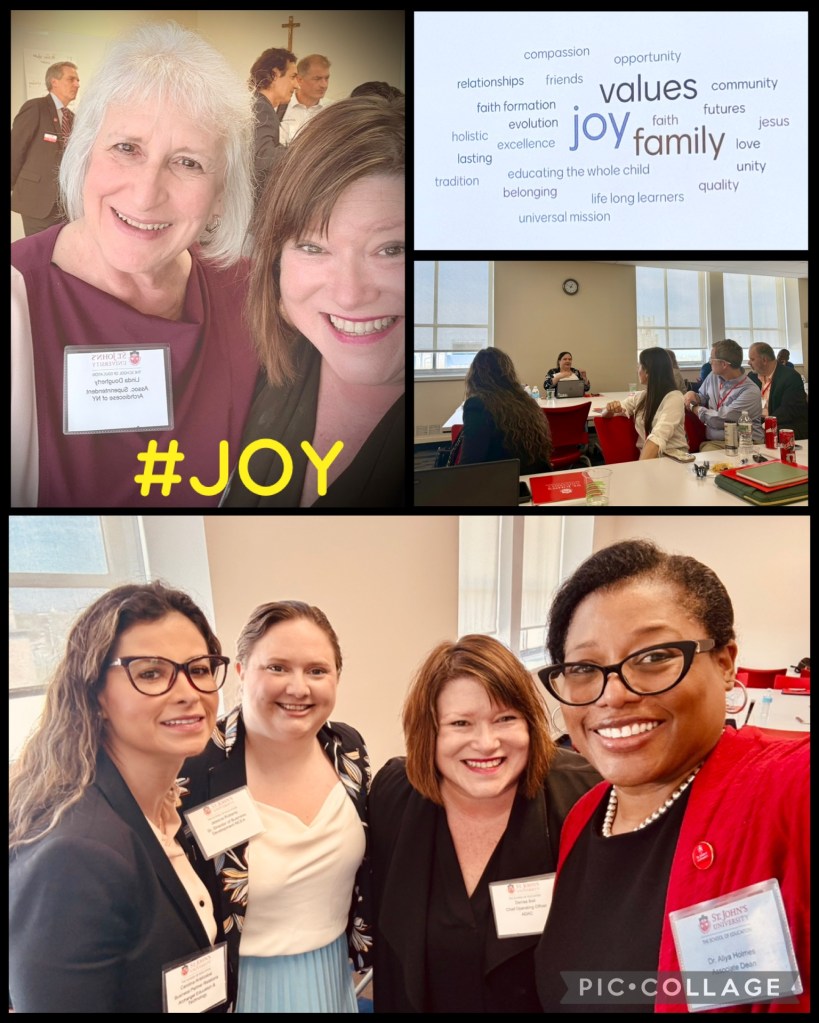
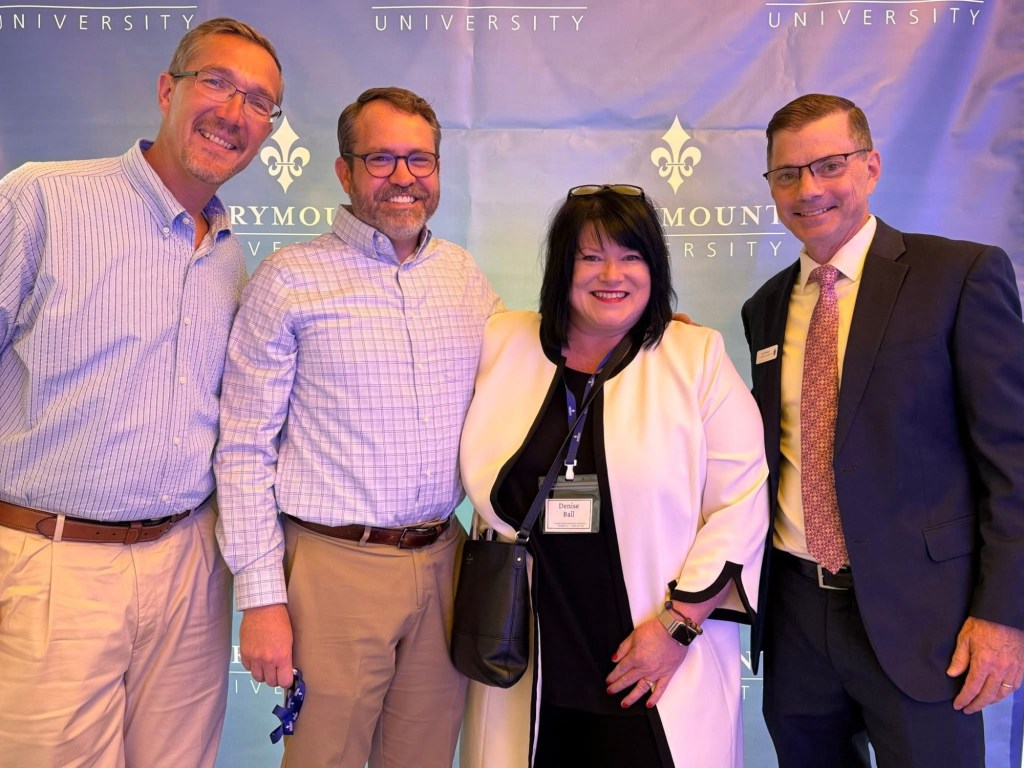
I always enjoy hearing and sharing the good with Boston College Roche Center educational leaders.

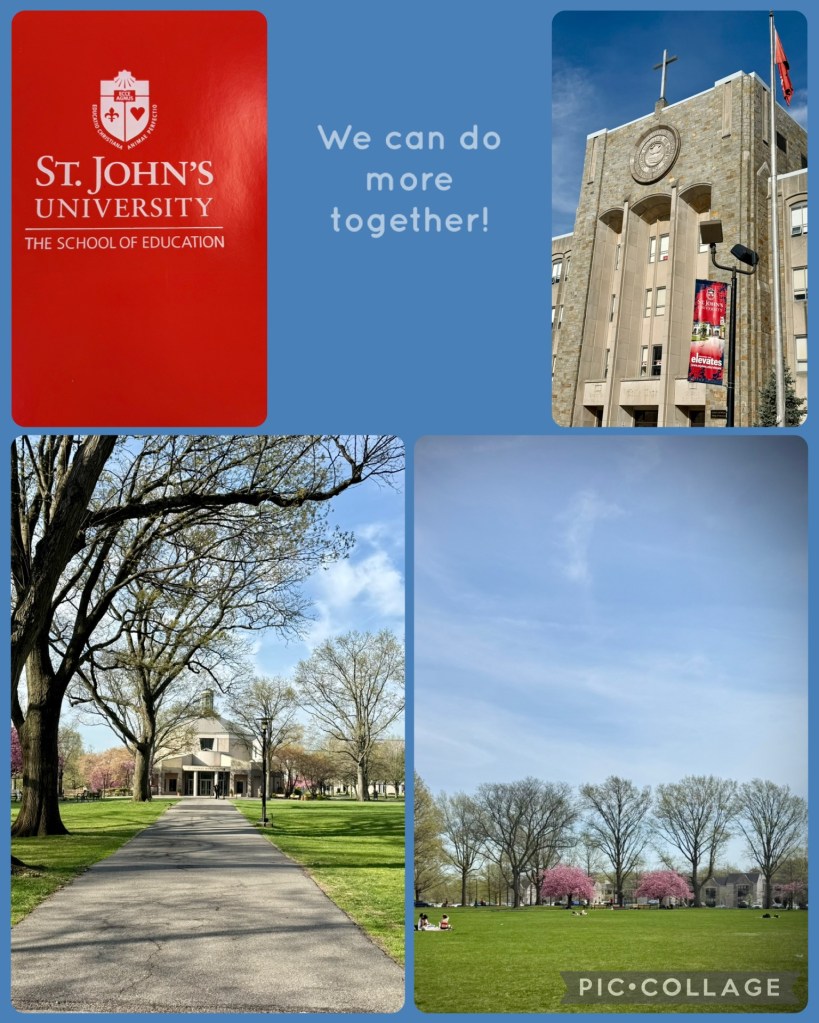
Institutions like Marymount University, Boston College, and St. John’s University are not only preparing future educators, they are increasingly listening, adapting, and responding to the real-time needs of school leaders and teachers. When leveraged intentionally, these partnerships can become a cornerstone strategy in addressing the teacher retention challenge.

At their best, university-school partnerships move beyond transactional relationships and become transformational. They create shared responsibility for developing, supporting, and sustaining educators across the full arc of their careers.

St. John’s University edTech Summit—a think tank session!

What This Looks Like in Practice

Educational leaders can take intentional steps to deepen these partnerships in ways that directly impact teacher retention:

Enhancing School-Based Opportunities Through Strategic Partnership

Professional learning is most effective when it is grounded in the context of the school and led by those closest to the work. I find there is value in leaning on university partners as thought partners. These relationships bring research, frameworks, and support that strengthen intentionally designed opportunities (Desimone & Garet, 2015).

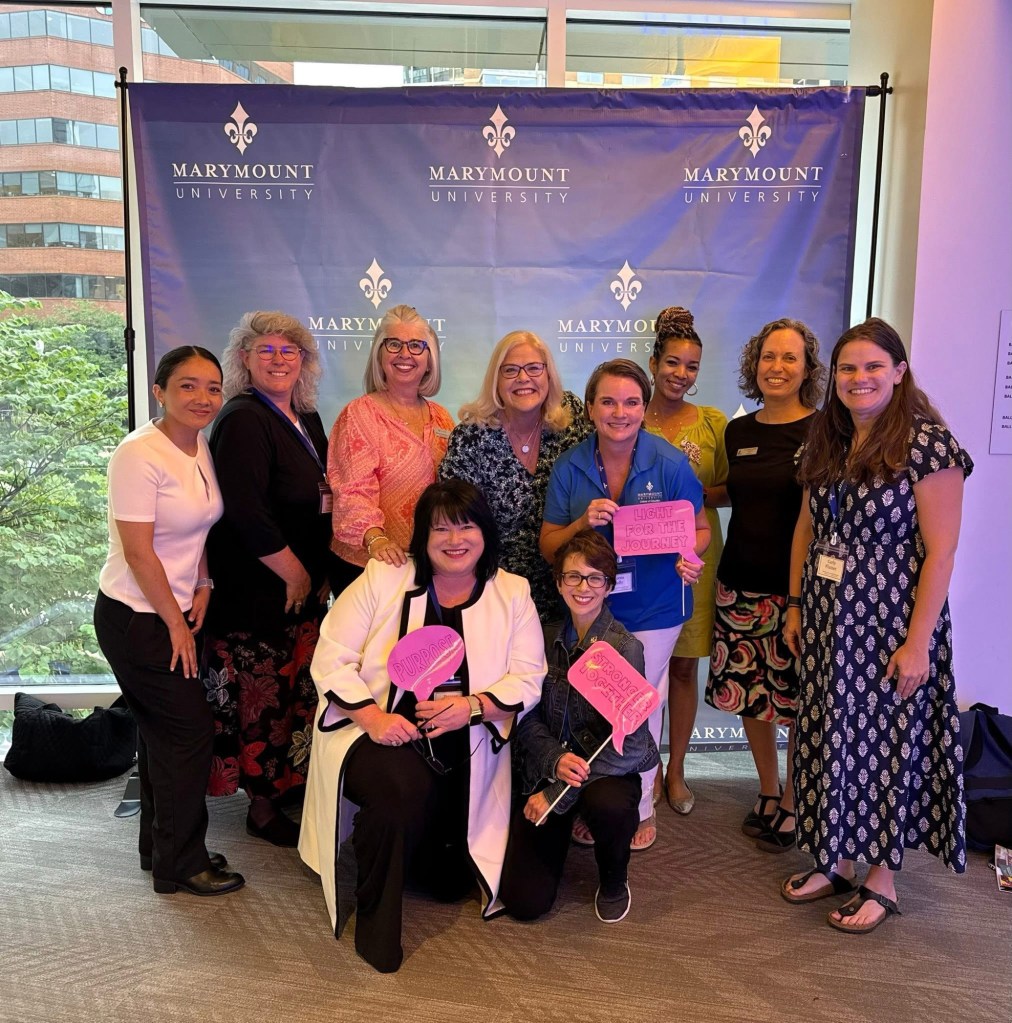
Marymount University Regional Catholic School Leadership Conference

Creating Leadership Pathways

Retention is closely tied to growth. Universities can partner with school systems to build leadership pipelines, offering graduate programs, certifications, and cohort models that empower teachers to see a future within the profession. When educators can envision their next step, they are more likely to stay (Ingersoll et al., 2018).

Embedding Research into Practice

Strong partnerships allow schools to serve as living laboratories where research informs practice and practice refines research. Whether through action research, dissertation collaboration, or pilot programs, teachers feel valued when their experiences contribute to broader learning and improvement (Coburn & Penuel, 2016).

Expanding the Teacher Pipeline with Purpose

Through intentional clinical experiences, residency models, and targeted recruitment efforts, universities can help schools attract candidates who are not only qualified but mission-aligned. This alignment is essential across all educational governance models, where purpose plays a central role in retention (Guha et al., 2016).

Supporting Educator Well-Being and Belonging

Teachers stay where they feel seen, supported, and connected. Universities can contribute by integrating social-emotional learning, reflective practice, and community-building strategies into both pre-service and in-service programming. Research consistently shows that school culture, trust, and collective efficacy are key drivers of teacher retention (Kraft et al., 2016). I am very passionate about this topic and my research highlights the central role of school climate, leadership, and relational trust in shaping teachers’ decisions to remain in the profession (Ball, 2023).

The most impactful university partnerships are grounded in a shared belief: that supporting teachers is not the responsibility of one institution, but a collective commitment.

When school systems and universities work together with intention, we begin to see action to impact. Professional learning becomes more meaningful, leadership becomes more distributed, and culture becomes more supportive. Most importantly, teachers begin to experience what so many are seeking: a sense of purpose, growth, and belonging within their schools.

For educational leaders, the invitation is clear: lean into these partnerships. Invite universities to the table not just as providers, but as collaborators. Share your challenges openly, co-create solutions, and build meaningful and impactful frameworks not one-time supports.

When we strengthen the bridge between universities and schools, we are not just preparing teachers, we are sustaining them.

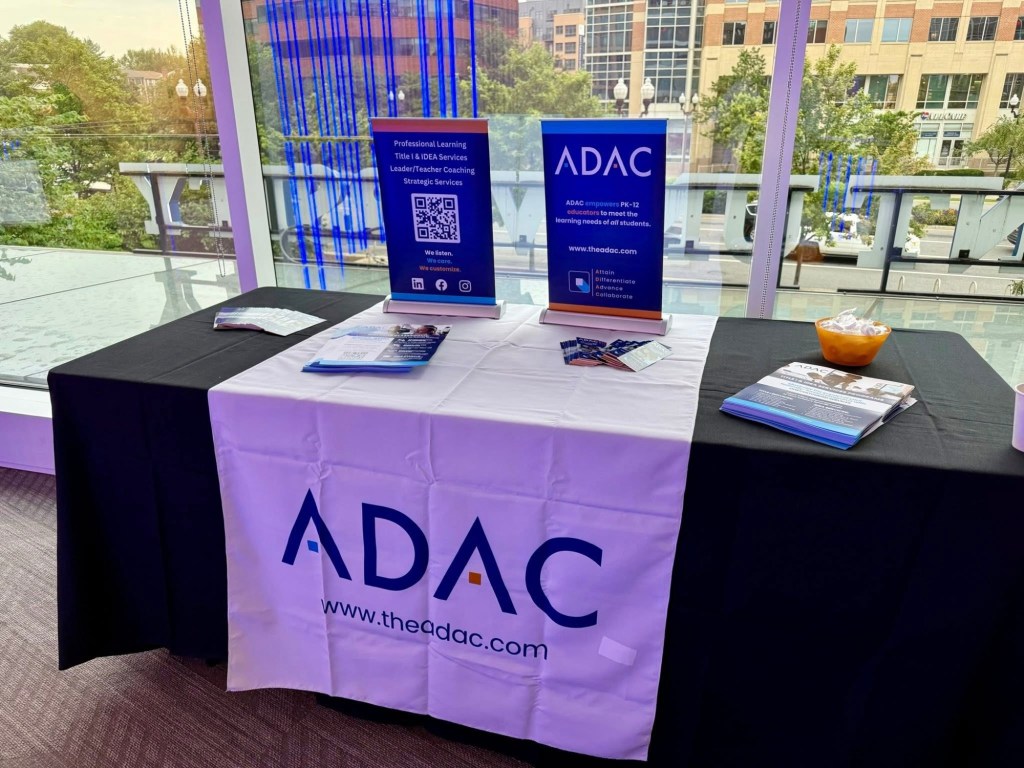
At the heart of this work is a simple but powerful truth…we can do more for our teachers when we do it together. The challenges facing education today call us to think beyond traditional structures and lean into the strength of collective impact. By partnering with universities and trusted vendor partners, we open the door to innovative, responsive solutions that better meet the needs of our educators. More importantly, these partnerships allow us to visibly and authentically demonstrate our gratitude for teachers, thankful for their dedication, their resilience, and their daily commitment to shaping the lives of the students entrusted to their care.

When educators feel supported not just by their school, but by a broader community working on their behalf, we move closer to building the kind of sustainable, mission-driven environments where teachers choose to stay and thrive.

References 

Ball, D. M. (2023). Improving teacher retention within Archdiocese of Washington schools (Doctoral dissertation, Liberty University). https://digitalcommons.liberty.edu/doctoral/5006  

Coburn, C. E., & Penuel, W. R. (2016). Research–practice partnerships in education: Outcomes, dynamics, and open questions. Educational Researcher, 45(1), 48–54. https://doi.org/10.3102/0013189X16631750

Desimone, L. M., & Garet, M. S. (2015). Best practices in teachers’ professional development in the United States. Psychology, Society, & Education, 7(3), 252–263. https://doi.org/10.25115/psye.v7i3.515

Guha, R., Hyler, M. E., & Darling-Hammond, L. (2016). The teacher residency: An innovative model for preparing teachers. Learning Policy Institute.

Ingersoll, R. M., Merrill, L., Stuckey, D., & Collins, G. (2018). Seven trends: The transformation of the teaching force. Consortium for Policy Research in Education.

Ingersoll, R. M., & Strong, M. (2011). The impact of induction and mentoring programs for beginning teachers: A critical review of the research. Review of Educational Research, 81(2), 201–233. https://doi.org/10.3102/003465431140

Leave a comment

Filed under Educational Resources, Hot Topics in Education, Inspiration, Positive School Culture, Sharing the Good in Education, teacher retention, Teacher Retention and Recruitment, University Partners

The Power of Traditions in a 30-Second World at Home & in the Classroom

We are raising children in a world of scroll, swipe, and sound bites. Information arrives in 30-second clips, fragmented headlines, and algorithm-driven content streams. Research suggests that rapid, high-frequency digital consumption can shorten attention spans and contribute to cognitive overload (Carr, 2010; Ophir et al., 2009). Attention is divided. Moments are rushed. Noise is constant.

In this environment, parents and teachers are called to be architects of pause.

Traditions and routines are not small things. They are anchors. They slow the train. They invite us to stop long enough to see, truly see, the children in our classrooms and the people in our homes.

These pauses do something powerful to the human spirit…

They create predictability in an unpredictable world. They foster emotional safety. They promote a grounded sense of reality, a reminder that life is more than reaction and response; it is relationship and presence. Research consistently links predictable routines with improved emotional regulation, reduced anxiety, and stronger mental and physical health outcomes in children and adolescents (Fiese et al., 2002; Spagnola & Fiese, 2007).

A Situation We Recognize

Imagine a middle school classroom on a Monday morning.

Students arrive buzzing from weekend activity and digital stimulation. Some are anxious about assignments. Others are carrying silent burdens from home. The energy is scattered.

Instead of diving immediately into content, the teacher begins with “Monday Morning Light.” A candle is turned on (battery operated for safety). Soft instrumental music plays for two minutes. Students are invited to write one gratitude and one intention for the week.

The room shifts…

Breathing slows. Shoulders drop. Eye contact increases. Students are no longer fragmented individuals entering from separate worlds, they are a community beginning together!

Over time, this simple ritual becomes a stabilizing force. It lowers stress responses and supports emotional regulation, outcomes that research connects to consistent family and classroom routines (Spagnola & Fiese, 2007).

That two-minute tradition communicates:

You are safe here. You belong here. We begin together.

Traditions do not waste time. They redeem it.

Why Traditions Matter

Traditions:

-Provide emotional security in uncertain times

-Strengthen identity and belonging

-Reinforce shared values

-Reduce stress through predictable rhythms

-Build intergenerational memory and meaning

-Cultivate hope

Traditions remind us of good memories of what was and give us hope for what is to come.

Let us never underestimate the power of hope. Hope strengthens resilience. Hope sustains effort. Hope fuels joy!

Simple Traditions to Begin Today

In the Classroom

1. Gratitude Friday

End every Friday with students naming one win from the week: academic, personal, or relational.

2. “Light the Week” Ritual

Begin Mondays with a short reflection, Scripture, quote, or moment of silence.

3. Celebration Wall

Create a space where students post small victories: kindnesses, perseverance, improvement.

4. Monthly Service Spotlight

Each month highlight a virtue or service theme and celebrate students who model it.

5. Seasonal Reset Days

At the start of each quarter, pause for goal-setting and community-building before diving into content.

At Home

1. Sunday Supper Tradition

Phones away. One question around the table that invites storytelling.

2. Birthday Blessings

Each family member speaks a word of affirmation over the birthday child, regardless of age.

3. First-Day-of-School (First-Day-of Quarter) Breakfast Ritual

Same meal. Same prayer. Same photo spot. Every year/every quarter.

4. Advent or Lent Reflection Nights

Short candle-lit gatherings with reflection and shared intention.

5. Monthly Memory Night

Pull out old photos and tell stories. Children anchor their identity in narrative memory. (Note: my kids are in their twenties and Michael and I still lean in on this tradition a few times a year.)

Intentional Pauses are Essential

Traditions are not elaborate productions. They are intentional pauses.

In a world that accelerates, traditions decelerate.

In a culture that fragments, traditions gather.

In a society that overwhelms, traditions ground.

Children, young and old, do not simply need information. They need formation.

They need rhythms that say:

You belong. You are known. You are part of something lasting.

As parents and teachers, we are not just managing days.

We are shaping memories.

We are cultivating hope.

We are building anchors that will steady our children long after they leave our classrooms and homes.

Let us be people who pause, let us be people who build traditions, and let us be people who carry hope forward.

Stay tuned for more information on making a difference for children and in service to others. When We Train Our Eyes to See the Good—Amazing Things Happen (Ball, 2026) is in one of the final draft phases 😉.

I would love to hear the classroom and home traditions and routines being used—please leave a comment and share with those who follow this blog. This blog has surpassed over 1 million views…thank you for sharing the good!

May we continue to seek knowledge in all things~

Denise

References

Carr, N. (2010). The shallows: What the Internet is doing to our brains. W. W. Norton & Company.

Fiese, B. H., Tomcho, T. J., Douglas, M., Josephs, K., Poltrock, S., & Baker, T. (2002). A review of 50 years of research on naturally occurring family routines and rituals: Cause for celebration? Journal of Family Psychology, 16(4), 381–390. https://doi.org/10.1037/0893-3200.16.4.381

Ophir, E., Nass, C., & Wagner, A. D. (2009). Cognitive control in media multitaskers. Proceedings of the National Academy of Sciences, 106(37), 15583–15587. https://doi.org/10.1073/pnas.0903620106

Spagnola, M., & Fiese, B. H. (2007). Family routines and rituals: A context for development in the lives of young children. Infants & Young Children, 20(4), 284–299. https://doi.org/10.1097/01.IYC.0000290352.32170.5a

Leave a comment

Filed under Creating a Positive School Culture, Inspiration, Positive School Culture, Traditions for Home & the Classroom

Engage, Explore, Elect: Non-Partisan Classroom Activities on the Voting Process for K-8

Figure 1: Created by Denise Ball in Collaboration with Dall-E, 2024.

A positive learning environment contributes to improved academic performance, and greater student engagement (Aldridge & McChesney, 2018). It is an essential reminder that as K-12 educators, we are called to develop the minds of students, helping build a framework to embrace critical thinking and learn how to focus inquiry and imagination to solve problems that just one day might help the betterment of mankind. As educators, we develop classrooms to foster creative thought and model in word and action what it looks like to be kind, to show tolerance, compassion, forgiveness, and mercy. What an awesome responsibility we take on when we choose to make a difference in the classroom for the students placed in our care.

In a world that can often promote chaos, our classroom and school environments must be one of safety and peace. Classrooms that prioritize emotional safety and inclusion help students build resilience and improve their academic skills (Ryzin, Roseth, & Biglan, 2020). Classroom environments that are supportive and structured promote not only academic success but also social and emotional development in students Quinn, 2017). As we walk through the presidential voting season, we must remember that parents are the first teachers of their children. The political season can be one of intense emotion. However, as educators, we do not embrace the emotion or give in to the chaos of the world. Instead, we focus on creating and modeling positive learning environments for our students, parents, and co-workers. Teachers who create a positive classroom environment by fostering respect, collaboration, and support tend to see higher levels of student engagement and achievement (Havik & Westergard, 2020).

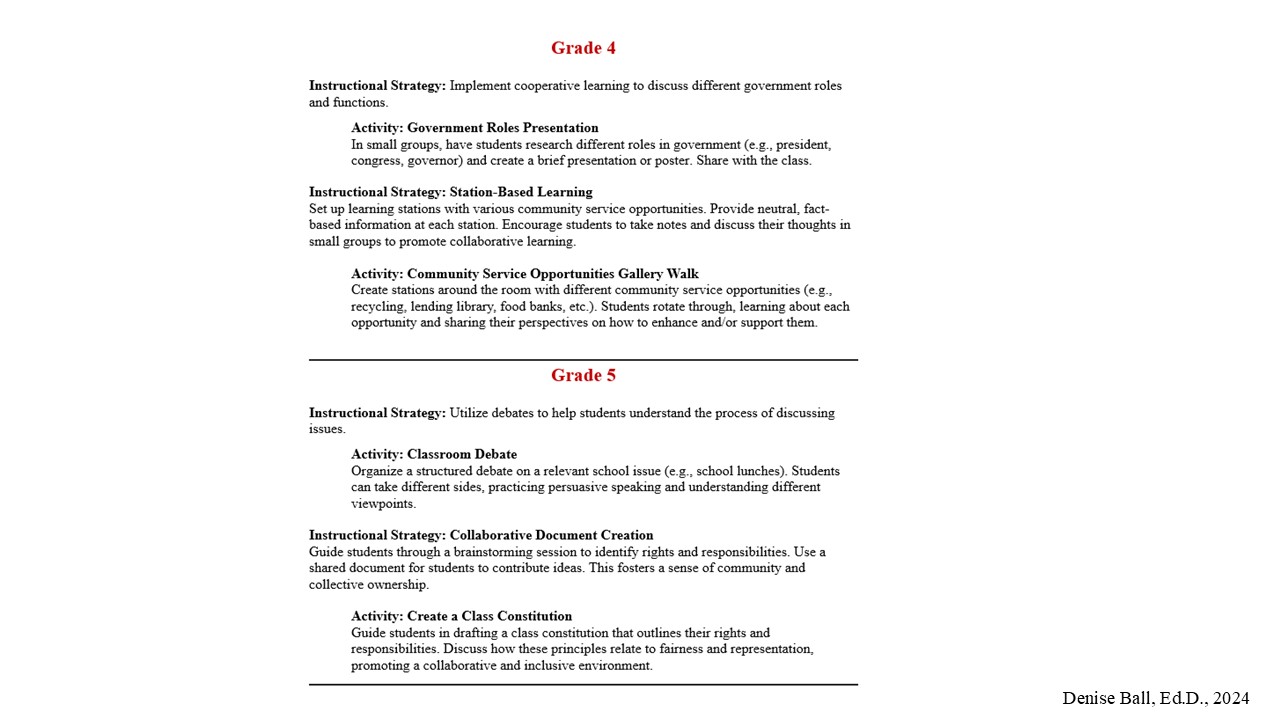
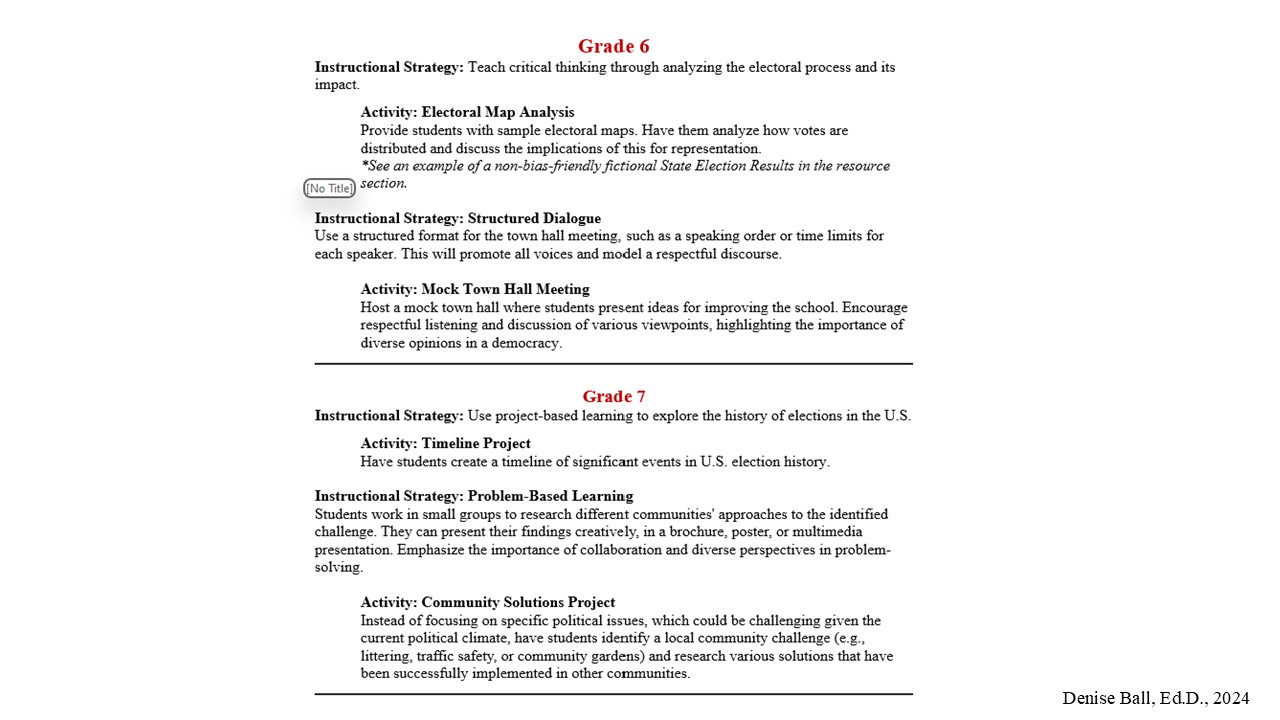
I have provided below some recommended non-partisan activities for students to help develop and promote critical thinking, and engage in learning about the electoral process while fostering a sense of civic responsibility without the emotional weight of real-world politics.

For all those who have chosen education as a career, thank you. You make a difference!

May we continue to seek knowledge in all things,

Denise

References

Aldridge, J. M., & McChesney, K. (2018). The relationships between school climate and adolescent mental health and wellbeing: A systematic literature review. International Journal of Educational Research, 88, 121-145.

Havik, T., & Westergard, E. (2020). Do teachers matter? students’ perceptions of classroom interactions and student engagement. Scandinavian Journal of Educational Research, 64(4), 488-507.

Quin, D. (2017). Longitudinal and contextual associations between teacher-student relationships and student engagement: A systematic review. Review of Educational Research, 87(2), 345-387.

Van Ryzin, M. J., Roseth, C. J., & Biglan, A. (2020). Mediators of effects of cooperative learning on prosocial behavior in middle school. Journal of Applied Developmental Psychology, 66, 101084.

Leave a comment

Filed under Creating a Positive School Culture, Curriculum Resources, Educational Resources, Educational Websites and Resources, Positive School Culture, Principals and Administrator Tools, Sharing the Good, Sharing the Good in Education

Join #AOBEDCHAT Premiere January 8th with Guest Fr. Matt Foley

We would love to have educators join the conversation on Monday, January 8th at 7 PM for the Archdiocese of Baltimore Catholic Schools premiere Twitter edChat. We will be discussing student service learning with guest, Friar Matt Foley! #ShareTheGood #AOBCatholicSchools #RiseAbove

Leave a comment

Filed under Curriculum Resources, Twitter edChat

Never Underestimate the Power of Believing in a Child

As educators, we have been blessed with an awesome responsibility to educate the whole child to become productive citizens and leaders of tomorrow.

As an administrator, one of the blessings of my job is to help my faculty and staff be the best they can be in the lives of those placed in their care.

Simple reminders:

*to greet students at the door and actually “see” them each day

*to remember that as an educator, we are the rational adult called to model behaviors for our students…forgiveness, flexibility, humor, compassion etc.

*it is okay for students to know that mistakes have been made or something is not “known” …demonstrate how to build the muscle of “recovery” and “collaboration”

Never underestimate the power we have in lifting up our students to new heights…if you BELIEVE they will ACHIEVE!


May we continue to seek knowledge in all things~

Denise

image

Leave a comment

Filed under Blogs that Inspire Us, Curriculum Resources, Inspiration, Team Building/Positive Work Environments

iPad Apps for Creative and Fun Learning Presented by Local Teacher

I was listening to one of my teachers present today to my faculty of 40 and thought that the apps shared were so good that I would share them with our Unlock the Teacher blog readers.  I feel blessed to work in a building with such creative energy and passion for teaching and work with a professional development team at Unlock the Teacher LLC that I sometimes have to pause…and remember to whom much is given, much will be expected.  Thank you to all the teachers out there who sacrifice and share their time and talent for our children…our future!

Classroom Management

Class Dojo: www.classdojo.com (FREE App)

Showing Student Growth

ThreeRing: www.threering.com (FREE App)

  • Capture student work in a virtual portfolio
  • Take a picture, audio or video
  • Share with parents and peers
  • Students can upload various works

Quizlet: www.quizlet.com (FREE App)

  • Set up vocabulary flashcards
  • Students can access cards from any SMART device
  • Do NOT need access to Internet once cards are downloaded

A+Pro: www.A+Pro.com (FREE App)

  • Similar to Quizlet
  • Flashcard application
  • Cards can be placed in groups or topics…great for vocabulary or research papers 🙂
  • Cards can be separated into “know”, “unsure” or “don’t know” piles to help with memorization

Educreations: www.educreation.com (FREE App)

  • Ability to make presentation videos with voice over…FUN!
  • Great to use when student is absent from a class
  • Students can create presentations to demonstrate mastery…THINK Bloom’s Taxonomy

If you have some great apps for learning, please share.  It is in the collaborative process that we all learn! When we share what we know, the students benefit.

May we continue to seek knowledge in all things,

Denise

P.S. Thank you Karina for allowing me to share with our Unlock the Teacher readers. Mucho Gracias!

3 Comments

Filed under IPad Apps for Learning

An Innovative Program for Helping Students Succeed…Sharing the Good in Education

One school’s approach to ensure educational resources are available for students.

St. Regis Educare – An Innovative Program for Helping Students Succeed

St. Regis Educare (SRE) is a newly created program serving the students of St. Regis Catholic Elementary and Academy, in Bloomfield Hills, Michigan. The SRE program is staffed by three certified teachers who are dedicated to supporting the varied needs of St. Regis students. Based on the premise that each student has unique gifts and talents, with different learning styles and academic abilities, SRE supports teachers in providing differentiated instruction within and outside the classroom.

In keeping with the St. Regis mission: Respect, Educate, Give, Inspire, and Support, SRE is dedicated to respecting individual students’ needs and supporting and inspiring them to reach their fullest academic potential.

The service provided in this program is more than a library of resources for teachers and parents. It is more than a place where students can come for help with their homework. It is a professionally staffed center for learning, where students attend workshops, join literature circles, compete in Math competitions, and follow academic plans designed specifically to meet their individual needs.

SRE Services

St. Regis Educare provides three different types of assistance/enrichment for students. They work with individuals and small groups needing assistance or enrichment in academic subject areas. They  provide workshops to help students with concepts such as grammar or study skills, and  work with individuals and small groups on specific skills such as comprehension strategies or counting money. In order to make the concepts they are enhancing engaging, they  integrate technology, and utilize manipulatives, hands-on activities, and use modeling to help students achieve their goals.

With all this, they also provide the following benefits for teachers: assessments, which they will design and/or administer upon request; a central repository for teacher resources and reference books; and documented processes and forms to make using our services less complicated. To help bridge the ever widening need between parent and school, they provide a central repository for parent resources, and are in the process of planning workshops for parents, so they can learn new ways to help their children succeed in school.

Development of the Program

This school year, St. Regis Educare has evolved from an idea and an empty office, into a focal point of learning for students in need of assistance or enrichment, as well as a central location for student, teacher, and parent resources.

Some highlights include:

  • A room that is now both inviting and functional for assisting students
  • Resource materials, games, technology, and manipulatives that are arranged by subject matter on labeled shelves for easy access
  • Documented processes and forms that are based on research of best practices and collaboration with professionals both in and outside the school
  • An extensive list of services designed to meet the varied needs of our students

As of this writing, at least one student or group from every grade, is being serviced by SRE, and they have had an abundance of positive comments from students, parents, and teachers who are grateful for the expertise and supportive of this team’s efforts. It is too soon in the development of the program to provide concrete results; however, I plan to monitor this program’s progress …stay tuned!

If your school or community is doing something great to help students, teachers or parents, please share.  It is in the collaborative model that we all rise to the level in which we have the potential to be.

May we all continue to seek knowledge in all things~

Denise

Leave a comment

Filed under Educational Resources, Sharing the Good, Sharing the Good in Education