Tag Archives: Sharing the Good with Dr. Denise Ball

Culture by Design, Not by Default: The Courage to Listen, Learn, and Lead With Intention

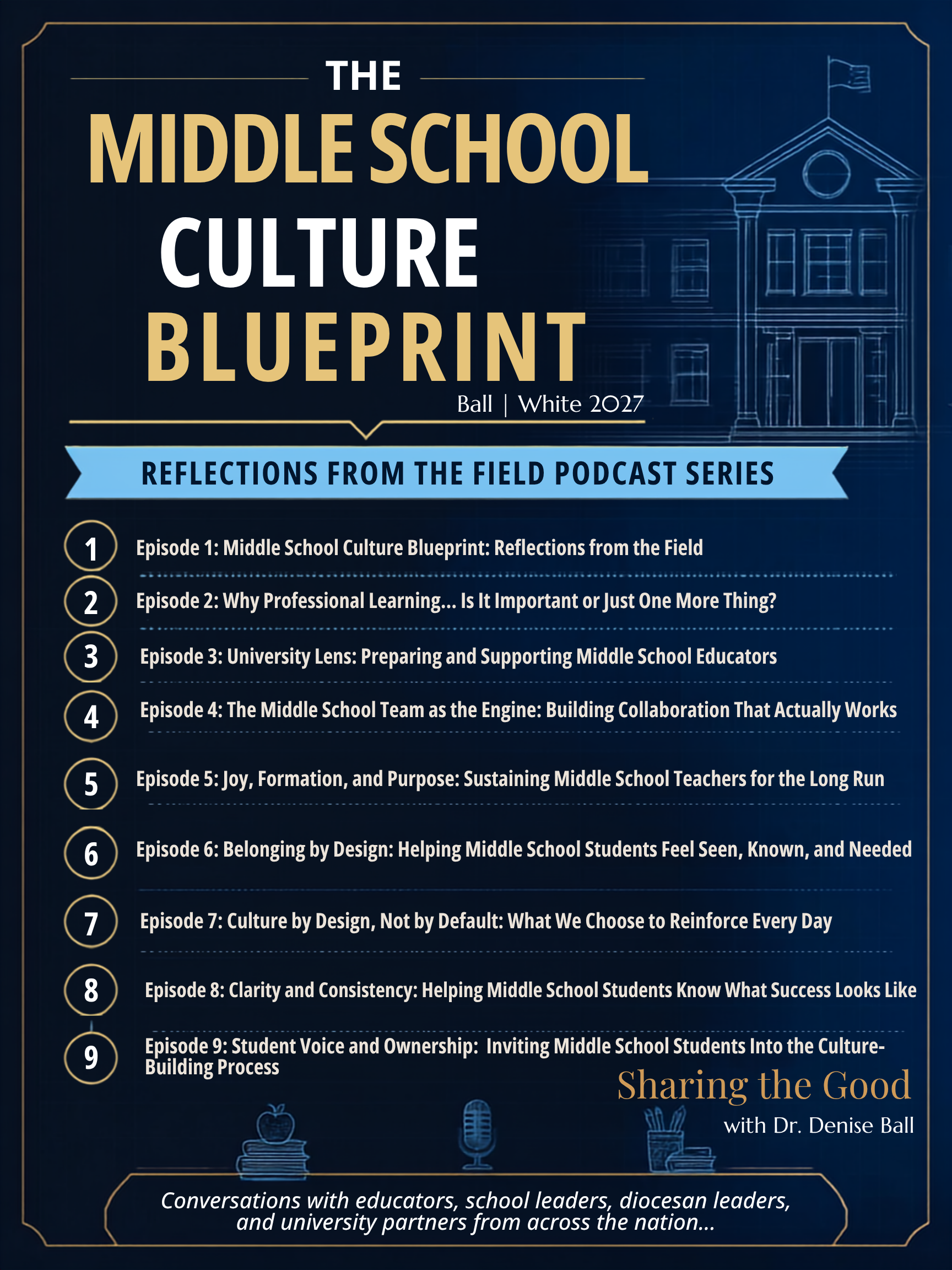
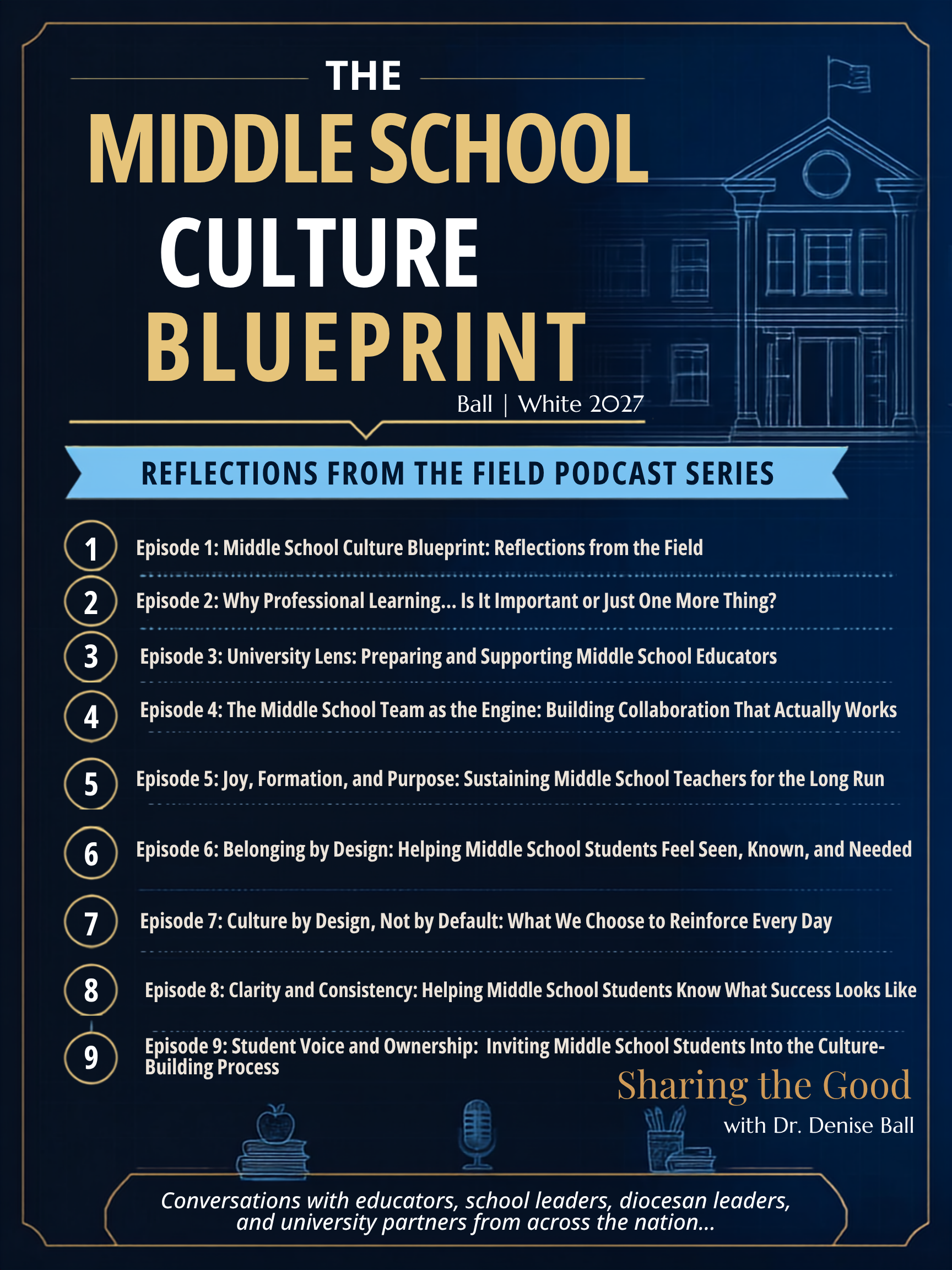
The Middle School Culture Blueprint: Reflections from the Field | Episode 7 with Dr. Anita Harkins-Mehsling
Sometimes the most powerful act of leadership is not offering a solution, but it is simply being present, listening, and acknowledging. This was one of the many meaningful reminders shared during my recent conversation with Dr. Anita Harkins-Mehsling, Associate Superintendent for the Archdiocese of Omaha Catholic Schools, for Episode 7 of The Middle School Culture Blueprint: Reflections from the Field.

Anita is a favorite voice of the Sharing the Good community, and it is always a JOY to welcome her into the conversation. With 36 years of experience serving in education, she brings a thoughtful combination of research, leadership experience, practical wisdom, and a deep commitment to Catholic education. Our discussion centered on a question that Dr. LaTonya White and I continue to explore through our work on The Middle School Culture Blueprint: How do we move from allowing school culture to develop by default to intentionally creating the conditions in which students and adults can thrive? Anita’s reflections offered several powerful lessons for school leaders and teachers alike.

Listening Is an Act of Leadership

Anita began by emphasizing the importance of intentional planning and discernment. As she reflected on professional learning and school improvement, she underscored the value of gathering feedback through surveys and then taking the additional step of personally asking questions, pausing, and truly listening to the responses. Even when feedback is constructive or difficult to hear, there is value in acknowledging the perspective being shared. I found this particularly important to share to remind us all.

As leaders, we can become so focused on solving problems, managing priorities, or moving initiatives forward that we unintentionally overlook the importance of simply listening. Yet the act of listening communicates respect. It reminds faculty, staff, families, and students that their voices matter. Most importantly, listening helps build trust. This is not always about agreeing with every perspective or immediately implementing every suggestion. It is about creating an environment where individuals know they have been heard and their contributions are valued.

Trust is strengthened when people experience that level of intentional care!
The Courage to Have Difficult Conversations

Another important thread in our conversation was the courage required to lead. Anita reminded us that school leaders must be willing to enter difficult conversations rather than avoiding them. This is especially important when we consider the culture we are creating within our school communities. Unresolved concerns, inconsistent expectations, and uncomfortable situations rarely disappear simply because they are left unaddressed. Leading with intention requires the courage to engage in honest dialogue while preserving the dignity of every individual involved.

I appreciate the connection between courage and compassion here because difficult conversations do not have to become confrontational conversations. When approached thoughtfully, they can become opportunities for understanding, growth, accountability, and stronger relationships. It is essential for us to recognize the dignity of every person, including in the moments when conversations are challenging.

Our Words Matter More Than We May Realize

One reflection that I hope every middle school educator takes to heart is Anita’s reminder about sarcasm. What an important point! Sarcasm can sometimes be perceived as harmless humor, but it can also be deeply hurtful, particularly for young adolescents navigating the complex social and emotional experiences of middle school. Students are paying attention to far more than the academic content we teach. They notice how adults speak to one another. They notice how teachers respond to mistakes. They notice whether corrections are offered with respect, and they notice whether humor strengthens relationships or comes at someone else’s expense.

Our middle school students come to us for learning, but they also come to us for formation. This is such an important distinction. We have the privilege of helping young people develop not only academic knowledge and skills but also character, confidence, responsibility, and an understanding of how to treat others. The words we choose are part of that formation. As Anita reminded us, the dignity of each person must remain at the heart of our work.

Collective Efficacy: Is This What Is Right for the Students?

One of my favorite moments in the conversation centered on collective efficacy and the importance of keeping students at the center of our decisions. Anita offered a question that I believe belongs at the forefront of every faculty meeting, leadership discussion, and school improvement effort:

“Is this what is right for the students?”

Such a simple question, yet one that can bring remarkable clarity to complex decisions. Anita then shared a story from her years in education that beautifully illustrates what collective commitment can look like in practice. While teaching at a school where English was a second language for many students, the faculty recognized an opportunity to strengthen communication with the students and families they served. Rather than placing the responsibility for communication entirely upon the families, the teachers approached the parent community with a question. Would parents be willing to tutor the teachers in Spanish one afternoon each week after school?

Think about the humility, trust, and partnership represented in that decision. The teachers recognized that they had something to learn from the very families they were serving. They identified a need. They invited collaboration, and they took collective responsibility for strengthening the school community. What a powerful example of educators placing students first!

This is the kind of story I hope we continue to celebrate and share. It reminds us that positive school culture is not simply created through programs, policies, or carefully written plans. It comes to life when individuals are willing to learn from one another and act together in service to students.

The Importance of Doing the Preparatory Work

As our conversation turned toward practical recommendations, Anita offered an important reminder to leaders who want to strengthen their school culture.

Do the preparatory work. Conduct an inventory and take time to have the conversations. Listen to the people who experience the culture every day, and allow the dignity of every person to guide the process.

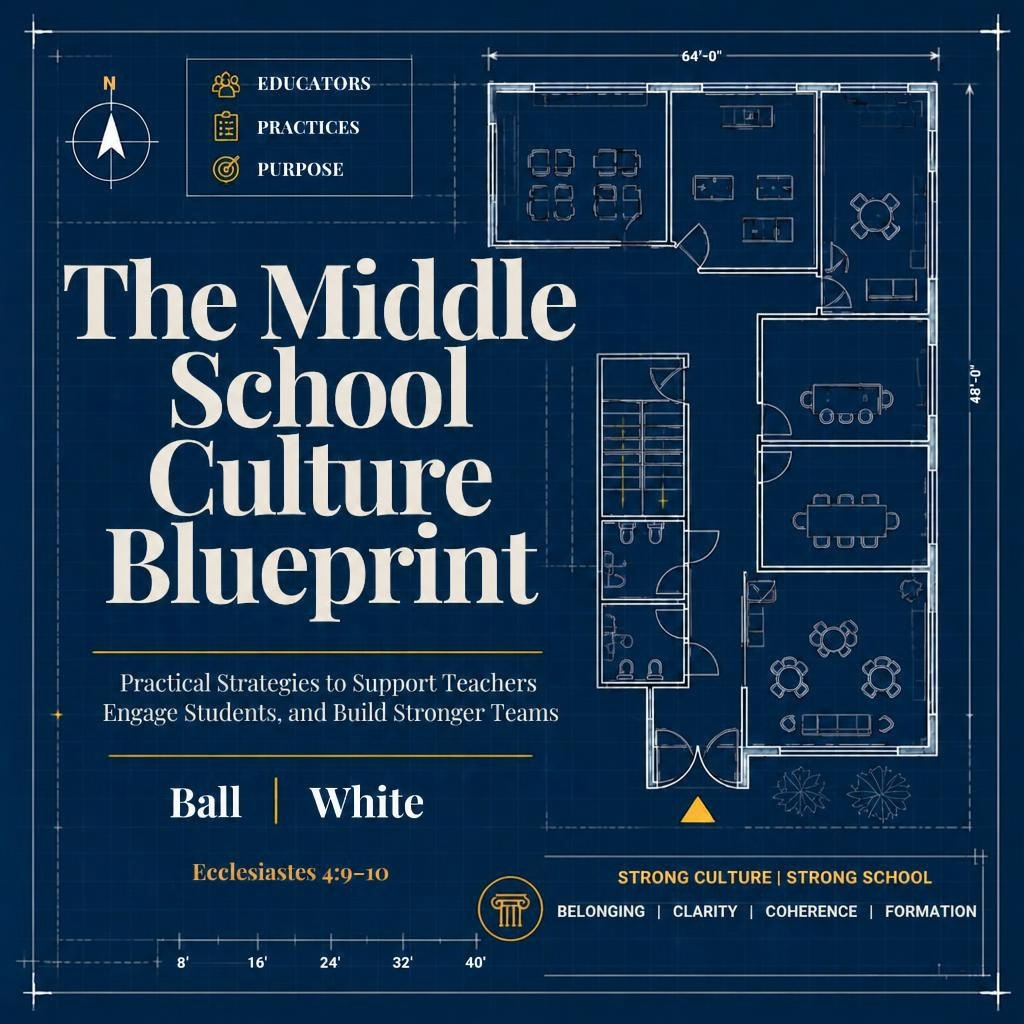
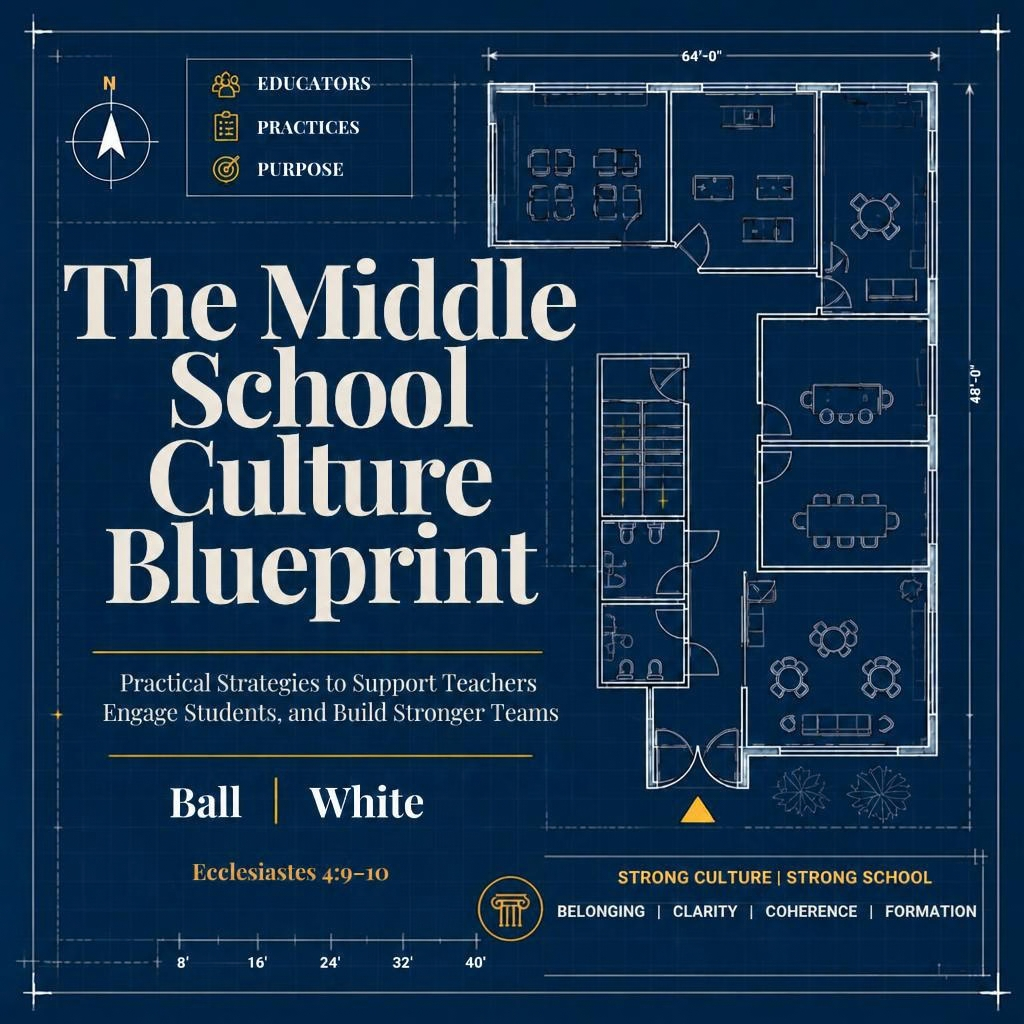
I appreciate how closely this aligns with the work LaTonya and I are developing through the four pillars of The Middle School Culture Blueprint: Belonging, Clarity, Coherence, and Formation.

Belonging invites us to create environments where individuals feel seen, known, valued, and needed.

Clarity challenges us to establish shared priorities and expectations.

Coherence encourages us to align our practices and decisions with those priorities.

Formation reminds us that our work is ultimately about helping young people grow academically, socially, spiritually, and personally.

These pillars are interconnected, and none can be sustained through good intentions alone. They require thoughtful reflection and daily attention. A culture inventory, meaningful conversations, and a willingness to examine our practices can help us recognize both the strengths worth protecting and the habits that may need to change.

Sometimes Presence Is Enough

As we approached the end of our conversation, Anita shared a reminder that I believe every school leader needs to hear: You do not always have to have the solution. Sometimes your presence is what matters most, and listening is enough. Acknowledging another person’s experience is the very thing that helps strengthen trust and connection. In a profession where leaders encounter countless decisions, competing priorities, and unexpected challenges, this is a particularly meaningful reminder.

We do not have to respond to every concern with a new initiative. We do not have to fill every silence with an answer. There is wisdom in pausing, listening, and allowing others to know that they are not navigating challenges alone… an essential part of culture by design.

The Gift of Serving in Education

As I reflect on this conversation, I am reminded of the blessing of collaboration and the extraordinary relationships we develop through serving in education. Relationships matter and remind me that the culture we intentionally cultivate is not limited to the walls of a school building. It extends across our schools, dioceses, universities, and professional communities. We are connected through a shared commitment to serve students, support educators, and strengthen those placed in our care.

A Final Reflection for School Leaders

As you consider the culture of your own school community, I invite you to reflect on three questions:

  1. Are we creating intentional opportunities to listen to those we serve, including when their feedback challenges our assumptions?
  2. Do our daily words, actions, and decisions consistently reflect the dignity and respect we hope our students will demonstrate?
  3. Are we collectively asking, “Is this what is right for the students?”

Culture by design begins when we make the intentional choice to examine what we are reinforcing each day. It grows when we have the courage to engage in meaningful conversations, and it thrives when we remain committed to listening, learning, and serving one another.

A heartfelt thank you to Dr. Anita Harkins-Mehsling for sharing her wisdom, experiences, and leadership with our Sharing the Good community.

Your commitment to serving others is a blessing to our profession.

May we continue to recognize that our words and actions matter, that every person deserves to be treated with dignity, and that we are called to serve with both courage and grace.

We can do so much more together.

Please feel welcome to watch Episode 7 of The Middle School Culture Blueprint: Reflections from the Field on Sharing the Good with Dr. Denise Ball, available on YouTube and your favorite podcast platforms.

Whether during your morning commute, a quiet moment of reflection, or a well-deserved pause in your day, I hope these conversations invite us to be intentional about learning from one another, reflecting on our shared mission, and rediscovering the JOY that first called us to serve.

We can do so much more together. It is easy to share the good!

May we continue to seek knowledge in all things,

Denise

#SharingTheGood #CatholicEducation #CatholicLeadership #MiddleSchoolCultureBlueprint #SchoolCulture
Leave a comment

Filed under Sharing the Good with Dr. Denise Ball, The Middle School Culture-Reflections from the Field Series

Deconstructed Retreat: Same Roads with an Intentional Way of Seeing

The journey is the retreat, gratitude is my compass, and JOY is found in the everyday.

What if a retreat was not defined by where we go, but by how we choose to see and respond to what surrounds us?

As educational leaders, we often encourage others to slow down, reflect, reconnect with their purpose, and care for their well-being. Yet, how often do we give ourselves permission to do the same? Perhaps we have made the idea of a retreat more complicated than it needs to be. Perhaps a retreat can happen on an ordinary drive, during a walk along the water, through a meaningful conversation, while listening to music, or in the unexpected kindness of others.

I am calling this my Deconstructed Retreat.

Gratitude: Beginning the Day with God

As I walk through this new season of life, I am striving to listen more intentionally, live more fully, and recognize God’s presence in all aspects of my life. One simple practice is beginning each morning with gratitude, giving thanks for another day to serve Him and others. My favorite morning jam these days is Phil Wickham’s Isn’t He Good. It is a beautiful reminder of God’s goodness and faithfulness. Recently, I shared the song with an NCEA intern. When I saw him a few weeks later, he shared that it had become his favorite morning jam, too!

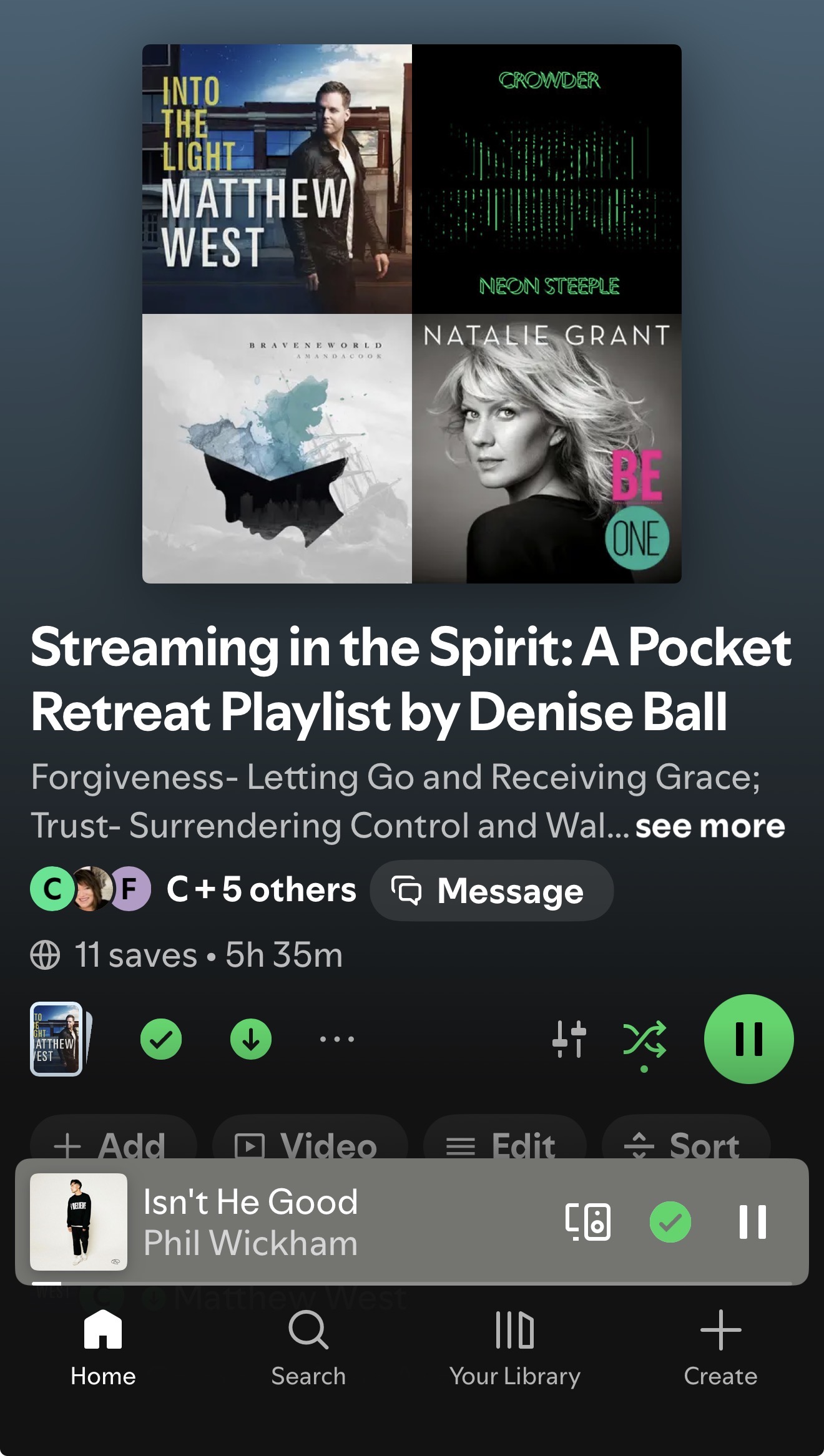
JOY is synergistic. When we share the good, it has a way of multiplying. Tune in to my favorite Spotify playlist I call, Streaming in His Spirit.

Figure 2. Streaming in the Spirit recommended praise and worship playlist supporting amazing Christian artists like Phil Wickham, Mathew West, Natalie Grant, Crowder, Amanda Cook and so many more artists lifting up their voice for the greater glory of God!

Surround Yourself with People and Ideas That Illuminate Your Soul

Throughout my educational leadership journey, I have found tremendous value in surrounding myself with people who carry His light, challenge my thinking, and inspire me to grow. I also love reading work that inspires my soul and lights my dendrites on fire!

One person I have recently discovered is author and podcaster Chris Stefanick, thanks to my husband sharing his morning men’s devotional with me. In Living Joy, Stefanick draws upon the wisdom of Blessed Solanus Casey: “It’s heaven begun, for the grateful on earth.” Stefanick (2020) reminds readers that gratitude helps us recognize and enjoy the blessings already present in our lives. What a powerful invitation for leaders. Gratitude does not remove our challenges. It changes the lens through which we experience them.

The Road Becomes the Retreat

This weekend, I traveled through Pennsylvania, Ohio, and Michigan, headed toward Lake Michigan in preparation for the MANS Great Lakes UNITY Conference and NCEA Catholic Leadership Summit.

The autumn colors, open roads, changing skies, and beauty of Lake Michigan provided an unexpected opportunity for reflection. As I traveled, I found myself returning to Matthew Kelly’s prayer of transformation in Rediscover Jesus (2015):

“Loving Father,

Here I am.

I trust that you have incredible plans for me.

Transform me. Transform my life.

Everything is on the table.

Take what you want to take and give what you want to give.

Transform me into the person you created me to be, so I can live the life you envisioned for me.

I hold nothing back; I am 100 percent available. How can I help?

Amen.”

In reading this invitation to trust God’s plans, hold nothing back, and become the person He created us to be felt particularly meaningful in this season of my life. There is something powerful about being willing to say, “How can I help?” Not simply in our professional lives, but in our personal and spiritual journeys as well. I am learning that sometimes the most meaningful transformation begins when we stop filling every moment with activity and allow ourselves to listen. I am so blessed to have my husband of 33 years, and two adult children, walking beside me on this journey, cheering, encouraging, and supporting the dream!

An Unexpected Gift of JOY

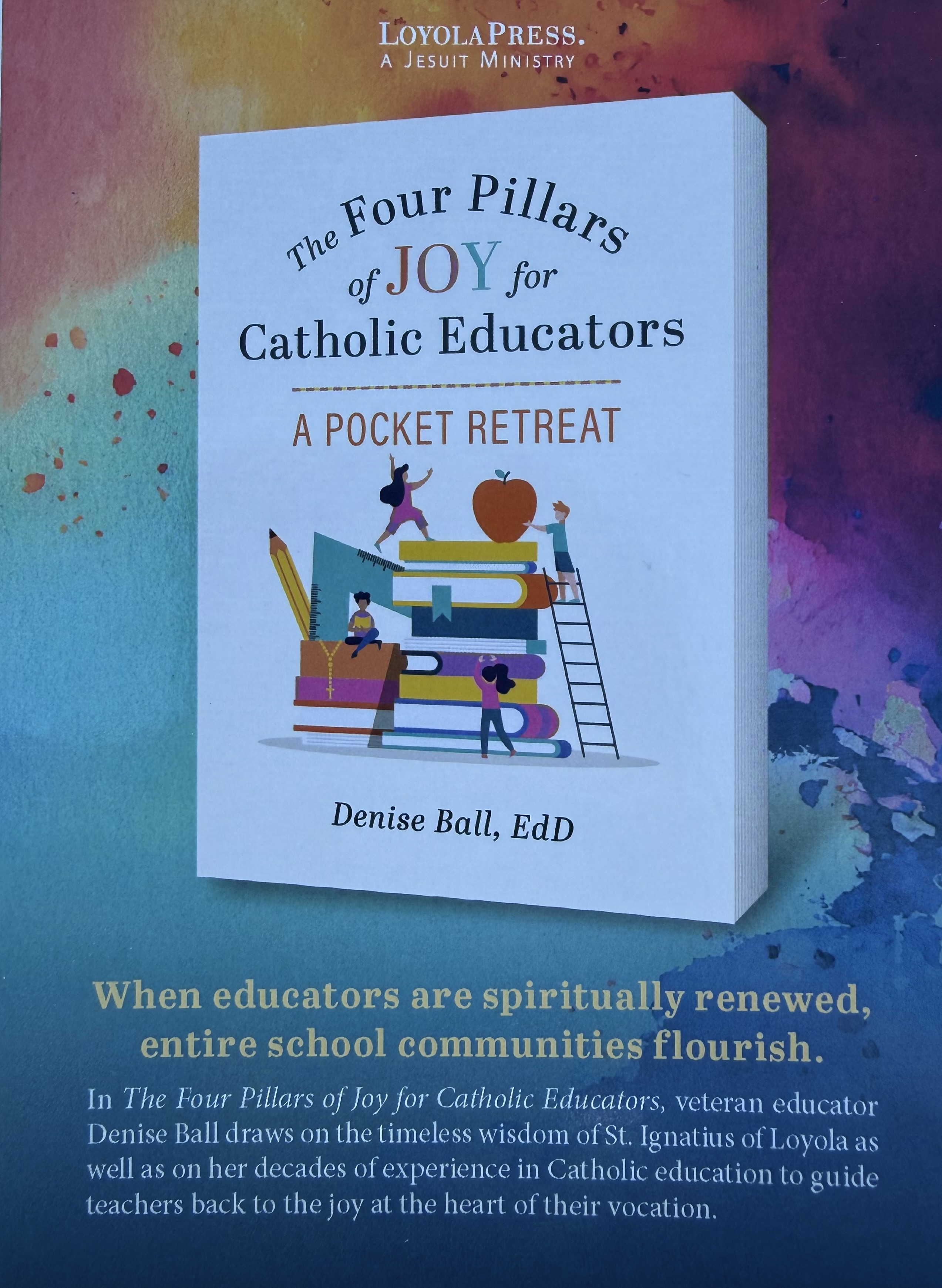
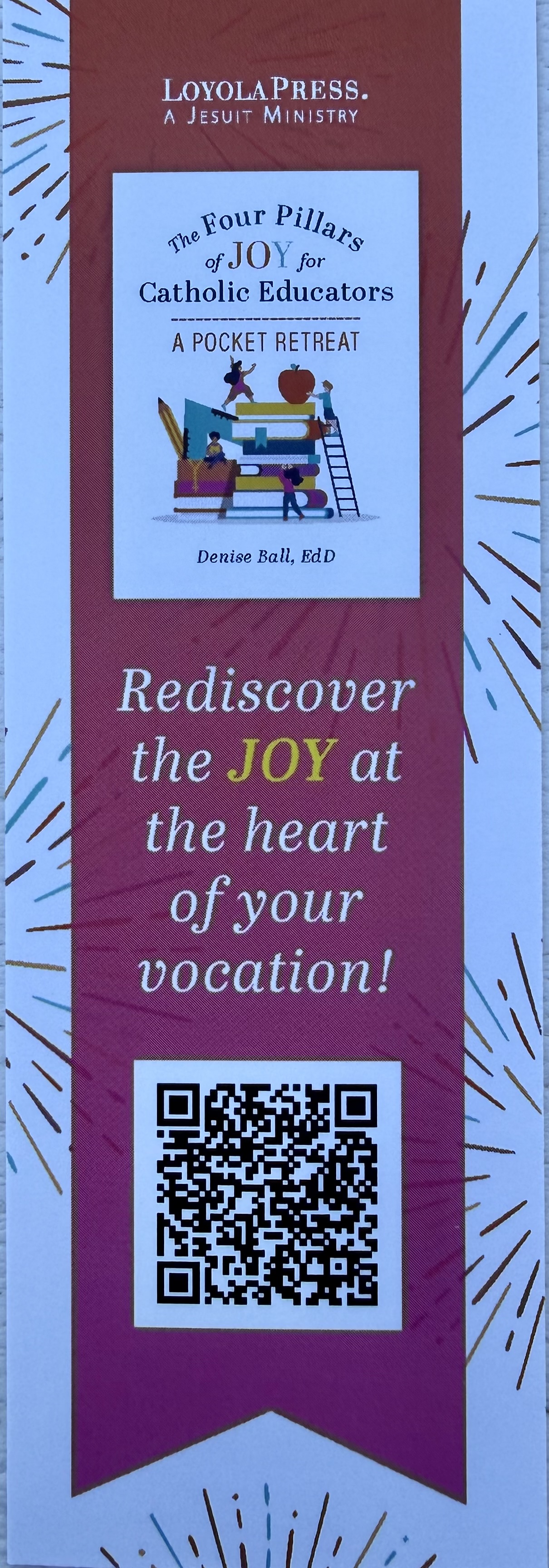
When I arrived at my destination today, a beautiful surprise awaited me. My Loyola Press partners had thoughtfully prepared a JOY Kit in celebration of my forthcoming book, The Four Pillars of JOY for Catholic Educators: A Pocket Retreat. What a gift! The kit includes creative resources designed to encourage educators to pause, reflect, and rediscover the JOY at the heart of their vocation. I am especially excited to raffle a few of these during my upcoming leadership session.

Choosing a publishing partner is an important process of discernment. I am deeply grateful to collaborate with a team that understands the heart of this work and the importance of nurturing the spiritual well-being of Catholic educators. Small acts of kindness can have a lasting impact.

Leading with Intention: The Retreat We Carry with Us

St. Ignatius of Loyola’s spirituality invites us to find God in all things. That invitation has become especially meaningful to me. What if we approached our everyday lives as opportunities for spiritual renewal? What if we intentionally made room to laugh, play, explore nature, enjoy fellowship, read something inspiring, and listen for God’s voice?

What if we recognized that caring for our own spiritual well-being is not separate from our leadership responsibilities, but essential to fulfilling them? As I prepare to spend time with educational leaders this week discussing Leading with Intention, I am reminded that intentional leadership begins with intentional living. We cannot continually pour into others without making space to be renewed ourselves.

As I traveled the highways, windows down, praise and worship turned up high, I realized that renewal does not always require a formal retreat. Sometimes it begins with gratitude, a beautiful sunrise, a favorite song, a conversation with a friend, or the courage to embrace a new season of life.

Continuously Streaming in His Spirit

Over these next few days, I am choosing to tune my eyes to God’s beauty, open my heart to His grace, and listen more closely to His invitations.

I intend to laugh, learn, explore, pray, and be fully present!

Not a traditional retreat, but a deconstructed retreat. One that reminds me that God is not waiting for us only at the destination. He is present throughout the journey. Same roads but an intentional, new way of seeing. I surrender!

Perhaps that is one of the greatest gifts of all, to discover that when we intentionally seek His presence, we can continuously stream in His Spirit!

What might change if you approached your next ordinary day as an opportunity for retreat?

With gratitude and JOY,

Dr. Denise Ball

References and Inspirations

Kelly, M. (2015). Rediscover Jesus: An invitation. Beacon Publishing.

Stefanick, C. (2020). Living Joy: 9 rules to help you rediscover and live joy every day. Emmaus Road Publishing.

Wickham, P. Isn’t He Good [Song].

Spiritual inspiration: St. Ignatius of Loyola and Blessed Solanus Casey.

Leave a comment

Filed under Retreats, Sharing the Good with Dr. Denise Ball

Belonging by Design: Every Student Has a Place, a Purpose, and a Part to Play

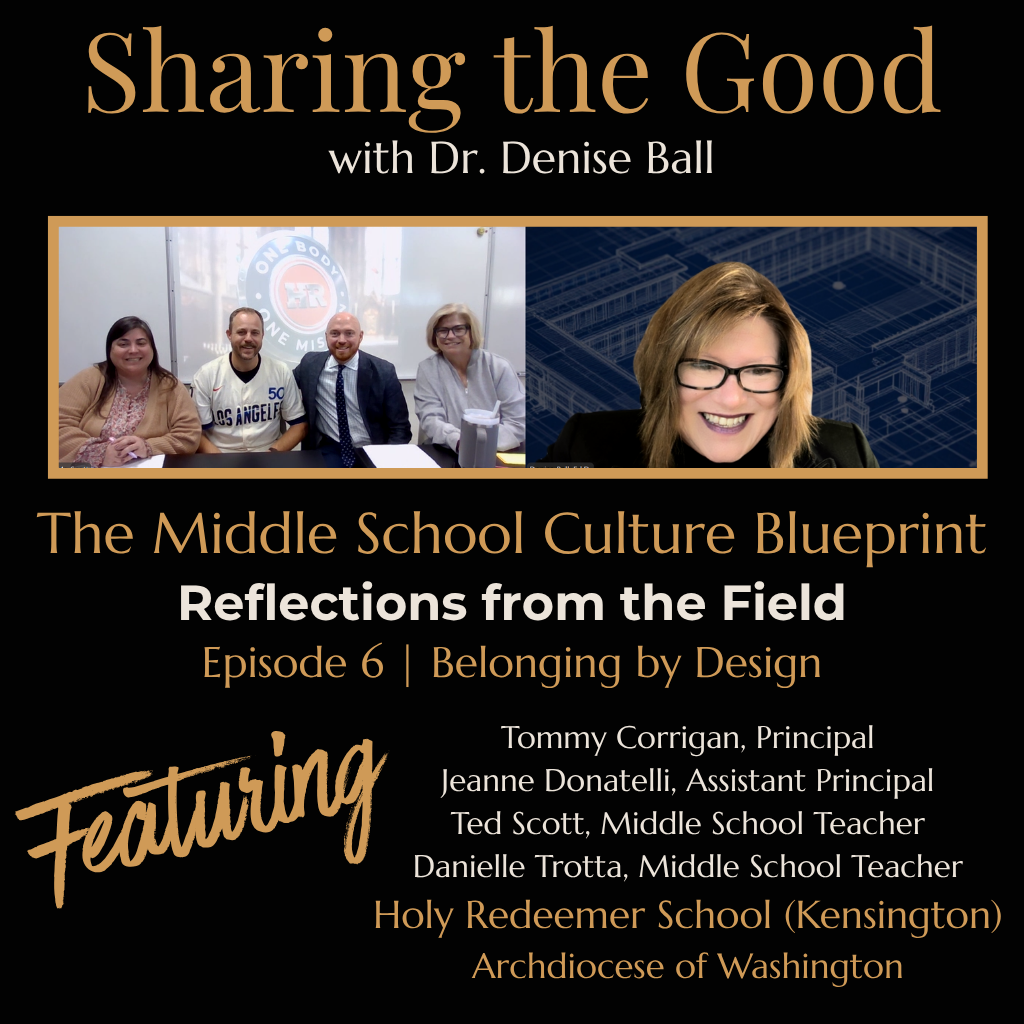
The Middle School Culture Blueprint: Reflections from the Field | Episode 6

What if one of the most powerful ways to help middle school students experience belonging is to give them a meaningful responsibility within their school community?

This question was at the heart of a wonderful conversation with the leadership and middle school team from Holy Redeemer Catholic School in Kensington, Maryland.

For Episode 6 of The Middle School Culture Blueprint: Reflections from the Field, I had the privilege of welcoming Principal Tommy Corrigan, Assistant Principal Jeanne Donatelli, and middle school teachers Ted Scott and Danielle Trotta to share how their school intentionally cultivates a culture where students are seen, known, and needed.

As Dr. LaTonya White and I continue developing The Middle School Culture Blueprint manuscript in collaboration with NCEA, we return often to a foundational principle, that a positive school culture does not happen by chance. It must be cultivated with intention.

Our conversation with the Holy Redeemer team offered a beautiful example of this principle in action.

From Belonging to Social Purpose

During our conversation, I shared the Thriving with Social Purpose model and research by Ford and Smith, highlighting the importance of helping students understand that they have a meaningful responsibility within their community. For middle school students, belonging is about more than being welcomed or included. It is also about understanding that their presence and contributions matter. I often think about the power of these three simple words and what it means for our students to be seen, known, and needed.

We want students to know that their teachers see them as individuals, recognize their gifts, and value the unique contributions they bring to the classroom. However, there is something especially powerful about helping students recognize that other people are counting on them. Ted and Danielle, both middle school teachers, brought this concept to life by describing the many “jobs” students have throughout the Holy Redeemer community.

These opportunities to contribute remind us that students are not simply recipients of an educational experience. They are active participants in building the community around them. What an important distinction! When we intentionally invite students to serve, lead, and assume responsibility, we help them recognize that they have a place and a purpose within the school.

Faith as the Foundation

Another meaningful thread throughout our conversation came from Tommy and Jeanne, who shared the importance of prayer in the daily life of Holy Redeemer. Prayer is not reserved for one moment of the school day. It is present throughout the day and serves as something the school community leans on. I found this particularly inspiring. In Catholic education, our shared faith provides the foundation upon which relationships, decisions, and community life are built. Prayer offers opportunities to pause, reconnect, express gratitude, and recognize that we are called to something greater than ourselves.

When prayer becomes part of the natural rhythm of a school, it reinforces a shared identity and purpose, and when students witness adults leaning on prayer, they experience an important lesson about the role of faith in everyday life.

Routines, Traditions, and Expectations Matter

One of my greatest takeaways from this conversation was the intentionality with which the Holy Redeemer team has created a framework of routines, traditions, and expectations. We sometimes think about school culture primarily in terms of relationships. While relationships are essential, they are strengthened by the structures that support them. Routines create predictability, traditions strengthen community identity, and clear expectations provide consistency. Together, these elements create the conditions in which students and adults can thrive. Dr. White and I speak to the four pillars of The Middle School Culture Blueprint being Belonging, Clarity, Coherence, and Formation.

Belonging helps students recognize that they are valued members of the community. Clarity establishes shared expectations. Coherence ensures that those expectations and practices are experienced consistently. Formation invites students to grow in character, responsibility, faith, and service to others. Each pillar strengthens the others.

The Holy Redeemer conversation reminded me that a thriving middle school culture is not built through one initiative or a particularly successful school event. It is cultivated through the daily decisions and shared commitments of an entire school team.

Celebrating Community Through Traditions

Speaking of traditions, I may have discovered another reason to visit Holy Redeemer! The team shared their Friday Night Lights flag football tradition, and I have already decided that I need to experience one of these games firsthand. What a wonderful opportunity for students and families to come together, celebrate their community, and strengthen the relationships that extend beyond the classroom. Traditions such as these create shared memories and help students connect their school experience to something larger than themselves. They become part of the story students carry with them long after they leave middle school.

A Reflection for Middle School Teams

As I reflect on this conversation, I am reminded that every student who walks through our school doors deserves to experience a community where their presence matters. Perhaps one of the simplest questions we can ask as educators is: Does every student have a meaningful opportunity to contribute to the life of our school?

Not every student will seek the spotlight. Not every student will participate in the same activities or demonstrate leadership in the same way, but every student has gifts to share.

Our responsibility is to create multiple pathways for those gifts to be recognized, nurtured, and celebrated.

Sharing the Good

A heartfelt thank you to Tommy, Jeanne, Ted, and Danielle for sharing their experiences and offering such meaningful reflections from the field. Your commitment to your students, families, and one another is evident in the intentional culture you continue to cultivate at Holy Redeemer Catholic School. It is a privilege to highlight the good happening within our Catholic schools and to learn alongside educators who so generously share their wisdom for the benefit of others.

As Dr. LaTonya White and I continue our work on The Middle School Culture Blueprint, conversations like this reaffirm why we believe the voices of practitioners must be part of the story. Research provides an important foundation, and the experiences of educators bring that research to life.

May we continue creating middle school communities where every student is seen, known, and needed because belonging is not simply about having a place in the school community. It is about knowing that we have a part to play in making that community stronger.

We can do so much more together.

Watch Episode 6 of The Middle School Culture Blueprint: Reflections from the Field on Sharing the Good with Dr. Denise Ball, available on YouTube and your favorite podcast platforms.

May we continue to seek knowledge in all things,

Denise

Denise M. Ball, Ed.D.

Retired Catholic Education Leader | Author | Researcher | Consultant
Assistant Professor | Marymount University

Join the conversation

LinkedIn: linkedin.com/in/deniseballedu 

Instagram: deniseball_edu

YouTube:www.youtube.com/@SharingTheGoodwithDrDeniseBall

Facebook: https://www.facebook.com/SharingTheGoodWithDrDeniseBall

Blog: www.unlocktheteacher.org

Leave a comment

Filed under The Middle School Culture-Reflections from the Field Series

Protecting the JOY: Sustaining the Educators Who Serve Our Students

The Middle School Culture Blueprint: Reflections from the Field | Episode 5

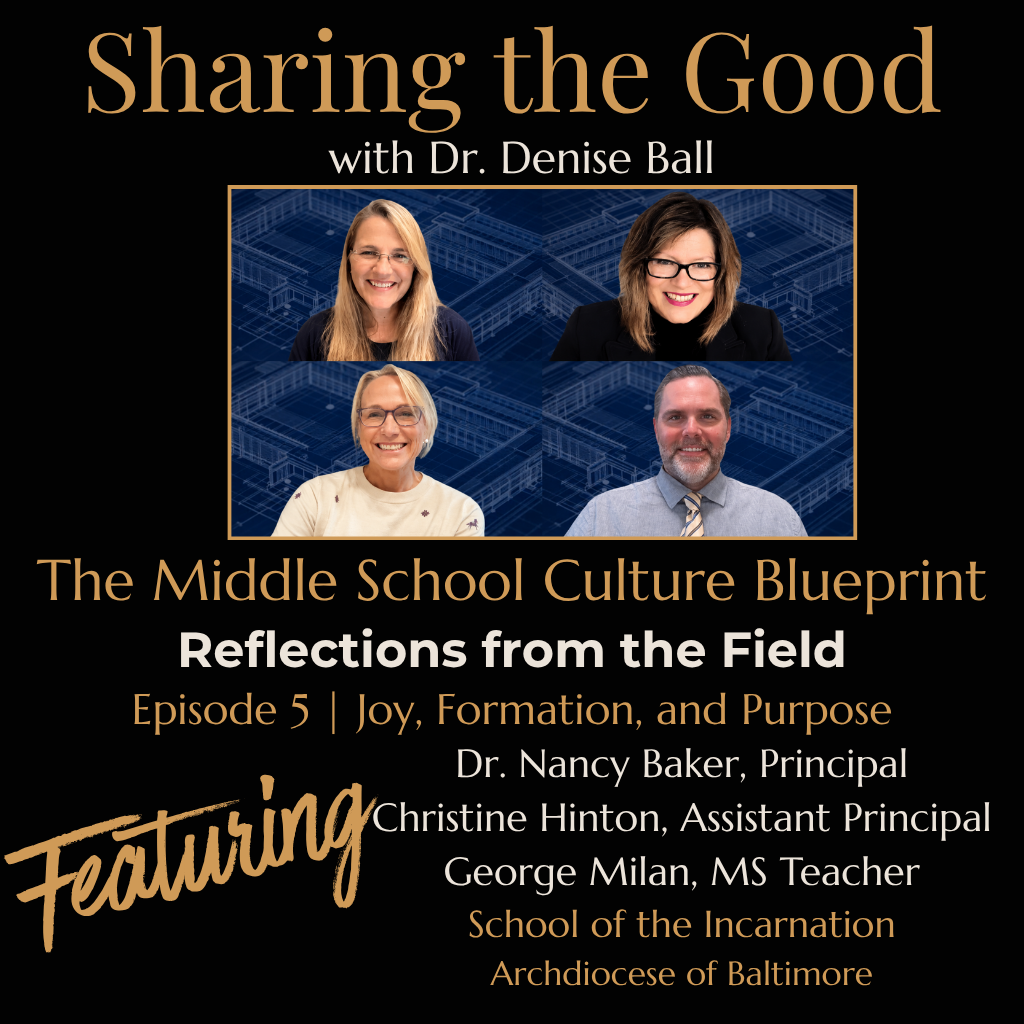
There is so much good happening within our Catholic schools, and one of the greatest privileges of my work is having the opportunity to share it! On this Thankful Thursday, I am especially grateful for three wonderful educators from School of the Incarnation in the Archdiocese of Baltimore who joined me for Episode 5 of The Middle School Culture Blueprint: Reflections from the Field.

Dr. Nancy Baker, Principal; Christine Hinton, Assistant Principal; and George Milan, Middle School Teacher, generously shared their experiences and perspectives on a topic that is increasingly important to our profession: sustaining the JOY, formation, and purpose of the educators who serve our students and families. What an inspiring conversation!

Protecting JOY Is a Leadership Responsibility

One of the most meaningful takeaways from our conversation was Dr. Baker’s reminder that school leaders must intentionally support balance among their faculty and staff. Think about that for a moment. Our educators enter the school year with enthusiasm, carefully developed plans, professional goals, and a genuine commitment to their students. Yet, even the most prepared teams will encounter unexpected challenges, competing priorities, and the inevitable demands of school life. If we want educators to sustain their JOY throughout the school year, we must recognize their need for balance and renewal.

Supporting educator well-being cannot be reduced to an occasional celebration or another initiative. It requires leaders to pay attention to the daily experiences of the people entrusted to their care. Are we protecting their time? Are we recognizing their contributions? Are we providing opportunities for renewal? Are we creating an environment where they can continue to grow personally, professionally, and spiritually? These are important leadership questions.

Our educators give so much of themselves to their students and families. We must be equally intentional about creating the conditions that sustain them.

Trust Is the Foundation of a Strong Team

Christine Hinton brought another essential perspective to our conversation: the importance of establishing and maintaining trust. I appreciated her emphasis on this fundamental element of school culture. Trust is not established through a single conversation, meeting, or professional development experience, but it is developed through our everyday interactions, the consistency of our actions, and our willingness to support one another. School leaders have countless opportunities to strengthen trust through their daily presence, communication, and relationships, and the small moments matter!

Checking in with a teacher after a challenging day, listening before responding, providing clarity during uncertainty, and recognizing the professional expertise of our colleagues are all meaningful ways to strengthen the adult culture of our schools. Trust allows teams to collaborate, navigate challenges, and remain focused on their shared mission. It also reminds us that our teachers need to experience the same sense of belonging that we work so intentionally to create for our students.

Never Underestimate the Power of Humor!

…and then there is George Milan! As a veteran middle school teacher, George reminded us of something I absolutely love, and that is the importance of humor in the classroom.

Middle school is a wonderfully unique developmental season. Our students are growing academically, socially, emotionally, and spiritually. Every day presents opportunities to build relationships, navigate unexpected moments, and celebrate the remarkable young people entrusted to our care. Sometimes, laughter is exactly what we need! Try that on today…

Humor can create connection, strengthen relationships, and help us navigate the unexpected moments that are inevitably part of teaching middle school students. I appreciate this reminder because JOY does not mean every day will be easy. It means we can find moments of gratitude, connection, and purpose even when the work becomes challenging. Imagine the impact on students when they experience classrooms where educators genuinely enjoy teaching and learning alongside them. Our adult culture matters because students experience it every single day.

Connecting the Conversation to The Middle School Culture Blueprint

As Dr. LaTonya White and I continue developing The Middle School Culture Blueprint for publication with the National Catholic Educational Association, conversations like this reinforce the importance of our four interconnected pillars:

Belonging: Educators need to know they are seen, valued, respected, and supported as members of their school community.

Clarity: Clear expectations, meaningful communication, and a shared understanding of priorities help educators navigate the demands of their work.

Coherence: When leadership practices, professional learning, and schoolwide priorities are aligned, educators can devote more energy to the work that matters most.

Formation: Our teachers deserve opportunities to continue growing professionally, personally, relationally, and spiritually throughout their careers.

These pillars are not exclusively about students. They are equally important to the adults responsible for creating and sustaining a positive school culture.

If we want our middle school students to thrive, we must also create school cultures where our educators can thrive.

A Thankful Thursday Reflection

As we settle into the rhythm of another school year, I encourage school leaders to consider a few important questions. Are we paying attention to the well-being of our faculty and staff? Are we intentionally building trust among our teams? Are we creating opportunities for laughter, celebration, and meaningful connection? And perhaps most importantly, are we ensuring that our educators know how much we value their service?

Our educators are highly educated professionals who have chosen a meaningful vocation. Their knowledge, experience, commitment, and daily sacrifices deserve our recognition and respect.

We need to SEE them, RESPECT them, SUPPORT them, and THANK them.

I am incredibly grateful to Dr. Nancy Baker, Christine Hinton, and George Milan for freely giving their time to participate in this conversation and contribute their reflections from the field. Their willingness to share their experiences is a gift to our profession.

There is tremendous power in educators learning from educators. On this Thankful Thursday, may we remember that protecting JOY is not an additional task on our already full schedules. It is an essential part of creating and sustaining the school cultures we desire for our students, families, and colleagues.

Let’s continue to see the good, share the good, and create school cultures where everyone can flourish!

I choose JOY!

Denise


Watch Episode 5: Joy, Formation, and Purpose

https://rss.com/podcasts/sharing-the-good-with-dr-denise-ball/3199282

The Middle School Culture Blueprint, coauthored by Dr. Denise M. Ball and Dr. LaTonya White, is forthcoming from the National Catholic Educational Association in spring 2027.

Leave a comment

Filed under Sharing the Good with Dr. Denise Ball, The Middle School Culture-Reflections from the Field Series

The Middle School Team as the Engine: Building Collaboration That Actually Works 

Middle school students may move through several classrooms and interact with several teachers during a single school day, but they do not experience those classrooms in isolation. Together, those interactions shape a student’s understanding of school culture.

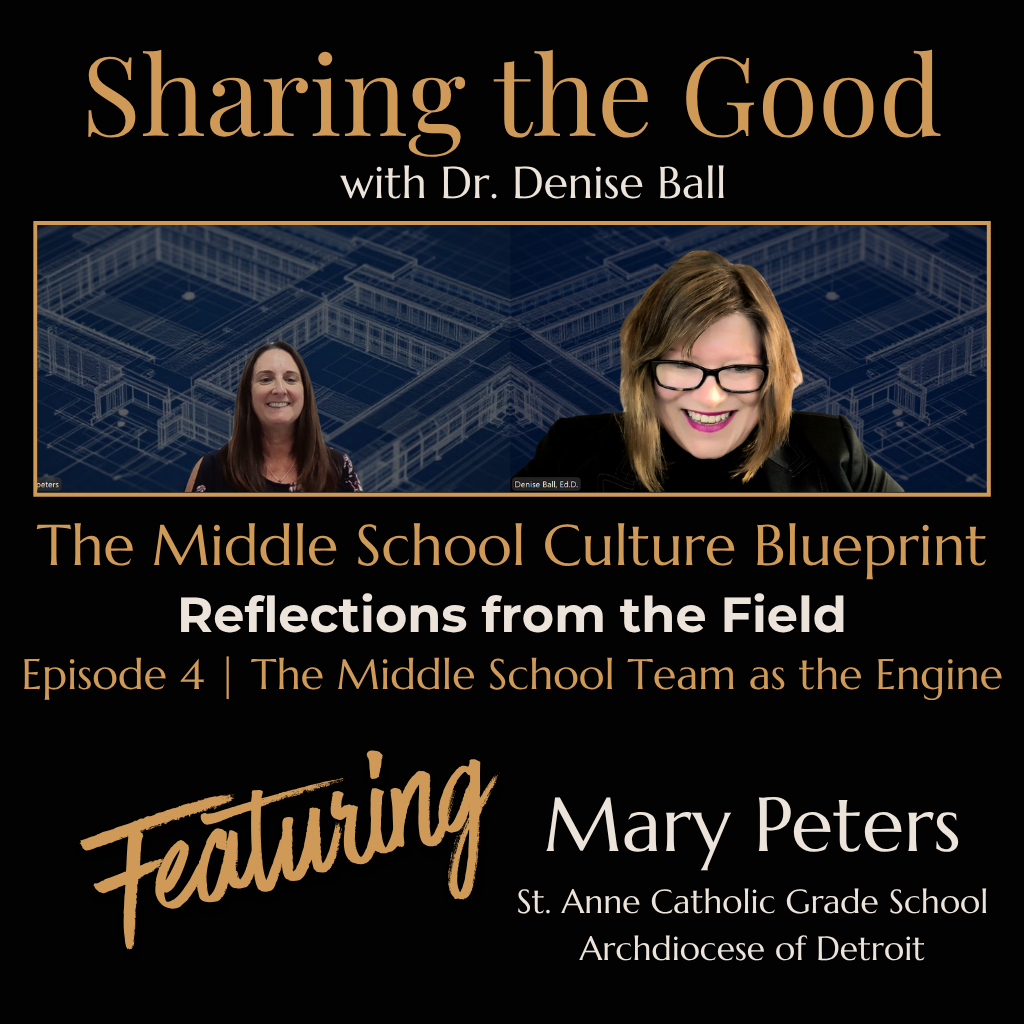
That idea was at the heart of Episode 4 of The Middle School Culture Blueprint: Reflections from the Field. I was blessed to welcome Mary Peters, a veteran middle school educator at St. Anne Catholic Grade School in the Archdiocese of Detroit, for a conversation about what happens when middle school educators intentionally begin thinking and working as a team.

Mary shared a wonderfully practical example from her school: a common middle school assessment template centered on Claim, Evidence, Reasoning (CER). Teachers across the middle school use this common framework when assessing student learning. Think about what that can mean for a young adolescent moving from one content area to another. The subject matter changes, the teacher changes, and the learning experience changes. However, there is a familiar framework helping the student understand how to communicate thinking and demonstrate learning. This is so powerful! That is coherence, a Middle School Culture Blueprint pillar in action.

It is also an important reminder that consistency does not require uniformity. We do not want every teacher or classroom to look exactly the same. Great educators bring their own gifts, personalities, content expertise, and creativity to their classrooms. Shared frameworks can provide enough clarity and consistency to help students successfully navigate those different environments.

Mary also shared that this year her middle school team is meeting monthly as a professional learning community )PLC), with a shared middle school vision serving as a focus for their work. I love the intentionality behind this practice. A vision should not simply be words written on a document. It can become a framework for conversation: Who are we as a middle school? What do we want our students to experience? What do we believe about teaching and learning? Where do we need greater consistency, and how can we better support one another?

As Dr. LaTonya White and I continue developing The Middle School Culture Blueprint, our work is framed around four interconnected pillars: Belonging, Clarity, Coherence, and Formation.

Mary reflected during our conversation that all four are essential to creating and maintaining a positive school culture. I think her examples demonstrate why. Belonging reminds us that students and adults need to know they are seen, valued, and part of a community. Clarity helps everyone understand expectations and what success looks like. Coherence connects classrooms, practices, language, and expectations so that students experience a community rather than a collection of unrelated classrooms. Formation recognizes that we are continually helping students, and one another, grow academically, professionally, personally, and spiritually. One of the most important lessons from this conversation is that building a strong middle school culture does not always require another large initiative. Sometimes it begins with a shared assessment framework. A monthly conversation. A common expectation. A team willing to ask, “What do we want our students to experience, and educators willing to move from “my students” to “our students.”

When middle school teachers work as a true team, collaboration becomes more than another meeting on the calendar. It becomes part of the culture. When Belonging, Clarity, Coherence, and Formation begin working together, we create environments where both students and educators have greater opportunities to thrive!

Thank you to Mary Peters for sharing the wisdom that comes from years of serving middle school students and to my co-author, Dr. LaTonya White, for continuing this important work alongside me.

There is so much good happening in our Catholic schools. Let’s continue to see it, learn from it, and share it.

All are welcome to join the conversation:

Sharing the Good with Dr. Denise Ball YouTube Channel

Sharing the Good with Dr. Denise Ball on Spotify

May we continue to seek knowledge in all things,

Denise

Leave a comment

Filed under Sharing the Good with Dr. Denise Ball, The Middle School Culture-Reflections from the Field Series

Through a University Lens: Preparing and Supporting Middle School Educators

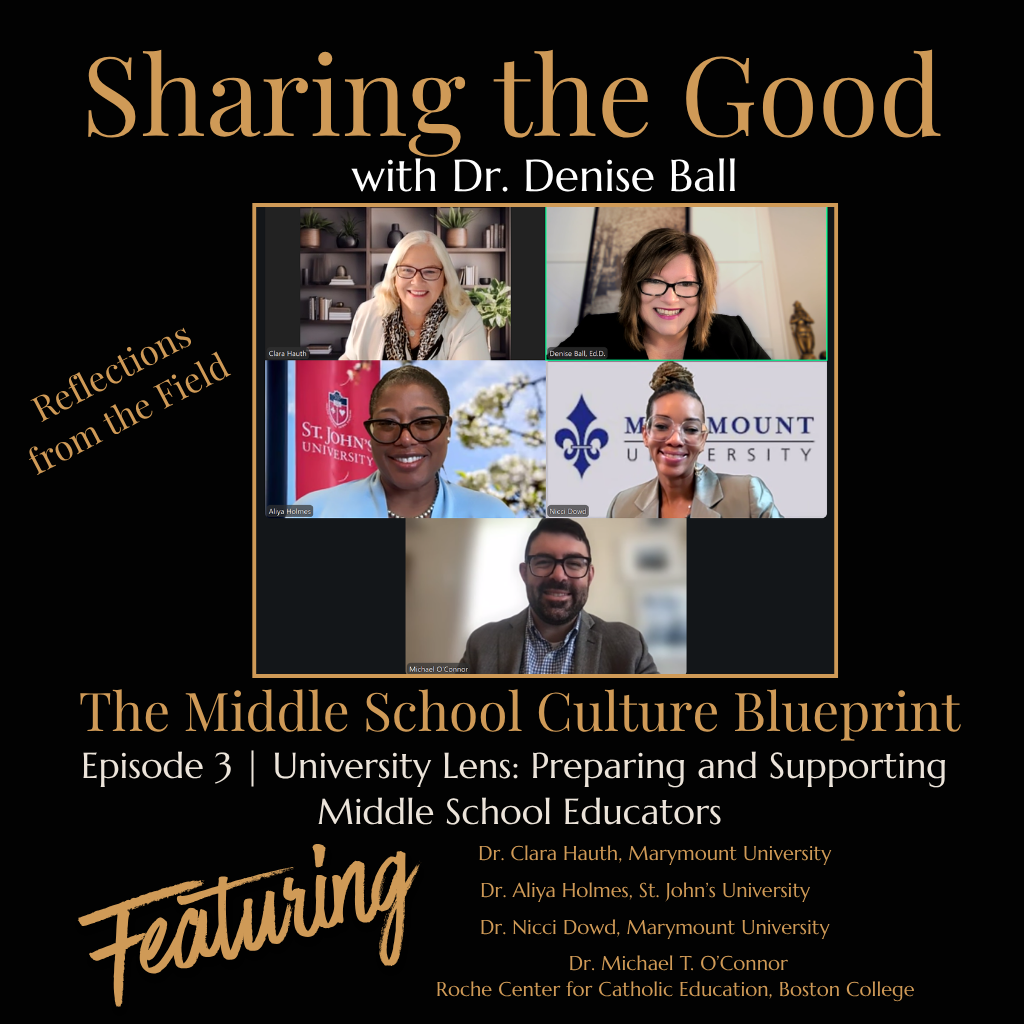
There was something particularly meaningful about Episode 3 of The Middle School Culture Blueprint: Reflections from the Field. Four university leaders, representing the Roche Center for Catholic Education, Boston College, Marymount University, and St. John’s University, came together around a shared question:

How can universities better prepare, support, and walk alongside the educators and leaders serving our Catholic schools?

Dr. Michael O’Connor, Dr. Nicci Dowd, Dr. Aliya Holmes, and Dr. Clara Hauth each brought a different lens to the conversation, including professional learning, teacher preparation, innovation and partnership, and educational leadership. Yet throughout the discussion, a common message emerged. Higher education has an important opportunity not simply to prepare people before they enter schools, but to remain connected to the field, listen to its needs, and continue learning alongside the educators doing the work each day.

The Middle School Culture Blueprint: Reflections from the Field

Episode 3 | University Lens: Preparing and Supporting Middle School Educators

That spirit of partnership matters! Our teachers and school leaders are navigating increasingly complex responsibilities while remaining focused on the students and families entrusted to their care. Universities can be important partners in that work through relevant professional learning, leadership development, research, teacher preparation, and meaningful school-university partnerships. The strongest partnerships, however, are not built around universities deciding what schools need. They begin with listening. They invite practitioners into the conversation, connect research with classroom realities, and recognize that knowledge flows in both directions. Universities have much to offer schools, but schools also have much to teach universities.

Perhaps the most powerful moment came as each panelist offered a final word of encouragement to educators. Dr. Michael O’Connor reminded them, “You are not alone. Lean on Christ and those in your orbit.” Dr. Nicci Dowd encouraged educators to “Design for possibilities, not limitations.” Dr. Aliya Holmes reminded us to lean on God and community and to recognize the importance of the small things. Dr. Clara Hauth encouraged educators to “Give yourself grace, and ask questions…advocate for yourself and others.” Different words, yet a common thread that community, relationships, and formation all essential, and that none of us was meant to do this important work alone.

As Dr. LaTonya White and I continue preparing The Middle School Culture Blueprint for publication with the National Catholic Educational Association in spring 2027, I am increasingly grateful for the voices entering these Reflections from the Field conversations. Teachers, principals, diocesan leaders, pastors, and university colleagues are reminding us that strong middle school cultures are built when people are willing to listen, share what they have learned, and contribute their gifts for the good of others.

Michael, Nicci, Aliya, and Clara are blessings to the universities they serve, and their willingness to invest in the formation and support of educators is a beautiful example of educational community in action. This is what it looks like when we stop thinking in silos and begin asking what we can accomplish together!

Please be encouraged to listen, engage, and join the conversation.

We can do more–together!

May we continue to seek knowledge in all things,

Denise

Denise Ball, Ed.D.

Retired Catholic Education Leader | Author | Researcher | Consultant
Marymount University | Assistant Professor

Join the conversation

LinkedIn: linkedin.com/in/deniseballedu 

Instagram: deniseball_edu

YouTube: www.youtube.com/@SharingTheGoodwithDrDeniseBall

Facebook: https://www.facebook.com/SharingTheGoodWithDrDeniseBall

Blog: www.unlocktheteacher.org

Sharing the Good is also available wherever podcasts are enjoyed!

Leave a comment

Filed under The Middle School Culture-Reflections from the Field Series

Why Professional Learning…Is it Important or Just One More Thing?

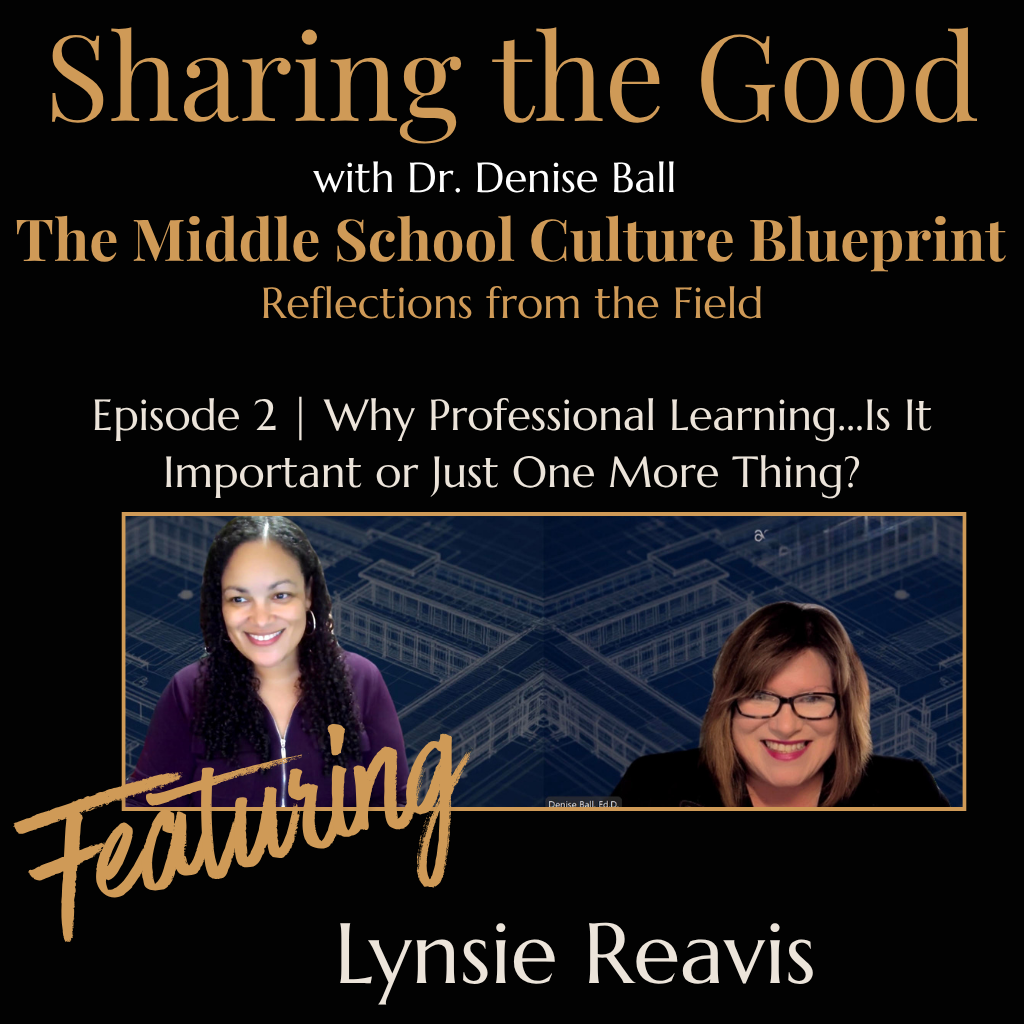
Professional learning is intended to help educators grow, strengthen their practice, and ultimately better serve students. Yet for teachers carrying increasingly full plates, even well-intentioned professional learning can sometimes feel like “one more thing.” That tension became the starting point for Episode 2 of The Middle School Culture Blueprint: Reflections from the Field, where I had the opportunity to talk with Lynsie Reavis, Director for Educational Programs for the Archdiocese of Washington. Our conversation offered an important reminder for those of us who lead and design professional learning: honoring teachers’ time, capacity, and experience must be part of the planning process.

One of Lynsie’s recommendations was beautifully practical…to choose one or two meaningful initiatives each year and avoid exceeding three. Teachers wear many hats, and meaningful implementation requires time. Rather than expecting every educator to embrace a new initiative at the same pace, Lynsie encouraged leaders to begin with those who are ready and willing. These educators can become “initiative ambassadors,” sharing authentically with colleagues how a new practice is influencing teaching and learning. Growth can often spread more effectively through trusted relationships and visible impact than through another mandate. That same relational approach shaped Lynsie’s own middle school teaching. She spoke about creating challenges and friendly competition to make learning collaborative and enjoyable and reflected on the familiar instructional progression of “I do, we do, you do.”

Our conversation also reinforced how professional learning can strengthen the culture of an entire middle school. Lynsie emphasized giving teams time to develop shared expectations around practices such as weekly assessment schedules, bell work, and family communication. These conversations require compromise, openness, and time, but the resulting coherence matters. Middle school students move among multiple teachers and classrooms each day, and, as Lynsie reminded us, they are always watching the dynamics and structures around them. Greater consistency among adults can create greater clarity and security for students. Professional learning, then, becomes more than the transfer of information. It becomes an opportunity to strengthen relationships, shared language, teamwork, and culture.

Click HERE to listen to episode 2 and available anywhere podcasts are enjoyed.

For educators interested in exploring this area further, Deans for Impact’s free The Science of Learning resource offers an accessible, research-informed look at how cognitive science can inform everyday instructional decisions. 

https://www.deansforimpact.org/files/assets/thescienceoflearning.pdf?

Perhaps one of the most important themes of our discussion was reflection. Lynsie highlighted brain-based teaching and learning and reminded us that the instructional decisions educators make influence how students experience and process learning. That makes reflection essential, not optional. As Dr. LaTonya White and I continue our work on The Middle School Culture Blueprint (NCEA, 2027), these conversations continue to reinforce the interconnected nature of Belonging, Clarity, Coherence, and Formation, our middle school culture blueprint. Professional learning can contribute to each of these pillars when it is thoughtful, relevant, and connected to the actual work of teachers. And through all of the strategies, structures, initiatives, and demands of education, Lynsie left us with a simple reminder worth carrying with us, “Always remember your why!”

May we continue to seek knowledge in all things,

Denise

Denise M. Ball, Ed.D.

Retired Catholic Education Leader | Author | Researcher | Consultant

Assistant Professor | Marymount University

Join the conversation

LinkedIn: linkedin.com/in/deniseballedu 

Instagram: deniseball_edu

YouTube: www.youtube.com/@SharingTheGoodwithDrDeniseBall

Facebook: https://www.facebook.com/SharingTheGoodWithDrDeniseBall

Blog: www.unlocktheteacher.org

Leave a comment

Filed under The Middle School Culture-Reflections from the Field Series

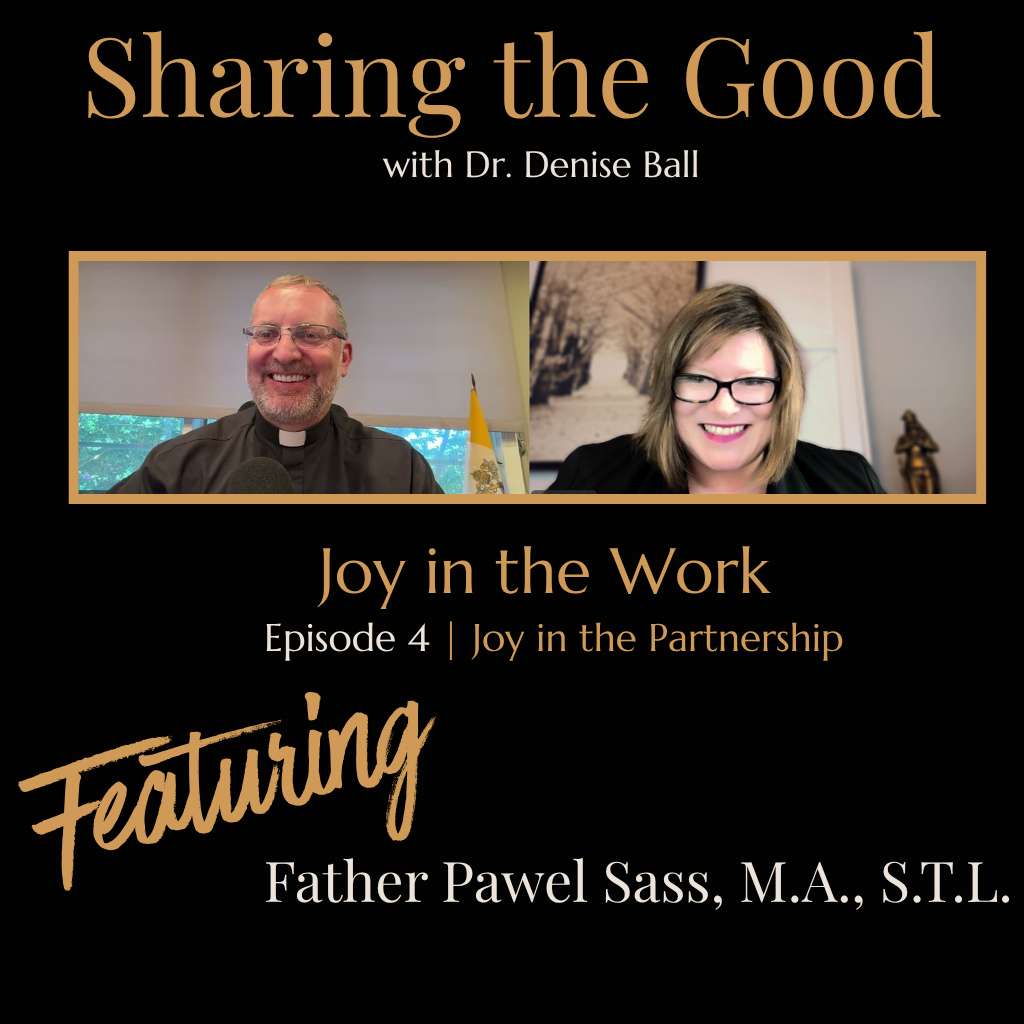
Joy in the Partnership: The Pastor-Principal Relationship and the Culture We Create

Joy in the Work | Episode 4 | A Conversation with Father Pawel Sass, M.A., S.T.L.

What becomes possible in our Catholic schools when pastors and principals see their partnership not simply as a responsibility, but as a gift?

That is the question I have been carrying with me since my recent conversation with Father Pawel Sass, Pastor of the Shrine of Saint Jude in Rockville, Maryland, for Episode 4 of the Joy in the Work series.

When we talk about strengthening Catholic schools, we rightfully talk about teachers, principals, students, families, curriculum, instruction, faith formation, and school culture. However, there is another relationship that I believe deserves much more of our attention: The pastor-principal partnership.

The pastor and principal have distinct roles and responsibilities, but they share something extraordinary: responsibility for advancing the mission of a Catholic school community. When that partnership is healthy, collaborative, prayerful, and rooted in mutual respect, the effects can extend far beyond the two people involved.

Teachers and students notice and experience it, and the school families and parishioners take notice and experience it. This partnership has a huge impact on a Catholic school culture. 

Partnership Has Shaped My Own Leadership Lens

Throughout my years serving Catholic education, I have been blessed to work alongside wonderful priests and to learn from spiritual leaders who modeled a positive approach to Catholic schools. Msgr. Chuck Kosanke in the Archdiocese of Detroit and Father John Williamson in the Archdiocese of Baltimore are two priests whose mentorship and example helped shape my own understanding of partnership.

They helped me see that the relationship between pastor and principal does not need to be defined by hierarchy, territoriality, or uncertainty about who controls what.

At its best, it can be characterized by trust, communication, shared mission, respect for one another’s expertise, prayer, laughter, and a genuine belief that we are better when we serve together.

At one point in our conversation, Father Pawel offered a wonderfully simple reminder:

“We are too blessed to be stressed.” (Sass, 2026)

It made me smile. Of course, leadership can be stressful. Catholic school leaders and pastors carry real responsibilities, difficult decisions, competing priorities, and the needs of many people. Father Pawel was not suggesting otherwise. What I heard in his words was an invitation to remember the blessings while carrying the burdens.

Leadership can become so consumed by what needs fixing that we forget to notice what is flourishing:

The student who finally understands. The teacher who stayed a few extra minutes to help. The family who expresses gratitude. The colleague who makes us laugh or put up a bulletin board. The parishioner who quietly supports the school. The opportunity to celebrate Mass together. The privilege of accompanying children as they grow in faith and knowledge, and the people God has placed beside us.

There will always be another problem to solve, but there will also always be something for which to give thanks. Perhaps part of sustaining joy in the work is learning to hold both realities at once.

Another image Father Pawel shared has stayed with me.

“Clean the cup.”

His reflection was that we need to clean the cup so we can be filled by the Holy Spirit and then empty ourselves again in service to others (Sass, 2026).

What a beautiful image for leadership. Those of us who serve others spend much of our lives pouring out. We give attention. We give encouragement, time, we solve problems and we listen. We teach, lead and we accompany others on this journey of life. But we cannot continually pour from a cup we never allow God to refill.

Prayer, reflection, rest, gratitude, community, and time with God are not distractions from leadership. They help prepare us for it.

Perhaps the question is not simply, “How much more can I give?”

Perhaps sometimes the better question is:

“What do I need to release so there is room for the Spirit to fill me again?”…Clean the cup, be filled, be poured out in service, return, and allow God to fill it again! There is a rhythm of vocation in that image that I find beautiful.

One of the most practical parts of my conversation with Father Pawel centered on conflict. Healthy partnerships are not partnerships without disagreement. Pastors and principals will disagree. Teachers and administrators will disagree. Colleagues will misunderstand one another. We are human beings doing important work together, so conflict will happen.

The question is not whether disagreement will occur. The question is what we do when it does.

Father Pawel offered three practices that are beautifully simple and profoundly useful.

1. Begin With Quiet, Personal Prayer

Before responding, reacting, emailing, calling, or entering the difficult conversation: Pray.

Not necessarily publicly, not performatively, but quietly and personally. Bring the situation to God before bringing it back to the other person. Prayer creates space between the emotion we are experiencing and the response we choose to make.

It invites us to ask: Am I listening? Am I seeking understanding? Is pride influencing my response? What might I be missing? Holy Spirit, how are You asking me to enter this conversation?

For Catholic leaders, perhaps prayer should not simply open our meetings. Perhaps it should also precede our disagreements.

2. Practice “Table Fellowship”

Father Pawel’s second recommendation may be my favorite:

Enjoy table fellowship. (Sass, 2026)

Sit down together, share a meal, have coffee, break bread, and just talk.

Father Pawel reminds us that there is something deeply human, and deeply Christian, about gathering around a table. The person across from us can become very easy to misunderstand when our interaction is reduced to an email, a disagreement, a meeting agenda, or a problem that needs solving. The table changes the posture. At the table, we remember the person. We listen differently. We tell stories. We laugh. We learn about one another, and we discover what we have in common.

I think sometimes the disagreement that seemed enormous becomes easier to navigate once the relationship returns to the center. There is wisdom in table fellowship that extends far beyond the pastor-principal relationship. What might change in our leadership teams, faculties, departments, and school communities if we spent a little more time breaking bread together?

3. Assume the Good

Father Pawel’s third piece of wisdom may be the most challenging:

Assume the good.

When someone says something that frustrates us, assume the good. When a decision surprises us, assume the good. When communication is imperfect, assume the good. When we disagree about the path forward, begin with the belief that the other person also cares about the mission.

Assuming the good does not mean avoiding accountability or pretending harmful behavior is acceptable. It means resisting the temptation to assign negative motives before we have taken the time to understand.

Imagine beginning a difficult pastor-principal conversation from this posture:

“I know you care about our school and our mission. Help me understand how you are seeing this.”

That is very different from beginning with:

“Why would you do this?”

One posture opens a door and the other may close it before the conversation even begins.

I keep returning to Father Pawel’s three practices:

  • Pray
  • Table Fellowship
  • Assume the good

They require no new program, no strategic plan, no committee, or budget. They require intentionality. I think this is one of the lessons emerging throughout this entire Joy in the Work series. Positive culture is often built through seemingly small, repeated relational practices.

How we enter the room, how we listen, how we choose to respond to mistakes, how we welcome people, how we handle a disagreement is important to the partnership. 

How we recognize another person’s gifts, how we repair a relationship, and how we choose to begin again can build trust and a strong foundation for the partnership. 

As shared in earlier episodes, small moments, repeated consistently, have a way of becoming culture.

A healthy pastor-principal partnership does not require the pastor to become the principal or the principal to become the pastor. Their roles are distinct, their gifts are different, and areas of expertise vary. That is not a weakness in the partnership, and it may be one of its greatest strengths.

Partnership asks us to recognize: You bring something to this mission that I cannot bring alone. In Catholic education, that recognition carries particular significance. The pastor brings spiritual leadership, sacramental life, theological formation, and pastoral care. The principal brings educational leadership, instructional expertise, organizational leadership, and the daily stewardship of the school community. Together, they can help ensure that Catholic identity is not simply something written in a mission statement, but becomes something people experience.

As the Joy in the Work series continues, another piece of the larger picture is becoming clearer to me.

  • Dr. Christina Mendez-Hall invited us to Lead with Joy,
  • Dr. Nicci Dowd encouraged us to Make Room for Joy,
  • Dr. Joy Roberts helped us explore Joy, Belonging, and the Power of Community, and 
  • Father Pawel Sass reminds us that there can also be Joy in the Partnership.

We do not have to carry the mission alone, and that in itself is a source of joy. There is someone beside us. Someone with different gifts. Someone who sees things we may not see. Someone with whom we can pray, and can break bread together. Someone with whom we can disagree and begin again. Someone who can remind us, on the difficult days, why we said yes to this work in the first place.

I left my conversation with Father Pawel inspired and grateful.

The Shrine of Saint Jude and St. Jude Catholic School in Rockville, Maryland, are blessed to have a pastor who so clearly values Catholic education and recognizes the importance of collaboration.

Our conversation has me reflecting on…

What becomes possible in our Catholic schools when pastors and principals see their partnership not simply as a responsibility, but as a gift?

Perhaps we create stronger relationships, and we navigate conflict with greater grace. Perhaps our teachers feel more supported, and families experience greater unity. Perhaps students encounter a more authentic witness of Christian community, and perhaps we make a little more room for joy.

I am grateful to Father Pawel Sass for sharing his faith, wisdom, humor, and JOY in Episode 4 of the Joy in the Work series:

Joy in the Partnership: The Pastor-Principal Relationship and the Culture We Create

Join the conversation on YouTube: https://youtu.be/BqIdg4uuwCU or listen wherever you enjoy your favorite podcasts.

Maybe the next time conflict finds its way into our work, we can remember Father Pawel’s simple wisdom:

Pray, enjoy table fellowship, and assume the good! Maybe, every once in a while, remind ourselves: “We are too blessed to be stressed.” (Sass, 2026)

When we train our eyes to see the good, amazing things happen!

Reference

Ball, D. M. (2026). Joy in the partnership: The pastor-principal relationship and the culture we create [https://youtu.be/BqIdg4uuwCU]. Sharing the Good with Dr. Denise Ball.

Leave a comment

Filed under Joy in the Work Series, Sharing the Good with Dr. Denise Ball

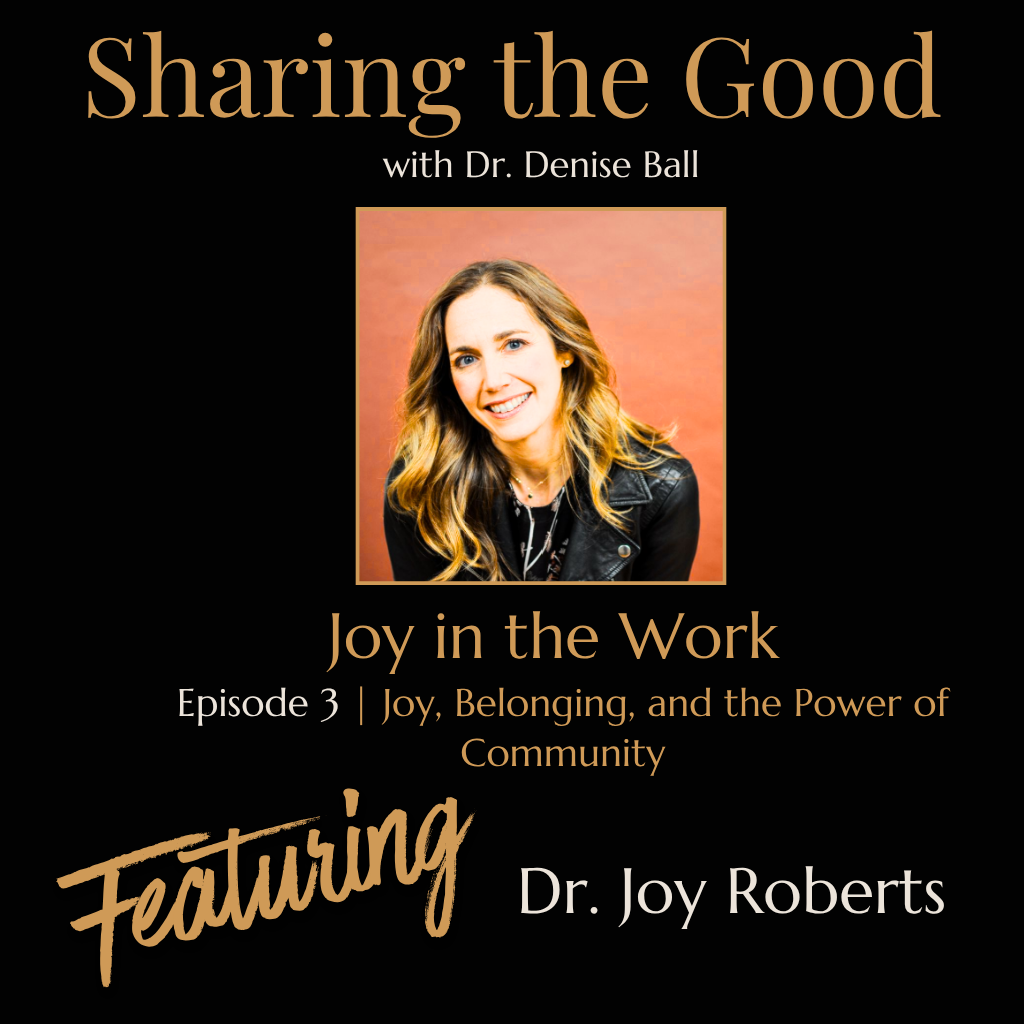
Joy in the Work | Episode 3

Joy, Belonging, and the Power of Community

A Conversation with Dr. Joy Roberts

What if one of the greatest sources of joy in our work is knowing that we belong to something larger than ourselves?

That is the question I have been carrying with me since my recent conversation with Dr. Joy Roberts for Episode 3 of the Joy in the Work series.

What a joy it was to welcome Joy to Sharing the Good with Dr. Denise Ball for a wonderful conversation about joy, belonging, relationships, and the power of community.

Joy is the co-founder and president of Friendzy, an organization that partners with schools across the nation and across governance models to help create classroom and school cultures where students and educators experience a strong sense of belonging.

Throughout our conversation, Joy reminded us that strong communities do not happen by accident. They are built through relationships and through the everyday ways we help people know they are seen, valued, and connected.

Belonging Matters

Belonging is a word we hear frequently in education, but I wonder if we sometimes underestimate just how important it is.

At its heart, belonging communicates something profoundly human (Roberts, 2026), conveying I am known here, I am valued here, my presence matters here, and there is a place for me here.

Research gives us good reason to pay attention to these experiences. The Institute of Education Sciences has studied school belonging as part of the social, emotional, and behavioral context for teaching and learning, examining its connections with student engagement, well-being, behavior, and academic outcomes. In one rigorous middle school study involving more than 1,000 students, an intervention designed in part to address students’ concerns about belonging produced a statistically significant improvement in students’ reported social belonging and fewer behavioral referrals overall (Borman et al., 2019).

At the same time, the larger research base reminds us to be thoughtful about our claims. The What Works Clearinghouse’s review of social-belonging interventions found mixed effects on academic achievement. Belonging is not a magic program that guarantees an academic outcome. Rather, it is part of the relational and cultural environment in which learning takes place.

I think the distinction matters. Belonging is not another initiative to add to the school calendar, but is something people experience.

Culture Answers the Question: Do I Belong Here?

Think for a moment about the messages people receive throughout an ordinary school day.

A principal stands at the door and knows a student’s name. A veteran teacher checks on a new colleague. A student is invited into a group. A teacher’s idea is genuinely considered during a faculty meeting. A parent walks into the office and is warmly greeted. Someone notices when a colleague is having a difficult day. A student makes a mistake and discovers that the mistake does not diminish their value within the community.

None of these moments requires a new program, which Dr. Roberts reminds us that educators do not need, yet together, these moments communicate: You are seen, you are valued, you are connected, and you belong! That is culture.

Research on school marginalization offers another important lens. The Institute of Education Sciences has supported research examining how experiences of marginalization relate to student social relationships, engagement, well-being, behavior, and achievement. Importantly, student-teacher and student-peer relationships are among the factors researchers examine when trying to understand these connections.

In other words, relationships are not peripheral to the educational experience, but are part of it.

Belonging Is for the Adults Too

One of my favorite parts of my conversation with Joy was that we did not limit our discussion of belonging to students.

Students absolutely need to know that they belong, but so do teachers, and so do principals. We also cannot forget the importance of belonging is for our instructional assistants, counselors, administrative assistants, maintenance teams, professors, diocesan and system leaders, and everyone else who contributes to the life of a learning community. As someone who has spent much of my research and professional work thinking about school culture and teacher retention, I continue to come back to the importance of the environment in which educators are asked to do their work. We cannot continually ask educators to create communities of belonging for children while paying little attention to whether the adults themselves experience connection, trust, collaboration, and belonging.

Imagine the difference between a teacher thinking: “This is where I work.” and believing: “These are my people. My contribution matters here. We are doing something important together.”

That is a very different experience of work, and perhaps that is where belonging and joy begin to intersect.

We Were Never Meant to Do This Work Alone

Education is deeply relational work. There will always be difficult days. There will be students whose needs challenge us, lessons that do not unfold as planned, difficult conversations, competing priorities, and problems without immediate solutions.

Belonging does not eliminate any of those things. Community does, however, change how we carry them.

There is a profound difference between thinking: “I have to figure this out.” and knowing: “We will figure this out together.” That is the power of community; we learn from one another. In a healthy school culture we encourage, challenge, and celebrate one another! We sometimes carry one another, and need to remind each other why the work matters.

A Thread Through the Joy in the Work Series

As this series continues, I am beginning to see a beautiful thread emerging through these conversations. Dr. Christina Mendez-Hall invited us to Lead with Joy and consider how we choose to enter the work. Dr. Nicci Dowd encouraged us to Make Room for Joy by creating environments where people have permission to learn, make mistakes, collaborate, and grow. This week, Dr. Joy Roberts has invited us to think about joy, belonging, relationships, and the power of community.

Perhaps these ideas are not separate at all. We choose how we show up, and we choose to make room for one another. We build relationships, and through this we create belonging. We discover that we are part of something larger than ourselves, and together, we shape culture!

Belonging Is Built in the Small Moments

Perhaps one of the most encouraging things about belonging is that strengthening it does not always require a large-scale initiative.

It can begin today:

*Learn someone’s name,

*Pull up another chair,

*Ask a colleague what they think…and then LISTEN,

*Invite someone into the conversation,

*Notice who has become quiet,

*Celebrate someone’s contribution,

*Check on the new teacher,

*Listen to the student who needs a few extra minutes,

*Thank the person whose work frequently goes unnoticed, and/or,

*Remind someone that they matter.

These actions may seem small, but small moments, repeated consistently, have a way of becoming culture, and culture has the power to communicate something transformative: You do not have to earn your place here. You are part of us.

A Question I Am Carrying With Me

I am grateful to Joy for generously sharing her wisdom, research, experiences, and JOY.

As I reflect on our conversation, I continue to carry this question: What if one of the greatest sources of joy in our work is knowing that we belong to something larger than ourselves?

To take it one step further, perhaps the question for each of us is: What can I do today to help someone else know that they belong too?

Join the Conversation

Learn more about Friendzy and explore its impact reports by visiting Friendzy.co, including the Competency and Belonging Impact Report.

Join the conversation on YouTube:
https://youtu.be/OfkNJkom_rY

Or listen wherever you enjoy your favorite podcasts.

When we train our eyes to see the good, amazing things happen!

May we continue to seek knowledge in all things,

Denise

#SharingTheGood #JoyInTheWork #Belonging #SchoolCulture #SchoolLeadership #CatholicEducation #EducatorJoy #Community #Friendzy
Research and Resources

Borman, G. D., Rozek, C. S., Pyne, J., & Hanselman, P. (2019). Reappraising academic and social adversity improves middle school students’ academic achievement, behavior, and well-being. Proceedings of the National Academy of Sciences, 116(33), 16286–16291.

Institute of Education Sciences, What Works Clearinghouse. (2021). Social Belonging Interventions: Intervention Report. U.S. Department of Education.

Institute of Education Sciences. School-Based Marginalization, Social Behavioral Competencies, and Achievement: A Meta-Analysis. National Center for Education Research.

Leave a comment

Filed under Sharing the Good with Dr. Denise Ball

Make Room for Joy: Creating Environments Where We Have Permission to Learn

What if one of the greatest gifts we can give the people with whom we work is permission?

Permission to ask a question. Permission to say, “I don’t know yet.” Permission to try something new. Permission to make a mistake. Permission to learn from one another, and perhaps, permission to experience JOY along the way.

After a wonderful conversation with my friend and colleague, Dr. Nicci Dowd, for Episode 2 of the Joy in the Work series on Sharing the Good with Dr. Denise Ball, these are the questions that came to mind.

Our episode is titled Make Room for Joy, but our conversation reminded me that making room for joy may begin by making room for people to be learners.

We Are All Still Learning

Nicci shared an idea during our conversation that has stayed with me: academic humility.

There is something freeing about recognizing that none of us has all the answers. Teachers do not. School leaders do not. Professors do not. Researchers do not, and that is okay.

We can bring years of education, research, leadership experience, and expertise into a room and still remain open to the possibility that someone sitting beside us may see something we have missed. That is one of the reasons I value collaboration so deeply. Many voices create the best outcomes.

When we create environments where people feel safe enough to ask questions, offer ideas, respectfully disagree, try something new, make a mistake, and begin again, we are doing more than supporting professional learning. We are helping create a culture in which people can grow; I believe there can be tremendous joy in that growth.

Making Room for Joy Means Making Room for Mistakes

As educators, we frequently tell students that mistakes are part of learning. But do the adults in our schools believe the same is true for them? That question is worth considering. If a teacher tries a new instructional strategy and it does not work as planned, what happens next? If a new school leader admits that they do not know the answer, how is that received? If someone offers a different perspective during a faculty meeting or professional learning session, do we become curious or defensive? If a colleague needs help, have we created an environment where asking for it feels safe?

The answers to those questions tell us something about culture. School culture is not created only through mission statements, strategic plans, programs, or initiatives. It is experienced in the everyday interactions between people: how we listen, how we respond, how we encourage, how we handle mistakes, how we celebrate growth, and whether the people around us believe they are valued members of the community. Sometimes the smallest interactions communicate the biggest messages.

UDL, Joy, and Creating Space for Every Learner

Nicci also shared how Universal Design for Learning, or UDL, has shaped the way she approaches her courses at Marymount University and the professional learning she facilitates with educators as an adjunct consultant for ADAC, Inc.

I loved hearing her connect the Universal Design for Learning to this conversation because at its heart, UDL asks us to think intentionally about the learners in front of us. Who is in the room? What might help them engage? What barriers might we remove? How might we provide different pathways for people to learn, participate, demonstrate understanding, and grow? Those questions matter whether the learners sitting before us are children, graduate students, teachers, or school leaders, and perhaps there is a connection to joy here too.

When people know they do not have to learn exactly like everyone else, when their questions are welcomed, when they have opportunities to contribute their gifts, and when mistakes are treated as part of learning rather than evidence that they do not belong, we make room for something important to happen.

We make room for growth, for belonging, and for joy.

The Joy of Learning Alongside One Another

One of the gifts of this season of my own work is the opportunity to keep learning alongside thoughtful people.

Nicci and I have the privilege of serving together on the Marymount University faculty, collaborating as adjunct consultants with ADAC, Inc., and beginning a second year of research with an amazing team focused on school culture and developing practical tools to help school leaders create environments where educators thrive.

Different settings, roles, and conversations, but there is a common thread running through all of them:

We can do more for the educators, school leaders, students, and families we serve when we learn and work together.

That is one of the reasons these Joy in the Work conversations are bringing me so much joy themselves. They are not intended to suggest that education is easy or that choosing joy somehow removes the very real challenges educators face. Instead, I hope they create a little space for us to stop, listen to one another, share what we are learning, ask good questions, and remember the good that continues to happen every day in classrooms, schools, universities, dioceses, and communities.

A Question for the New School Year

As another school year begins, perhaps there is a question each of us can carry into the environments we help create:

Do the people around me have permission to still be learners, and to experience joy while doing it?

Imagine what could happen in our classrooms, faculty meetings, professional learning communities, and leadership teams if the answer increasingly became yes. Perhaps making room for joy begins by making room for one another.

Join the Conversation

I am grateful to Dr. Nicci Dowd for sharing her wisdom, experience, and joy in Episode 2 of the Joy in the Work series, Make Room for Joy.

Join the conversation on YouTube: [https://youtu.be/ZeFiwsHr9hg] or listen wherever you enjoy your favorite podcasts.

As you begin another week of this important work, I invite you to consider:

Where are you finding joy in the work?

AND perhaps just as importantly:

How are you making room for someone else to find it too?

When we train our eyes to see the good, amazing things happen.

May we continue to seek knowledge in all things,

Denise

Leave a comment

Filed under Educational Resources