Tag Archives: Belonging

An Educator Toolkit: 90 Positive Comments to Help Every Student Feel Seen, Valued, and Connected

Belonging Begins with the Words We Choose

Since 2012, I have shared resources via this Unlock the Teacher blog focusing on positive comments, praise, and how to create positive classroom environments with a reminder that words matter! Since that time, these posts have received more than 1.3 million views. This continued reach has reinforced something I have believed throughout my years in education, that teachers and school leaders are searching for practical language that helps them recognize the good in students.

Positive words can encourage students and strengthen relationships. Yet, as our understanding of school culture continues to grow, we are also invited to think more deeply about the messages our words communicate.

Our comments can do more than acknowledge appropriate behavior, completed work, or academic performance. They can communicate:

  • I see you.
  • I value your ideas.
  • Your voice matters.
  • You are capable of growth.
  • You are an important member of this community.
  • You belong here.

School connectedness exists when students believe that the adults and peers in their school care about them as individuals and care about their learning. This sense of being valued, supported, and included is associated with stronger engagement, attendance, academic outcomes, and overall well-being.

Relationships are not built only through large programs or special events. They are shaped through daily interactions: the greeting at the classroom door, the response to a student’s question, the note written on an assignment, the conversation following a mistake, and the words chosen when a student takes a risk.

Research on relationship-centered classrooms emphasizes the importance of authentic affirmation, active listening, student agency, and opportunities for young people to know that their voices are taken seriously.

Student voice is more than allowing students to speak. It includes providing meaningful opportunities for them to influence their learning, make choices, offer feedback, participate in decisions, and see that their contributions can lead to action.

This updated educator toolkit offers 90 positive comments organized around nine dimensions of belonging. The statements can be adapted for:

  • Daily classroom conversations
  • Written feedback
  • Student conferences
  • Report cards and progress reports
  • Notes or messages sent home
  • Family conferences
  • Advisory periods
  • Morning meetings
  • Restorative conversations
  • Celebrations of student growth

These comments are not intended to become generic scripts or empty praise. They are starting points. The most powerful affirmations are sincere, specific, timely, and connected to something an educator has genuinely noticed.

1. Welcoming Every Student

  1. I am glad you are here today.
  2. Your presence adds something important to our classroom.
  3. You are an important member of this learning community.
  4. There is a place for your ideas in this classroom.
  5. I appreciate the energy you brought into the room today.
  6. I noticed that you came in ready to participate and contribute.
  7. Your experiences help our class learn and grow.
  8. You do not have to know every answer to belong in this classroom.
  9. Thank you for bringing your ideas, interests, and questions with you.
  10. Our classroom community is stronger because you are part of it.

2. Recognizing Identity and Voice

  1. Your perspective helped us see this topic differently.
  2. Thank you for sharing an idea that was important to you.
  3. You expressed your thinking with honesty and confidence.
  4. Your experiences give you insights that can help others learn.
  5. I appreciate how clearly you explained the reasoning behind your opinion.
  6. You asked us to consider something we had not discussed before.
  7. Your voice helped shape the direction of our conversation.
  8. You found a meaningful way to communicate your ideas.
  9. You advocated for yourself respectfully and clearly.
  10. Your contribution showed that there can be more than one valuable way to understand a topic.

3. Encouraging Effort and Growth

  1. I can see the growth you have made since you began this work.
  2. You used feedback to strengthen your thinking.
  3. You tried a new strategy when your first approach did not work.
  4. You asked for the support you needed to move forward.
  5. You stayed engaged even when the work became challenging.
  6. You set a goal and took meaningful steps toward reaching it.
  7. You are learning how to recognize which strategies work best for you.
  8. You took ownership of your learning today.
  9. You made a thoughtful choice about how to improve your work.
  10. Your progress shows what can happen when you remain open to learning.

4. Affirming Curiosity and Courage

  1. Your question helped deepen our learning.
  2. You were willing to say that you did not understand, and that took courage.
  3. You respectfully challenged an idea and encouraged us to think more carefully.
  4. You took an academic risk by sharing your thinking before you were certain that you for trusting our class.
  5. You followed your curiosity and discovered something new.
  6. You explored more than one possible answer.
  7. You made a connection that helped bring this concept to life.
  8. You were open to revising your thinking when you encountered new information.
  9. You asked for evidence instead of simply accepting an answer.
  10. Your curiosity helped make today’s learning more meaningful for everyone.

5. Strengthening Collaboration

  1. You made room for another person’s voice.
  2. You listened to understand, not simply to respond.
  3. You built upon a classmate’s idea in a respectful way.
  4. You helped your group identify a path forward.
  5. You disagreed respectfully while remaining open to another perspective.
  6. You asked a question that encouraged someone else to participate.
  7. You used your strengths to support the work of the group.
  8. You accepted responsibility for your part of the team’s work.
  9. You noticed when the group needed encouragement and offered it.
  10. You helped your team move forward without taking over the work.

6. Recognizing Kindness and Care

  1. You noticed that someone needed support and chose to help.
  2. The care you showed helped another person feel valued.
  3. You included someone who might otherwise have felt left out.
  4. You treated another person’s ideas with dignity and respect.
  5. You chose kindness even when the situation was difficult.
  6. You helped create a space where someone felt comfortable asking a question.
  7. You offered a sincere apology and worked to repair the relationship.
  8. You celebrated someone else’s success without taking attention away from them.
  9. Your words helped another person feel encouraged.
  10. You showed empathy by trying to understand how someone else might be feeling.

7. Building Responsibility and Trust

  1. I can depend on you to follow through on your commitments.
  2. You completed the responsibility you accepted.
  3. You made a responsible choice, even when no one was reminding you.
  4. You used your time in a way that supported your learning.
  5. You took care of our shared space and materials.
  6. You were honest about what happened and helped us find a solution.
  7. You recognized when you needed assistance and asked for it.
  8. You accepted responsibility for your choice without blaming someone else.
  9. You came prepared and ready to contribute.
  10. You used your independence while also knowing when to seek guidance.

8. Supporting Resilience and Reflection

  1. You paused to think before deciding what to do next.
  2. You did not allow one difficult moment to define the rest of your day.
  3. You changed your approach when you realized something was not working.
  4. You identified what you needed in order to begin again.
  5. You recognized a challenge and made a plan for addressing it.
  6. You gave yourself time to learn instead of expecting immediate perfection.
  7. You used a mistake as information for your next step.
  8. You returned to the work after feeling frustrated.
  9. You were patient with yourself while learning something new.
  10. You reflected honestly on your choices and identified how you would respond differently next time.

9. Creating Classroom Community

  1. Your actions helped make our classroom more welcoming.
  2. You helped create a space where others felt comfortable participating.
  3. You contributed an idea that improved our classroom community.
  4. You invited others to help make a decision.
  5. You reminded us of the expectations we created together.
  6. You helped our class solve a problem in a fair and respectful way.
  7. You shared a strength or talent that enriched our learning.
  8. You helped us recognize and celebrate someone else’s growth.
  9. You made a choice that supported both your learning and the learning of others.
  10. You showed through your actions that everyone has something meaningful to contribute.

Moving From Praise to Partnership

Positive comments become even more powerful when they invite students to recognize their own growth. Instead of ending the interaction after an affirmation, educators can add a reflective question.

For example:

  • You stayed engaged even when the assignment became difficult. What helped you keep going?
  • You made room for another person’s voice. What did you notice about the group after you did that?
  • You tried a new strategy when the first one did not work. How did you decide what to try next?
  • Your perspective helped us see the topic differently. What gave you the confidence to share it?
  • You advocated for yourself respectfully. How might you use that skill in another situation?

These questions move the conversation from adult approval to student reflection. As an educator, you are identifing something meaningful, and the student is invited to name the choices, strategies, and strengths that contributed to the outcome.

Over time, this approach can help students develop the language to say:

  • I know how I learn.
  • I can make thoughtful choices.
  • I can ask for what I need.
  • I can contribute to my community.
  • I can grow.

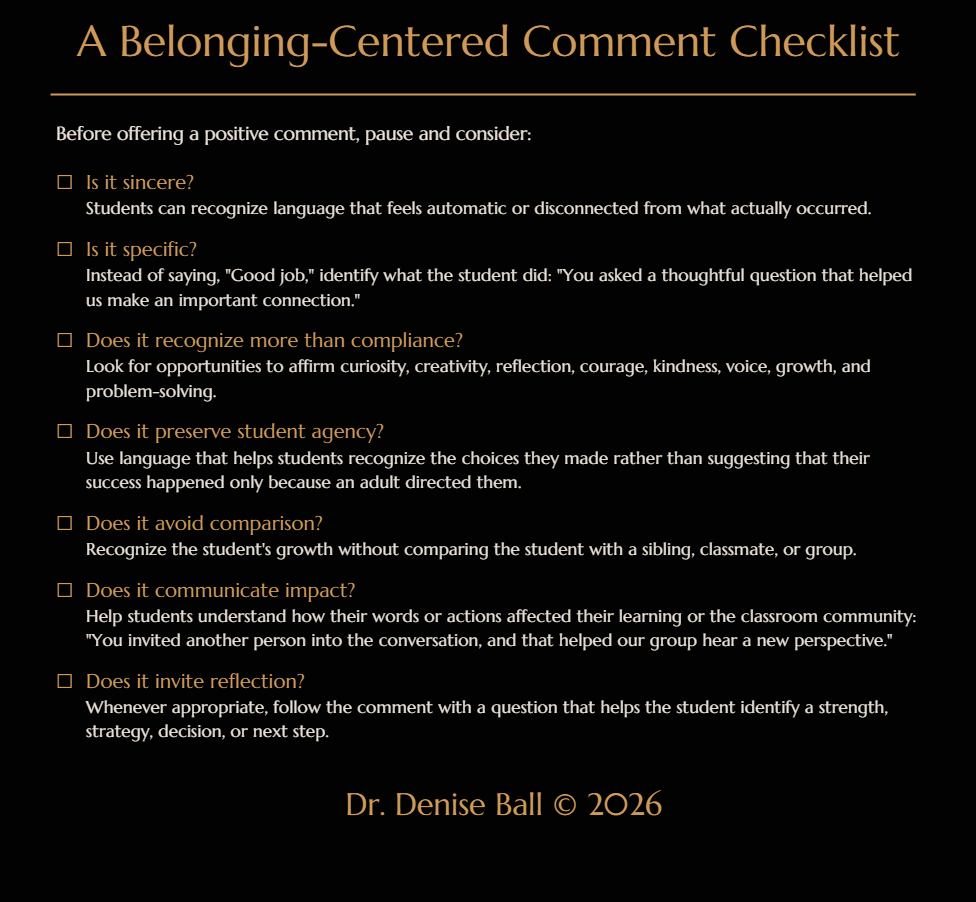
A Belonging-Centered Comment Checklist

Words Help Shape Culture

Positive language does not mean ignoring mistakes, avoiding difficult conversations, or removing accountability. Belonging-centered classrooms maintain clear expectations while communicating that a student’s mistake does not remove the student from the community.

Students need to hear more than what they should stop doing. They also need language that helps them understand what they are doing well, how they are growing, how their choices affect others, and how they can contribute.

There will always be a need to redirect behavior, offer correction, and establish boundaries. The question is whether students also hear:

-I believe you can make a different choice.

-You are still an important member of this community.

-Let us think together about what happened.

-What do you need to move forward?

-How can you help repair the situation?

-I am here to help you begin again.

The language educators use becomes part of the environment students experience each day. A carefully chosen comment may appear to be a small gesture, but to a student, it can communicate something much larger:

My teacher sees me. 

My ideas matter.

I am capable.

I have choices.

I can make a difference.

I belong here.

As educators prepare classrooms, develop lessons, establish routines, and welcome students into a new year of learning, may we also prepare the language we will use.

Belonging is strengthened one interaction at a time.

When we train our eyes to see the good, amazing things happen.

May we continue to seek knowledge in all things,

Denise

References and Additional Resources

Ball, D. M. (2012, July 22). 100 positive comments to utilize when referencing student behavior. Unlock the Teacher.

Centers for Disease Control and Prevention. (2024, November 18). School connectedness helps students thrive.

Hernández, L. E., Darling-Hammond, L., & Nielson, N. (2024, November 21). Cultivating relationships in secondary classrooms: Practices that matter. Learning Policy Institute.

Regional Educational Laboratory Pacific. (2025). Including voice in education: Addressing equity through student and family voice in classroom learning. Institute of Education Sciences.

Leave a comment

Filed under Words Have Power

The Leader’s Role in Creating Belonging

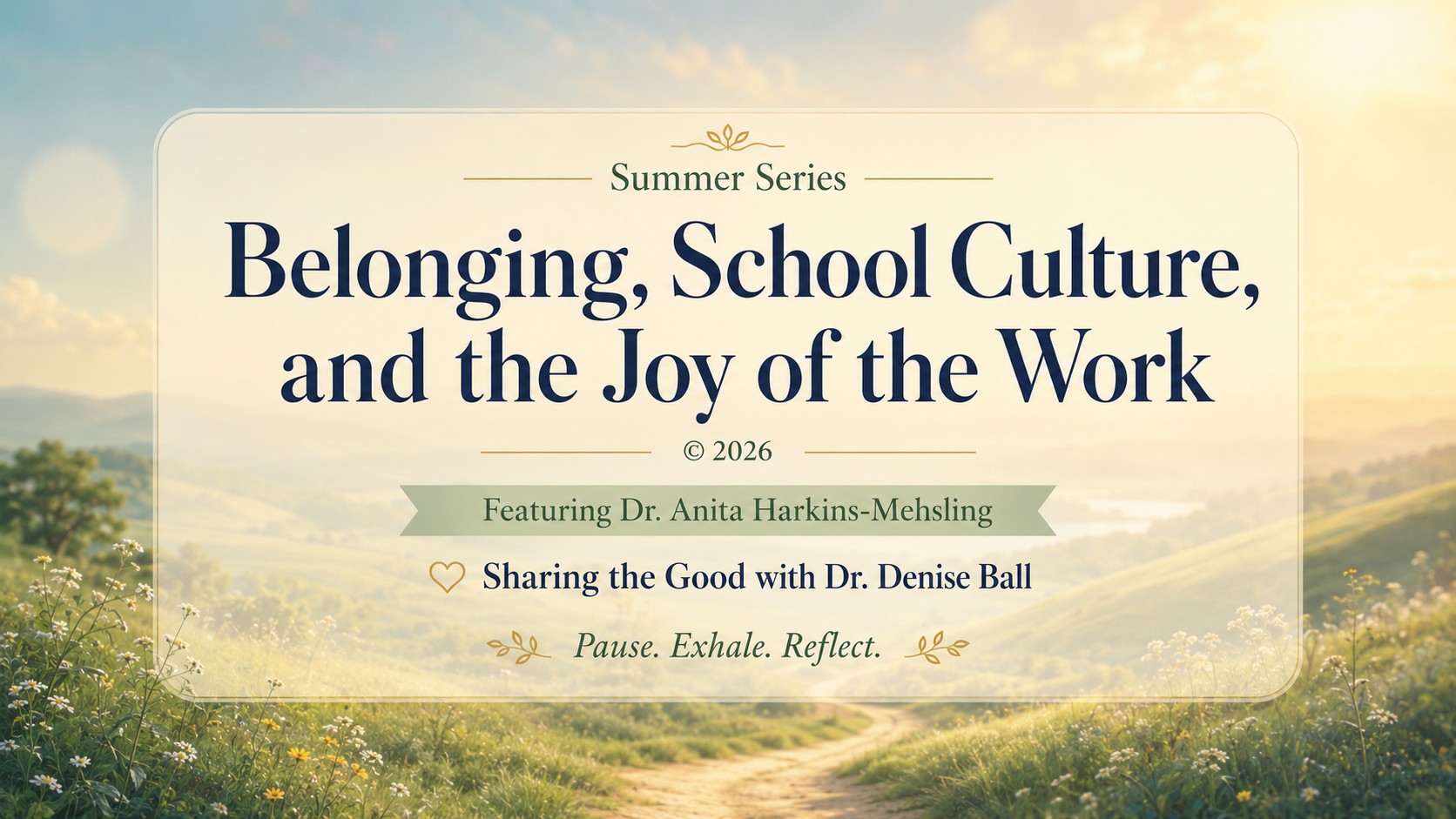
Summer Series 2026: Belonging, School Culture, and the Joy of the Work

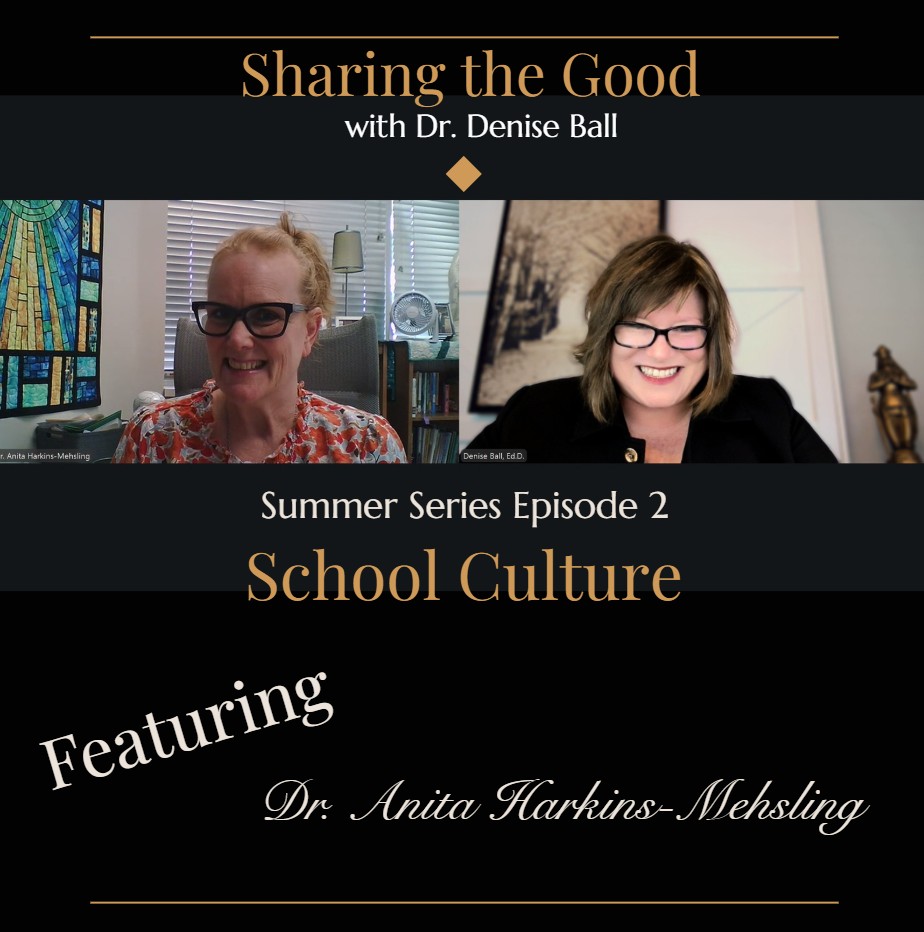
Episode 2 Featuring Dr. Anita Harkins-Mehsling

In Episode 2 of Summer Series 2026: Belonging, School Culture, and the Joy of the Work, I am grateful to continue the conversation with Dr. Anita Harkins-Mehsling, Associate Superintendent for the Archdiocese of Omaha.

In Episode 1, Anita and I reflected on why belonging matters and why summer is such a meaningful time for school leaders to pause, exhale, and consider the culture they hope to build and maintain for the 2026–27 school year.

In Episode 2, we turn our attention to the leader’s role in creating belonging and shaping a positive school culture.

A positive school culture does not happen by accident. It is nurtured through the rhythms, routines, relationships, words, and actions that help a school community stay connected to its mission. Culture is not created by a mission statement alone. Culture is experienced in the daily life of a school, in the way people are welcomed, supported, heard, encouraged, and invited to contribute to something greater than themselves.

Belonging is shaped through intentional relationships, communication, trust, presence, and the daily choices leaders make. The school leader sets the tone and helps create the conditions where people feel seen, valued, welcomed, and connected to the mission.

One of the important reminders Anita shared in this episode is that leaders should be intentional in how they welcome faculty and staff back to campus. The beginning of the school year is often filled with tasks, meetings, checklists, schedules, and classroom preparation. All of those things matter. Yet Anita reminds us that leaders also need to create space for people to reconnect, get to know one another, and remember that they are part of a shared mission.

That balance is so important. Teachers need time to prepare their classrooms. They need time to organize, plan, and feel ready to welcome students. They also need time to breathe, reconnect, laugh, share, pray, and remember that they do not carry the work alone.

The way a school year begins matters. People remember how they were welcomed (Ball, 2026). They remember whether the opening days were only about tasks or whether there was also time to reconnect with purpose, community, and joy.

As I listened to Anita, I found myself reflecting on my own leadership experiences and my research on school culture and teacher retention. I have spent much of the past decade studying and working in this area, and I continue to believe that school culture is created in ordinary moments. It is shaped in how a leader greets people, follows up, listens, remembers, encourages, and makes space for others to contribute.

One example from my own leadership practice was something I called Thankful Thursday. A couple of times a month, before the team arrived, I would leave notes of gratitude or encouragement. Sometimes the note was connected to something I noticed in a classroom. Sometimes it was simply a word of encouragement. They were not long or complicated, but they were intentional. These sticky notes were one more way of saying, “I see you. I notice the good work you are doing. Your presence and contribution matter here.” Gratitude helps shape culture and it sets a tone. It helps people know that their work is not invisible. 

Another practical way leaders can strengthen culture is by creating intentional opportunities for table talk during faculty and staff meetings. Meetings do not have to be used only for announcements, updates, and logistics…in fact they shouldn’t be. These are school culture prime opportunities to build trust and distribute joy!. They can also become spaces where people reflect together, listen to one another, and contribute to the shared mission of the school.

For example, after sharing a schoolwide focus or initiative, a school leader might ask each table to discuss: “Where are we already seeing this lived well in our school?” or “What is one next step we can take together?” Then each table can share one insight with the larger group. That kind of routine communicates something important: every voice matters, perspectives matter, and we are building and maintaining this positive school culture together.

In this episode, Anita and I break open the importance of helping faculty and staff feel seen and valued in specific ways. A general “thank you” is always appreciated, but specific gratitude has a different kind of impact. When a leader says, “I noticed the way you helped that student,” or “I saw how you supported your colleague,” it communicates that the person and the work are truly seen.

Again, this does not need to be complicated. Leaders might begin the year with handwritten notes, ask each staff member what helps them feel supported, highlight quiet acts of service during faculty meetings, check in with new faculty after the first two weeks, or intentionally thank office staff, aides, maintenance staff, cafeteria staff, and all who help the school function each day. Create a school environment where gratitude is the norm. If the adults model it, the students will follow. 

Culture is strengthened when leaders create a rhythm of noticing and naming the good.

Presence matters deeply, and in the life of a school, presence is not about hovering or checking up on people. It is about walking with people. It is about being close enough to the life of the school to understand where joy is visible, where support is needed, and where people may be carrying things quietly.

Dr. Harkins- Mehsling reminds us that sometimes the most powerful thing a leader can do is show up, listen, and remain steady. Presence builds trust over time, and is at the heart of belonging. In school culture work, trust is often the bridge between intention and impact. I call trust the glue for a strong positive school culture. Trust does not mean everything is easy. It means people believe they are being led with honesty, care, and purpose.

Leaders may intend to create belonging, but people experience belonging through communication, listening, relationships, and follow-through. Anita shared that she kept a notebook on her at all times, so she could jot down notes that would allow her to be intentional and follow-up with team members. 

Listening does not mean leaders can do everything requested. It does mean people are treated with dignity. Communication should help people understand not only the “what,” but also the “why.” When people understand the why behind decisions, they are more likely to stay connected to the mission, even when decisions are difficult.

One of the most helpful ideas in this conversation is that belonging does not have to become one more program, one more initiative, or one more thing added to everyone’s plate. Belonging can and should be woven into the rhythms that already exist. It can be built into faculty meetings, prayer, mentoring, communication, classroom visits, welcome-back days, celebrations, and leadership team conversations.

It is a way of asking: How will this decision, meeting, message, or practice help people feel seen, valued, and connected?

As leaders prepare for the 2026–27 school year, Episode 2 offers a simple but meaningful invitation: start small and be intentional. Create space for preparation and connection. Know or get to know your people and listen before acting. Build trust through follow-through, and create rhythms that help your community notice and share the good.

Belonging does not require perfection, but it does require intention, consistency, and love for the people we are called to serve.

I am grateful to continue this summer conversation with Dr. Anita Harkins-Mehsling and hope Episode 2 encourages school leaders to reflect on the culture they are creating, the welcome they are preparing, and the daily habits that help people feel seen, valued, and connected to the joy of the work.

Pause. Exhale. Reflect.

Join us for Episode 3 of Summer Series 2026: Belonging, School Culture, and the Joy of the Work on Sharing the Good with Dr. Denise Ball on July 14th.

Until next time, keep sharing the good.

When we train our eyes to see the good, amazing things happen.

May we continue to seek knowledge in all things,

Denise

Leave a comment

Filed under Episode 2 of Summer Series 2026: Belonging, School Culture, and the Joy of the Work

Summer Series: Belonging, School Culture, and the Joy of the Work

As school leaders enter the summer months, there is a sacred opportunity to pause, exhale, and reflect on the culture they hope to build and maintain for the 2026-27 school year.

I am grateful to share that Sharing the Good with Dr. Denise Ball will launch a three-part summer series on July 1st focused on Belonging, School Culture, and the Joy of the Work.

This series will feature Dr. Anita Harkins-Mehsling, Associate Superintendent for the Archdiocese of Omaha. Dr. Harkins-Mehsling brings more than 30 years of experience serving in education, and her recent research has focused on helping school leaders create a stronger sense of belonging within their school communities. She earned her doctorate from Doane University and continues to support Catholic school leaders in building healthy, mission-centered, and joy-filled school cultures.

The purpose of this series is to invite school leaders to reflect on belonging as a foundation for strong school culture. When people feel they belong, they are more likely to feel seen, known, valued, connected, and committed to the shared mission of the school.

Belonging is not an extra. It is part of the daily work of building a school community where students, teachers, staff, families, and leaders can flourish.

In episode 1, Dr. Harkins-Mehsling and I will discuss why belonging matters and why summer is such a meaningful time for school leaders to reflect on the culture they hope to create. We will explore what belonging means, how it is experienced by adults and students, and why feeling seen, known, and valued matters so deeply in the life of a school community.

In episode 2, we will focus on the leader’s role in creating belonging. Belonging is shaped through intentional relationships, communication, trust, presence, and the daily choices leaders make. We will talk about how school leaders can help faculty and staff feel seen and valued, how a leader’s presence shapes culture, and how belonging can be woven into the rhythm of the school year without becoming “one more program.”

In episode 3, we will connect belonging, joy, and the 2026-27 school year. This final conversation will invite leaders to consider how belonging can become part of the language, rhythm, and lived experience of the school. We will also reflect on how belonging contributes to joy, teacher retention, school stability, and the overall health of a school community.

Joy is not meant to be held alone. Joy is synergistic! When joy is shared among a school team, it strengthens culture, builds connection, and reminds us that the work we do matters. A joyful school community does not mean a perfect school community. It means a community where people are willing to see the good, name the good, and carry the good forward together.

For decades, I have found great joy in encouraging my family, teachers, students, schools, and school communities to notice and share the good. I have seen how transformative it can be when we pause long enough to name what is good, celebrate one another, and remind people that their work and their presence matter.

The Thankful Thursday shout-out this week is for the joy distributors… You know who you are!

Summer gives us space to breathe. It gives us space to ask important questions:

Who in our school community needs to feel more seen?

How do we help new faculty, staff, students, and families feel welcomed?

What practices help people feel connected to the mission?

Where did we see joy this year?

How can we carry that joy forward?

My hope is that this series offers school leaders a gentle but meaningful invitation to pause, exhale, and reflect before the next school year begins. Belonging matters, joy matters, and developing and maintaining a positive school culture matters.

The faculty, staff, students, and school communities we serve matter, and they deserve nothing less than our best!

I invite you to join us beginning July 1st for this three-part summer series on Sharing the Good with Dr. Denise Ball YouTube channel.

When we train our eyes to see the good, amazing things happen.

May we continue to seek knowledge in all things,

Denise

Leave a comment

Filed under Sharing the Good with Dr. Denise Ball

Summer Fellowship: A Time to Pause, Reflect, and Renew

There is something calming about the summer weeks in education. The pace shifts, the calendar breathes, and the noise of the school year begins to quiet just enough for leaders, teachers, and all those who serve school communities to pause and remember why the work matters. Why we CHOOSE to serve in education.

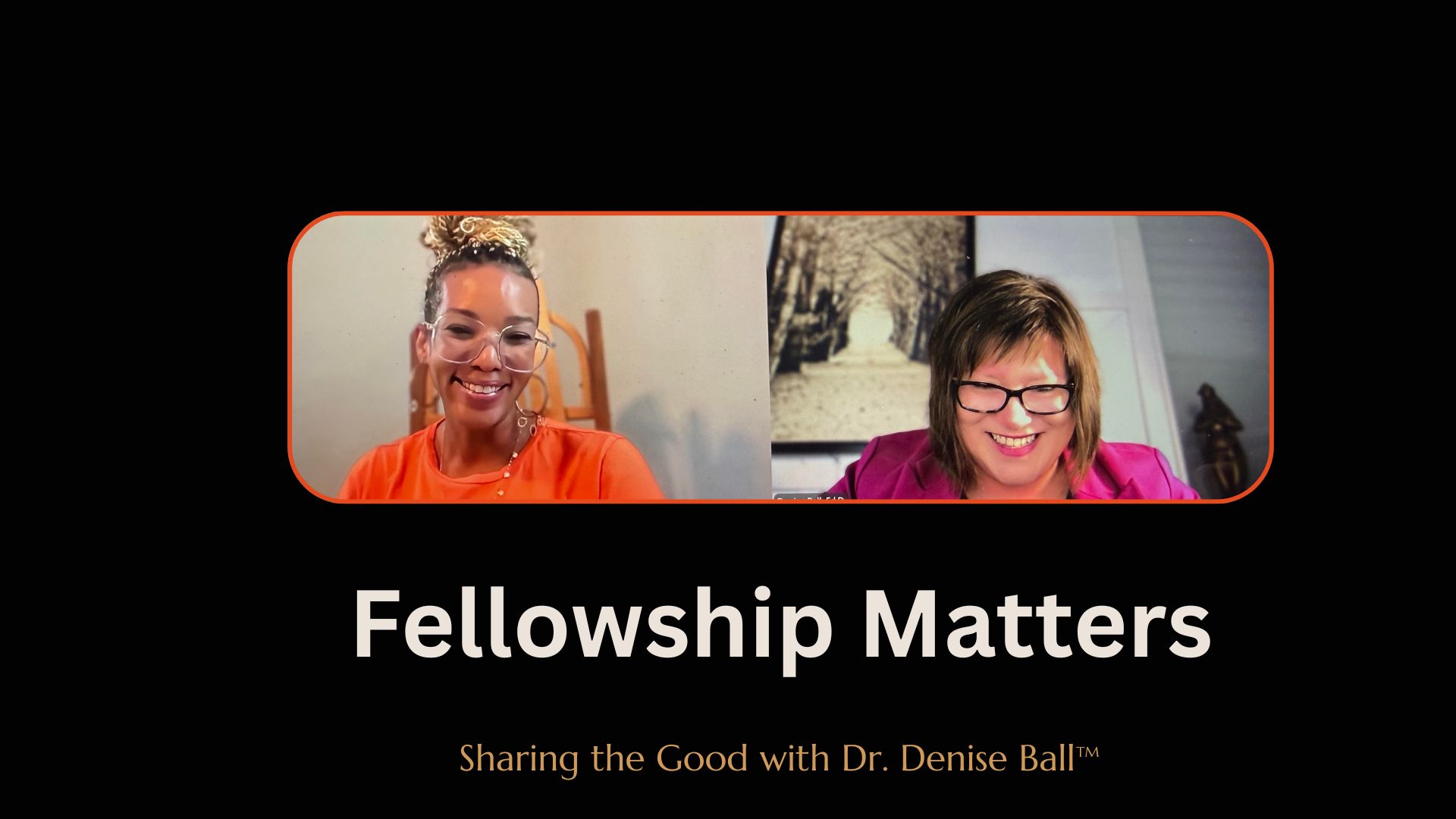
In my recent Sharing the Good with Dr. Denise Ball conversation, Dr. Nicci Dowd offered a beautiful reflection on the gift of fellowship and the importance of walking alongside others in faith, service, and community. Her words were a gentle reminder that fellowship is not simply about being with others. It is about being known, encouraged, strengthened, and reminded that we are not meant to do this work alone. Serving in education is a ministry (Dowd, 2026). [Dr. Nicci Dowd]

Educational leadership can be deeply meaningful, but it can also be lonely. Leaders are often called to hold the vision, solve the problems, support the team, manage the unexpected, and remain steady for others. Research on educational leaders’ well-being reminds us that positive relationships, purpose, engagement, health, and meaning are important dimensions of flourishing in leadership (Doyle Fosco, 2022). In other words, leaders do not thrive by carrying the work alone. They thrive when they are connected to people, purpose, and practices that restore them. Sometimes it might be easier to withdraw during these summer months, but I encourage you to reach out to a colleague or friend you have not talked with in a while and listen, share, and take joy from the fellowship.

Fellowship is one of those restoring gifts. It creates space for honest conversation, shared wisdom, prayerful encouragement, and the quiet reminder that someone else understands the road we are walking. For educational leaders, fellowship may come through a trusted colleague, a mentor, a faith-filled friend, a professional learning community, or a simple summer conversation over coffee. These moments may seem small, but they can become anchors of belonging. My quick and random chat with Nicci today was an instant bucket filler and reminded me of just how important these brief moments of fellowship are to spark inspiration and creativity.

Belonging matters because school communities are relational communities. Research continues to affirm that educator well-being is shaped not only by individual habits, but also by the relational and organizational conditions of the school community (Cann et al., 2022). When educators feel supported, respected, encouraged, and connected to a shared mission, the culture of the school is strengthened. When leaders model that same need for connection, they give others permission to seek support as well.

This is especially important for school leaders who are constantly pouring into others. Emotionally supportive leadership has been linked to educator well-being, especially during seasons of challenge and change (Floman et al., 2023). Leaders who listen, encourage, regulate their own emotions, and offer meaningful support help create healthier school environments. Yet leaders also need spaces where they can receive that same encouragement. Fellowship reminds us that the encourager also needs encouragement.

Summer offers a natural invitation to renew these connections. It is a time to step back from the constant urgency of the school year and ask a few important questions:

Who helped me carry the work this year?

Who might need to hear from me?

Who reminds me of the good?

Who helps me reconnect with faith, purpose, and joy?

Who can I encourage this week?

These questions are simple, but they are powerful. A text message, a phone call, a walk with a friend, a handwritten note, or an invitation to meet for coffee, jump on a quick Zoom (thank you, Nicci) can become a moment of grace. In a profession where so many people give so much of themselves, reaching out is not one more task but an act of caring for ourselves and others.

For those of us called to serve in education, fellowship also strengthens mission. Research on teacher retention highlights the importance of collegial support, trust, shared purpose, recognition, and leadership practices that build relationships within the school community (Ball, 2023 & Lochmiller et al., 2024). When leaders cultivate belonging, they help create communities where people are more likely to feel valued and more willing to remain committed to the work.

I encourage those who serve in education to view the summer not as a retreat from the mission but as preparation to return to it with a renewed heart. We pause so we can listen. We reflect so we can learn. We reconnect so we can remember that the work of education is not meant to be carried out in isolation.

Hebrews reminds us to “rouse one another to love and good works” and to encourage one another (Hebrews 10:24). That encouragement is not accidental but a muscle meant to be practiced. It is a choice and a service to others. It is part of building communities where faith, service, and joy can take root.

So, during these summer weeks, reach out. Call the colleague who lifted your spirit this year. Send a message to the friend who always helps you see the good. Thank the mentor who helped you keep going. Invite someone into conversation. Make room for fellowship. I jam every day on praise and worship. I try to share a link to a song at least once or twice a week with those who come to mind as I pray through song. Please be encouraged to share how you stay connected. This is a blog for learning!

We are better when we walk together…

When we train our eyes to see the good, amazing things happen.

May we continue to seek knowledge in all things,

Denise

References

Cann, R. F., Sinnema, C., Daly, A. J., Rodway, J., & Liou, Y.-H. (2022). The power of school conditions: Individual, relational, and organizational influences on educator wellbeing. Frontiers in Psychology, 13, Article 775614. https://doi.org/10.3389/fpsyg.2022.775614

Doyle Fosco, S. L. (2022). Educational leader wellbeing: A systematic review. Educational Research Review, 37, Article 100487. https://doi.org/10.1016/j.edurev.2022.100487

Floman, J. L., Ponnock, A., Jain, J., & Brackett, M. A. (2023). Emotionally intelligent school leadership predicts educator well-being before and during a crisis. Frontiers in Psychology, 14, Article 1159382. https://doi.org/10.3389/fpsyg.2023.1159382

Lochmiller, C. R., Perrone, F., & Finley, C. (2024). Understanding school leadership’s influence on teacher retention in high-poverty settings: An exploratory study in the U.S. Education Sciences, 14(5), Article 545. https://doi.org/10.3390/educsci140505

Leave a comment

Filed under Summer Strategies for Educational Leaders

What We Build Together: The Power of Collaboration–A Middle School Mindset Initiative

There is a particular kind of energy that comes from meaningful collaboration. The kind that is grounded in shared mission, fueled by trust, and sustained by a deep belief in the work we are called to do.

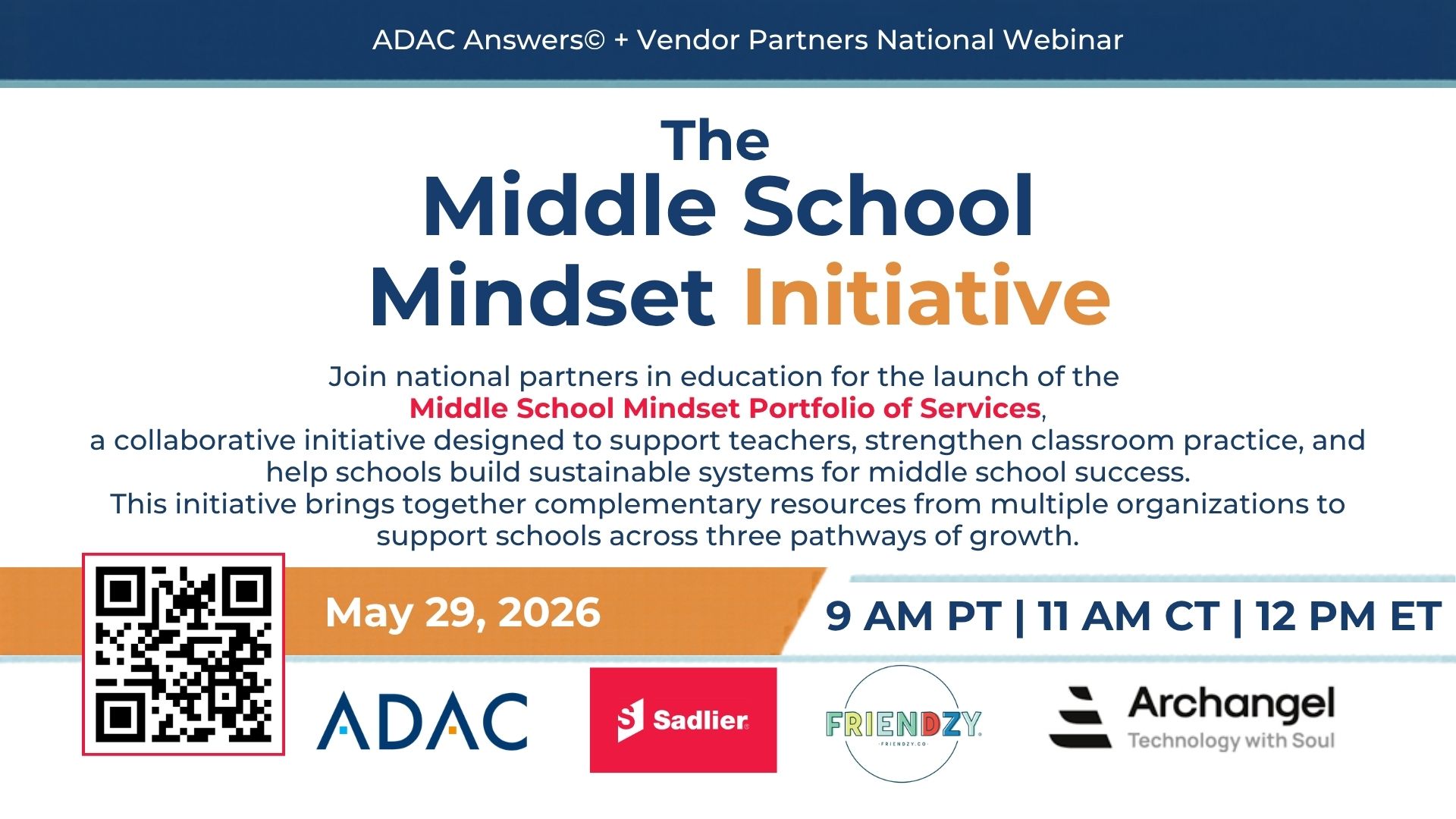
Over the past year, I have had the privilege of working alongside incredible partners to bring the Middle School Mindset Portfolio of Services to life. What began as an idea has grown into something far more powerful than any one organization could have accomplished alone. In just a few short weeks, we will launch this work nationally on May 29.

This moment feels significant, not simply because of the launch itself, but because of what it represents.

A Response to a Critical Moment

Middle school is a pivotal season of formation. It is a time when students are asking deeper questions about identity, belonging, and purpose. It is also a time when educators are navigating increasing complexity like academic recovery, student engagement, and social-emotional needs, all while striving to create classrooms where students feel known and valued.

We cannot meet this moment in isolation.

The Middle School Mindset Portfolio was built in response to that reality. It is not a single program or a one-size-fits-all solution. Rather, it is a collaborative ecosystem designed to support educators with practical strategies, meaningful resources, and a shared commitment to strengthening both instruction and culture.

The Gift of Partnership

One of the greatest joys in this work has been collaborating with mission-aligned partners who bring both expertise and heart to the table.

A special acknowledgment goes to Archangel Education and Technology, whose team is building an innovative digital ecosystem that will no doubt become a destination space for educators and system leaders. Their work reminds us that when technology is designed with purpose, it can truly amplify impact.

Equally inspiring has been our partnership with the Archdiocese of Miami pilot schools. On May 29th, during this complimentary webinar, we will hear directly from middle school teachers who have engaged in this work, educators who are thoughtfully applying strategies, reflecting on practice, and shaping what this portfolio will become at scale.

To visit these vendor partners supporting schools nationwide, please visit:

www.theadac.com | https://friendzy.co/ | https://www.sadlier.com/ | https://arch-te.com/

We can serve students and teachers more when we do it together!

From Research to Practice: Naming What Matters Most

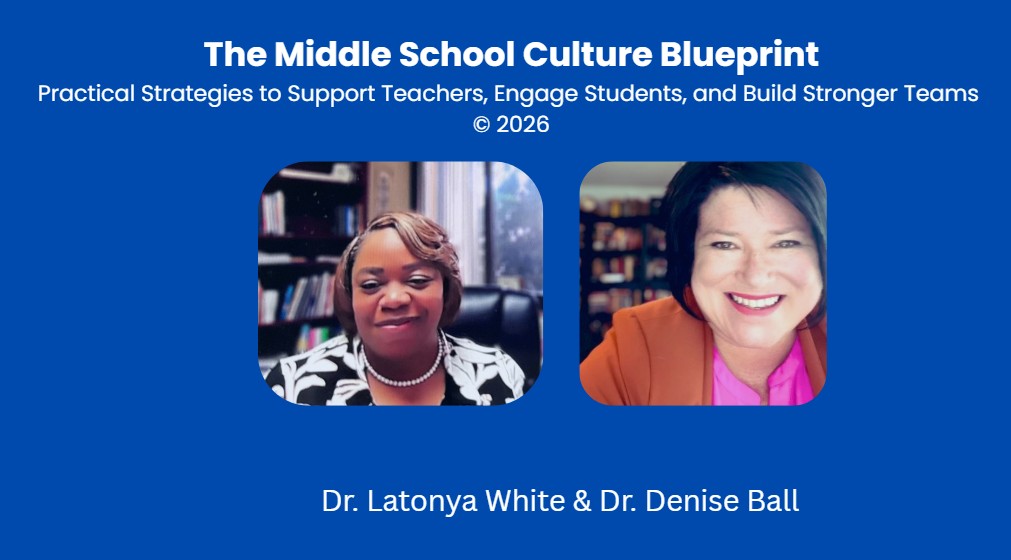
This work has also deepened my ongoing collaboration with Dr. LaTonya White. Together, we are preparing to share our research in the forthcoming Middle School Culture Blueprint (Ball & White, 2026).

At the center of our work is a simple yet deeply impactful reminder: what we reinforce each day becomes the culture we experience, whether by intention or by default.

Middle school culture does not happen by accident. It is shaped in the small, consistent moments: in how we greet students, how we structure learning, how we respond to challenges, and how we create space for student voice. Belonging is not a program we implement. It is a condition we intentionally cultivate through every interaction, every structure, and every expectation (Ball & White, 2026).

When we are intentional, we create environments where students and teachers can thrive. When we are not, culture is still formed, but often in ways that do not serve our mission. The opportunity before us is to lead with clarity, purpose, and hope, and to build cultures where every student and educator knows they are seen, valued, and called to grow.

A Moment of Anticipation

As we look ahead to our national webinar launch on May 29, I am filled with gratitude for the partnerships, for the educators, and for the shared commitment to this work. This is more than a program launch. It is a reflection of what is possible when we come together, listen deeply, and build something that responds to the real needs of our schools. It is a reminder that we are not alone in this work. And… it is an invitation to continue to collaborate, to continue to learn, and to continue to see the good that is unfolding all around us.

The May 29th registration is live (scan the QR code above). Come and join the conversation!

What a privilege it is to serve!

Leave a comment

Filed under Middle School Strategies