
Joy, Belonging, and the Power of Community
A Conversation with Dr. Joy Roberts
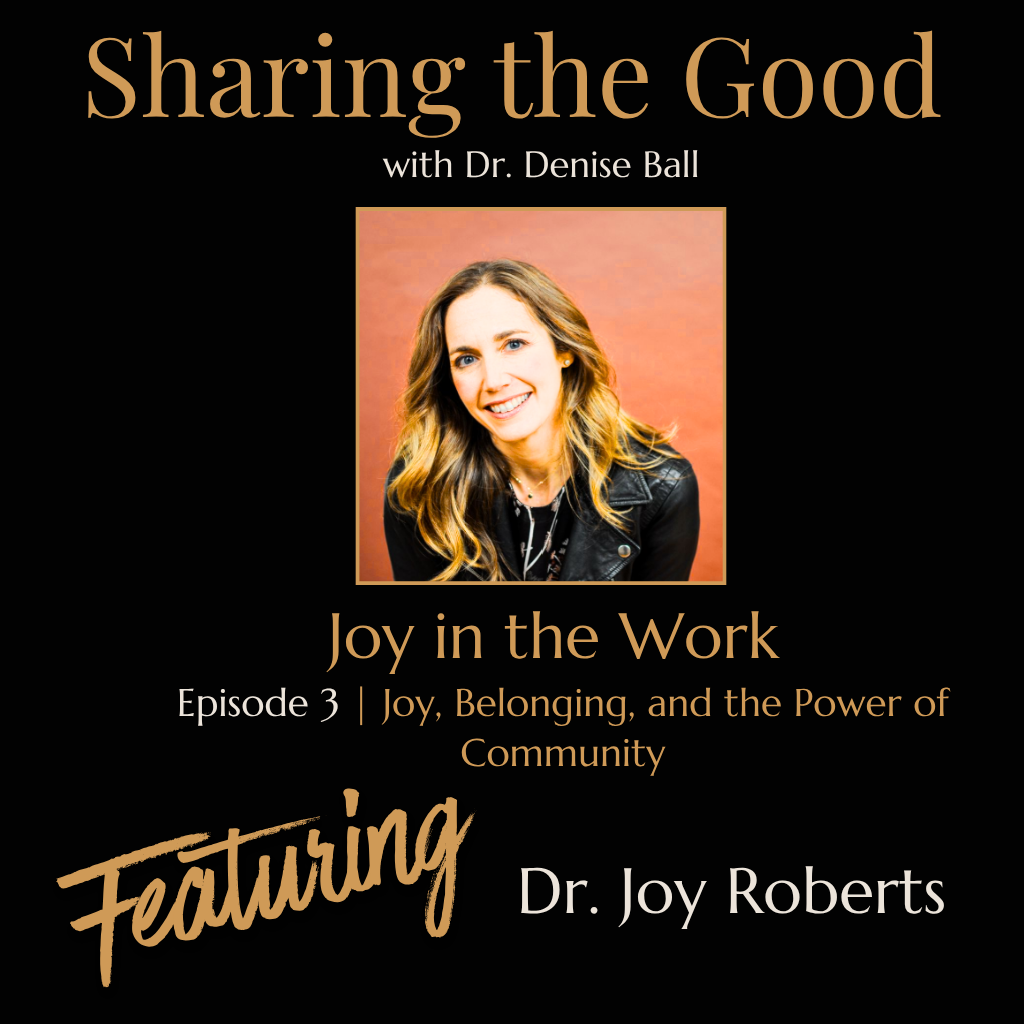
What if one of the greatest sources of joy in our work is knowing that we belong to something larger than ourselves?
That is the question I have been carrying with me since my recent conversation with Dr. Joy Roberts for Episode 3 of the Joy in the Work series.
What a joy it was to welcome Joy to Sharing the Good with Dr. Denise Ball for a wonderful conversation about joy, belonging, relationships, and the power of community.
Joy is the co-founder and president of Friendzy, an organization that partners with schools across the nation and across governance models to help create classroom and school cultures where students and educators experience a strong sense of belonging.
Throughout our conversation, Joy reminded us that strong communities do not happen by accident. They are built through relationships and through the everyday ways we help people know they are seen, valued, and connected.
Belonging Matters
Belonging is a word we hear frequently in education, but I wonder if we sometimes underestimate just how important it is.
At its heart, belonging communicates something profoundly human (Roberts, 2026), conveying I am known here, I am valued here, my presence matters here, and there is a place for me here.
Research gives us good reason to pay attention to these experiences. The Institute of Education Sciences has studied school belonging as part of the social, emotional, and behavioral context for teaching and learning, examining its connections with student engagement, well-being, behavior, and academic outcomes. In one rigorous middle school study involving more than 1,000 students, an intervention designed in part to address students’ concerns about belonging produced a statistically significant improvement in students’ reported social belonging and fewer behavioral referrals overall (Borman et al., 2019).
At the same time, the larger research base reminds us to be thoughtful about our claims. The What Works Clearinghouse’s review of social-belonging interventions found mixed effects on academic achievement. Belonging is not a magic program that guarantees an academic outcome. Rather, it is part of the relational and cultural environment in which learning takes place.
I think the distinction matters. Belonging is not another initiative to add to the school calendar, but is something people experience.
Culture Answers the Question: Do I Belong Here?
Think for a moment about the messages people receive throughout an ordinary school day.
A principal stands at the door and knows a student’s name. A veteran teacher checks on a new colleague. A student is invited into a group. A teacher’s idea is genuinely considered during a faculty meeting. A parent walks into the office and is warmly greeted. Someone notices when a colleague is having a difficult day. A student makes a mistake and discovers that the mistake does not diminish their value within the community.
None of these moments requires a new program, which Dr. Roberts reminds us that educators do not need, yet together, these moments communicate: You are seen, you are valued, you are connected, and you belong! That is culture.
Research on school marginalization offers another important lens. The Institute of Education Sciences has supported research examining how experiences of marginalization relate to student social relationships, engagement, well-being, behavior, and achievement. Importantly, student-teacher and student-peer relationships are among the factors researchers examine when trying to understand these connections.
In other words, relationships are not peripheral to the educational experience, but are part of it.
Belonging Is for the Adults Too
One of my favorite parts of my conversation with Joy was that we did not limit our discussion of belonging to students.
Students absolutely need to know that they belong, but so do teachers, and so do principals. We also cannot forget the importance of belonging is for our instructional assistants, counselors, administrative assistants, maintenance teams, professors, diocesan and system leaders, and everyone else who contributes to the life of a learning community. As someone who has spent much of my research and professional work thinking about school culture and teacher retention, I continue to come back to the importance of the environment in which educators are asked to do their work. We cannot continually ask educators to create communities of belonging for children while paying little attention to whether the adults themselves experience connection, trust, collaboration, and belonging.
Imagine the difference between a teacher thinking: “This is where I work.” and believing: “These are my people. My contribution matters here. We are doing something important together.”
That is a very different experience of work, and perhaps that is where belonging and joy begin to intersect.
We Were Never Meant to Do This Work Alone
Education is deeply relational work. There will always be difficult days. There will be students whose needs challenge us, lessons that do not unfold as planned, difficult conversations, competing priorities, and problems without immediate solutions.
Belonging does not eliminate any of those things. Community does, however, change how we carry them.
There is a profound difference between thinking: “I have to figure this out.” and knowing: “We will figure this out together.” That is the power of community; we learn from one another. In a healthy school culture we encourage, challenge, and celebrate one another! We sometimes carry one another, and need to remind each other why the work matters.
A Thread Through the Joy in the Work Series
As this series continues, I am beginning to see a beautiful thread emerging through these conversations. Dr. Christina Mendez-Hall invited us to Lead with Joy and consider how we choose to enter the work. Dr. Nicci Dowd encouraged us to Make Room for Joy by creating environments where people have permission to learn, make mistakes, collaborate, and grow. This week, Dr. Joy Roberts has invited us to think about joy, belonging, relationships, and the power of community.
Perhaps these ideas are not separate at all. We choose how we show up, and we choose to make room for one another. We build relationships, and through this we create belonging. We discover that we are part of something larger than ourselves, and together, we shape culture!
Belonging Is Built in the Small Moments
Perhaps one of the most encouraging things about belonging is that strengthening it does not always require a large-scale initiative.
It can begin today:
*Learn someone’s name,
*Pull up another chair,
*Ask a colleague what they think…and then LISTEN,
*Invite someone into the conversation,
*Notice who has become quiet,
*Celebrate someone’s contribution,
*Check on the new teacher,
*Listen to the student who needs a few extra minutes,
*Thank the person whose work frequently goes unnoticed, and/or,
*Remind someone that they matter.
These actions may seem small, but small moments, repeated consistently, have a way of becoming culture, and culture has the power to communicate something transformative: You do not have to earn your place here. You are part of us.
A Question I Am Carrying With Me
I am grateful to Joy for generously sharing her wisdom, research, experiences, and JOY.
As I reflect on our conversation, I continue to carry this question: What if one of the greatest sources of joy in our work is knowing that we belong to something larger than ourselves?
To take it one step further, perhaps the question for each of us is: What can I do today to help someone else know that they belong too?
Join the Conversation
Learn more about Friendzy and explore its impact reports by visiting Friendzy.co, including the Competency and Belonging Impact Report.
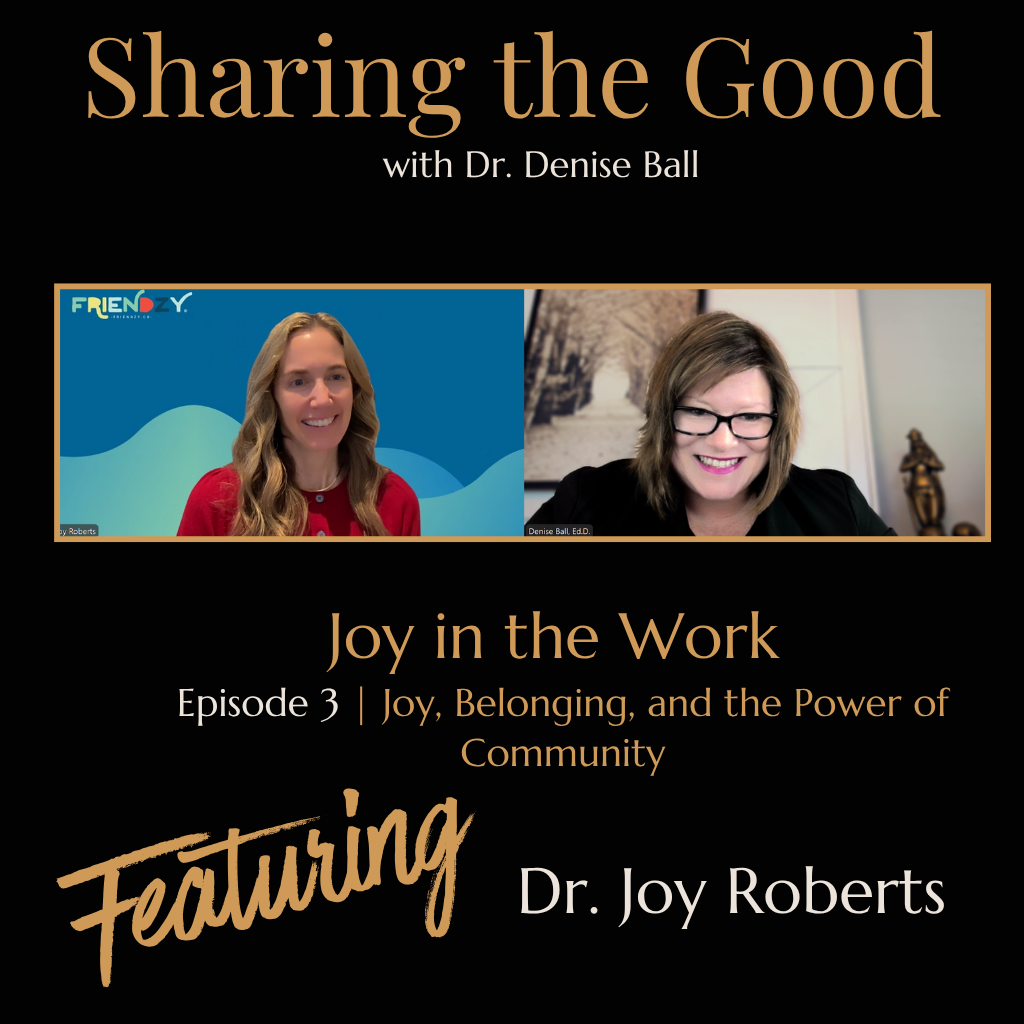
Join the conversation on YouTube:
https://youtu.be/OfkNJkom_rY
Or listen wherever you enjoy your favorite podcasts.
When we train our eyes to see the good, amazing things happen!
May we continue to seek knowledge in all things,
Denise
#SharingTheGood #JoyInTheWork #Belonging #SchoolCulture #SchoolLeadership #CatholicEducation #EducatorJoy #Community #Friendzy
Research and Resources
Borman, G. D., Rozek, C. S., Pyne, J., & Hanselman, P. (2019). Reappraising academic and social adversity improves middle school students’ academic achievement, behavior, and well-being. Proceedings of the National Academy of Sciences, 116(33), 16286–16291.
Institute of Education Sciences, What Works Clearinghouse. (2021). Social Belonging Interventions: Intervention Report. U.S. Department of Education.
Institute of Education Sciences. School-Based Marginalization, Social Behavioral Competencies, and Achievement: A Meta-Analysis. National Center for Education Research.


