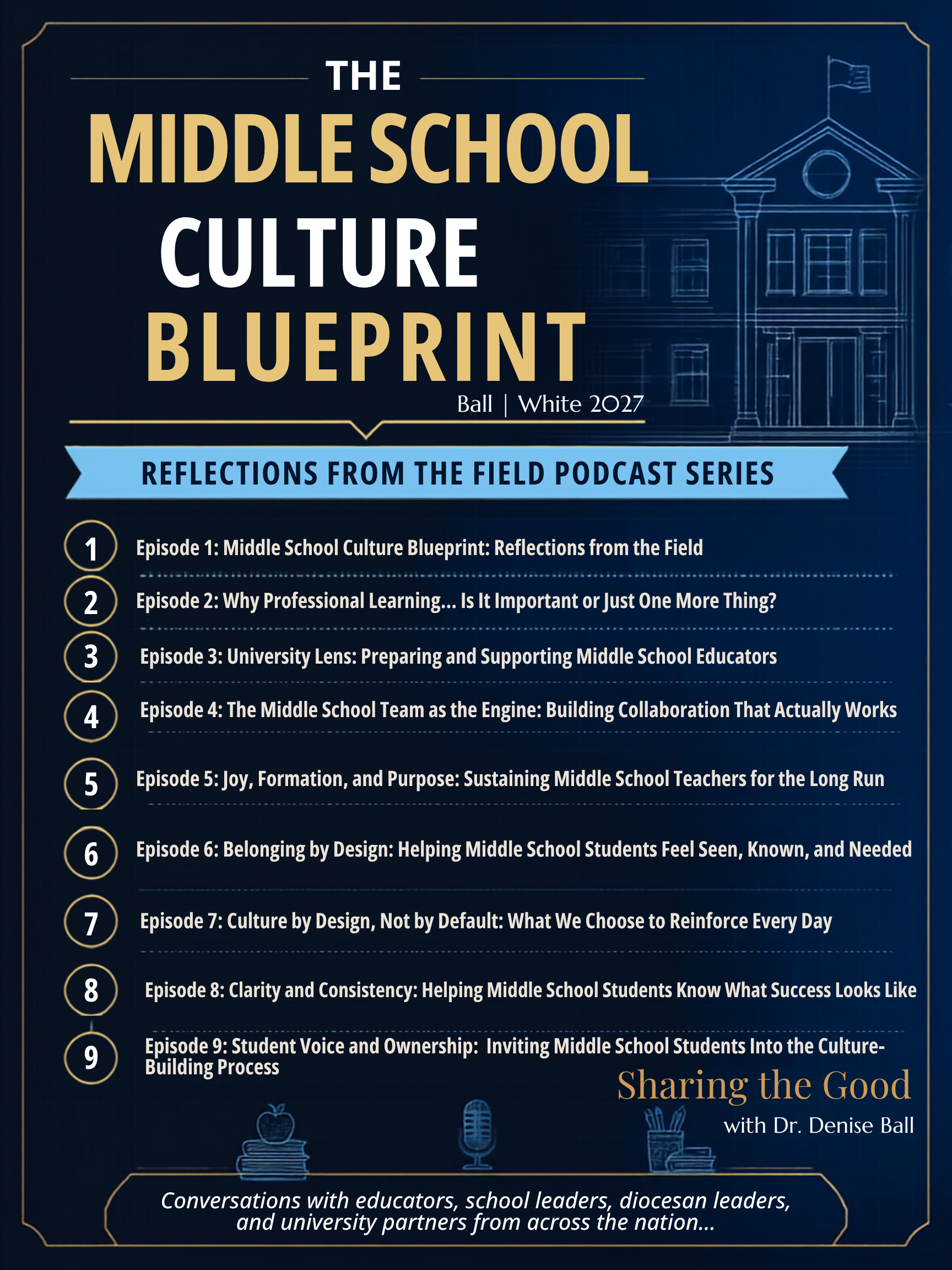
Category Archives: The Middle School Culture-Reflections from the Field Series

Protecting the JOY: Sustaining the Educators Who Serve Our Students

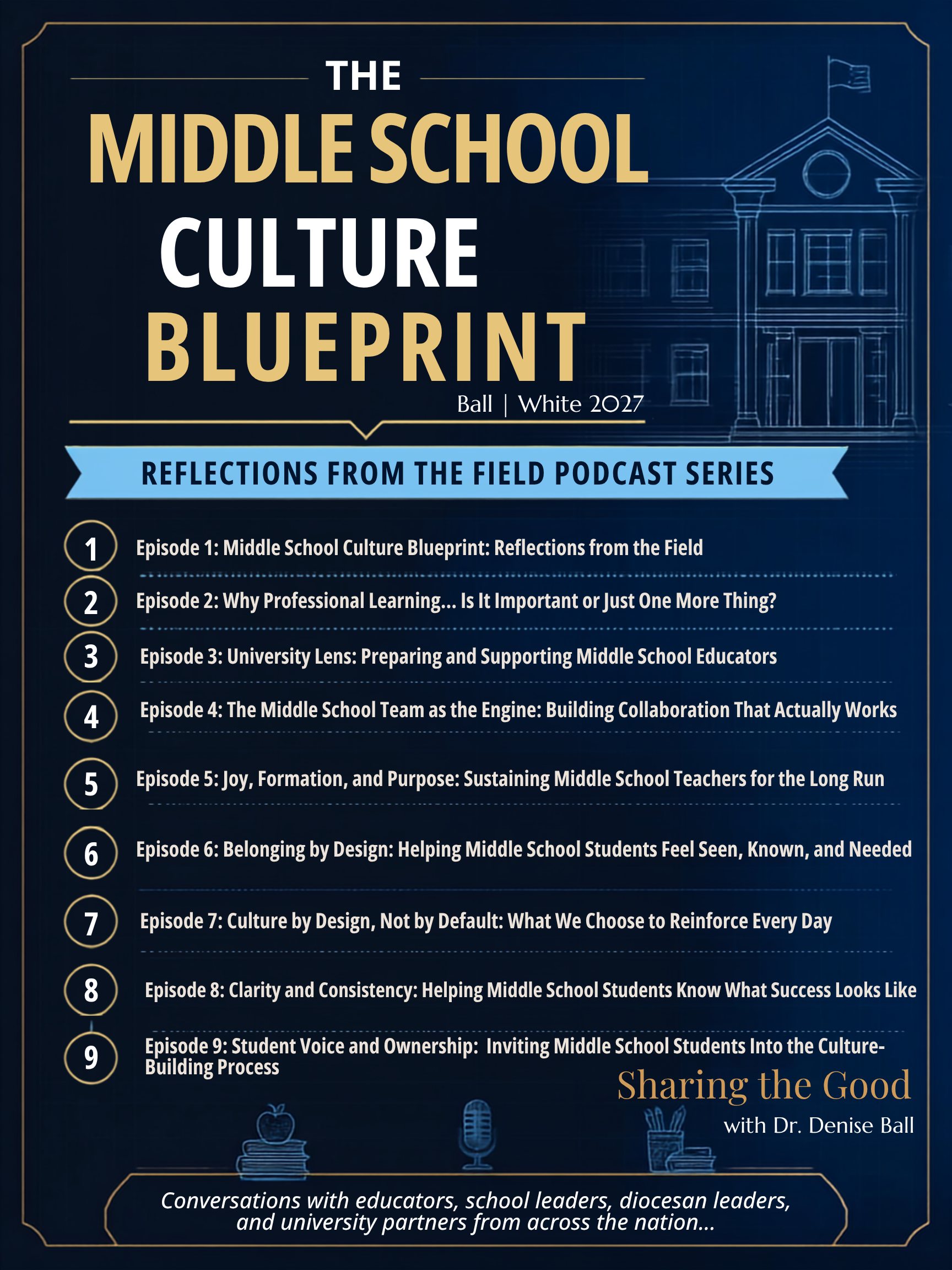
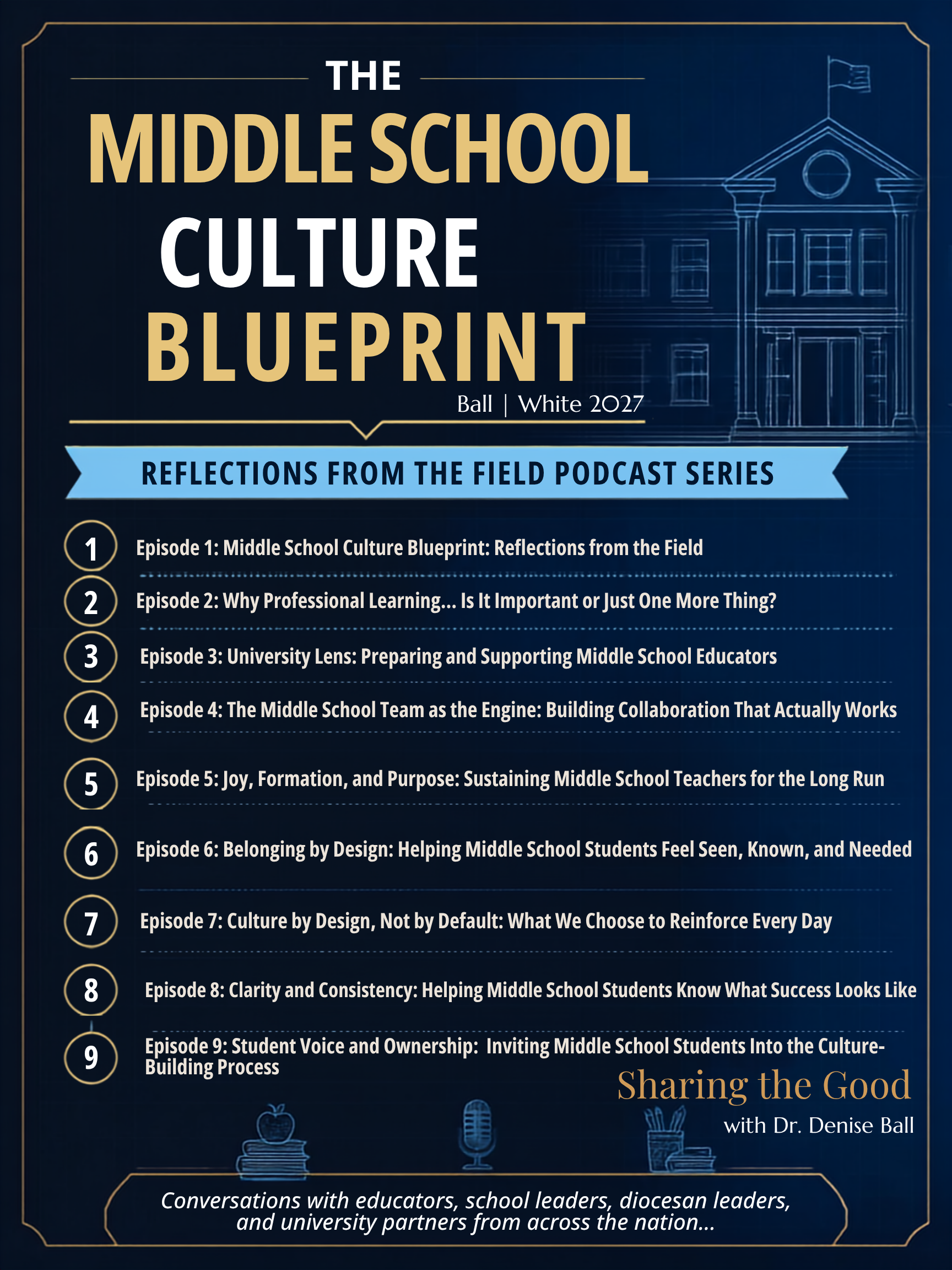
The Middle School Culture Blueprint: Reflections from the Field | Episode 5
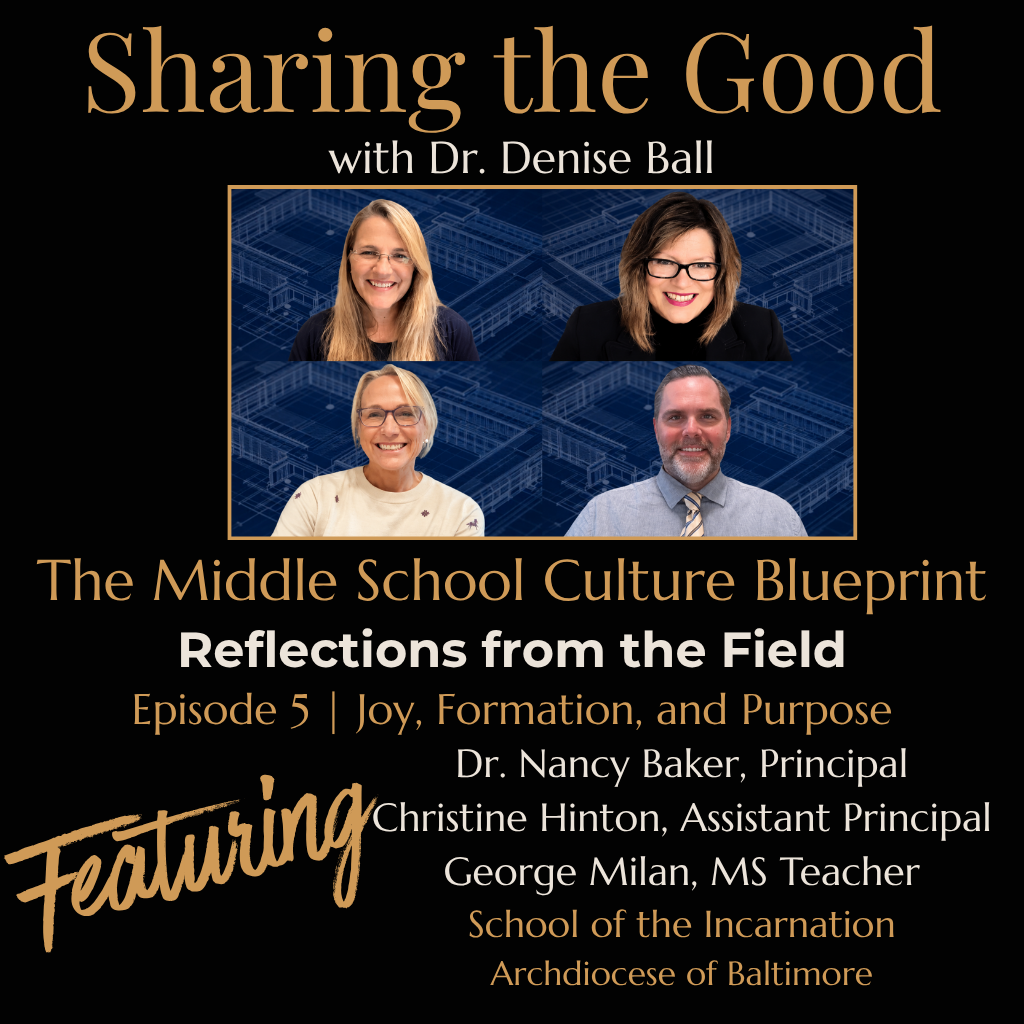
There is so much good happening within our Catholic schools, and one of the greatest privileges of my work is having the opportunity to share it! On this Thankful Thursday, I am especially grateful for three wonderful educators from School of the Incarnation in the Archdiocese of Baltimore who joined me for Episode 5 of The Middle School Culture Blueprint: Reflections from the Field.

Dr. Nancy Baker, Principal; Christine Hinton, Assistant Principal; and George Milan, Middle School Teacher, generously shared their experiences and perspectives on a topic that is increasingly important to our profession: sustaining the JOY, formation, and purpose of the educators who serve our students and families. What an inspiring conversation!

Protecting JOY Is a Leadership Responsibility

One of the most meaningful takeaways from our conversation was Dr. Baker’s reminder that school leaders must intentionally support balance among their faculty and staff. Think about that for a moment. Our educators enter the school year with enthusiasm, carefully developed plans, professional goals, and a genuine commitment to their students. Yet, even the most prepared teams will encounter unexpected challenges, competing priorities, and the inevitable demands of school life. If we want educators to sustain their JOY throughout the school year, we must recognize their need for balance and renewal.

Supporting educator well-being cannot be reduced to an occasional celebration or another initiative. It requires leaders to pay attention to the daily experiences of the people entrusted to their care. Are we protecting their time? Are we recognizing their contributions? Are we providing opportunities for renewal? Are we creating an environment where they can continue to grow personally, professionally, and spiritually? These are important leadership questions.

Our educators give so much of themselves to their students and families. We must be equally intentional about creating the conditions that sustain them.

Trust Is the Foundation of a Strong Team

Christine Hinton brought another essential perspective to our conversation: the importance of establishing and maintaining trust. I appreciated her emphasis on this fundamental element of school culture. Trust is not established through a single conversation, meeting, or professional development experience, but it is developed through our everyday interactions, the consistency of our actions, and our willingness to support one another. School leaders have countless opportunities to strengthen trust through their daily presence, communication, and relationships, and the small moments matter!

Checking in with a teacher after a challenging day, listening before responding, providing clarity during uncertainty, and recognizing the professional expertise of our colleagues are all meaningful ways to strengthen the adult culture of our schools. Trust allows teams to collaborate, navigate challenges, and remain focused on their shared mission. It also reminds us that our teachers need to experience the same sense of belonging that we work so intentionally to create for our students.

Never Underestimate the Power of Humor!

…and then there is George Milan! As a veteran middle school teacher, George reminded us of something I absolutely love, and that is the importance of humor in the classroom.

Middle school is a wonderfully unique developmental season. Our students are growing academically, socially, emotionally, and spiritually. Every day presents opportunities to build relationships, navigate unexpected moments, and celebrate the remarkable young people entrusted to our care. Sometimes, laughter is exactly what we need! Try that on today…

Humor can create connection, strengthen relationships, and help us navigate the unexpected moments that are inevitably part of teaching middle school students. I appreciate this reminder because JOY does not mean every day will be easy. It means we can find moments of gratitude, connection, and purpose even when the work becomes challenging. Imagine the impact on students when they experience classrooms where educators genuinely enjoy teaching and learning alongside them. Our adult culture matters because students experience it every single day.

Connecting the Conversation to The Middle School Culture Blueprint

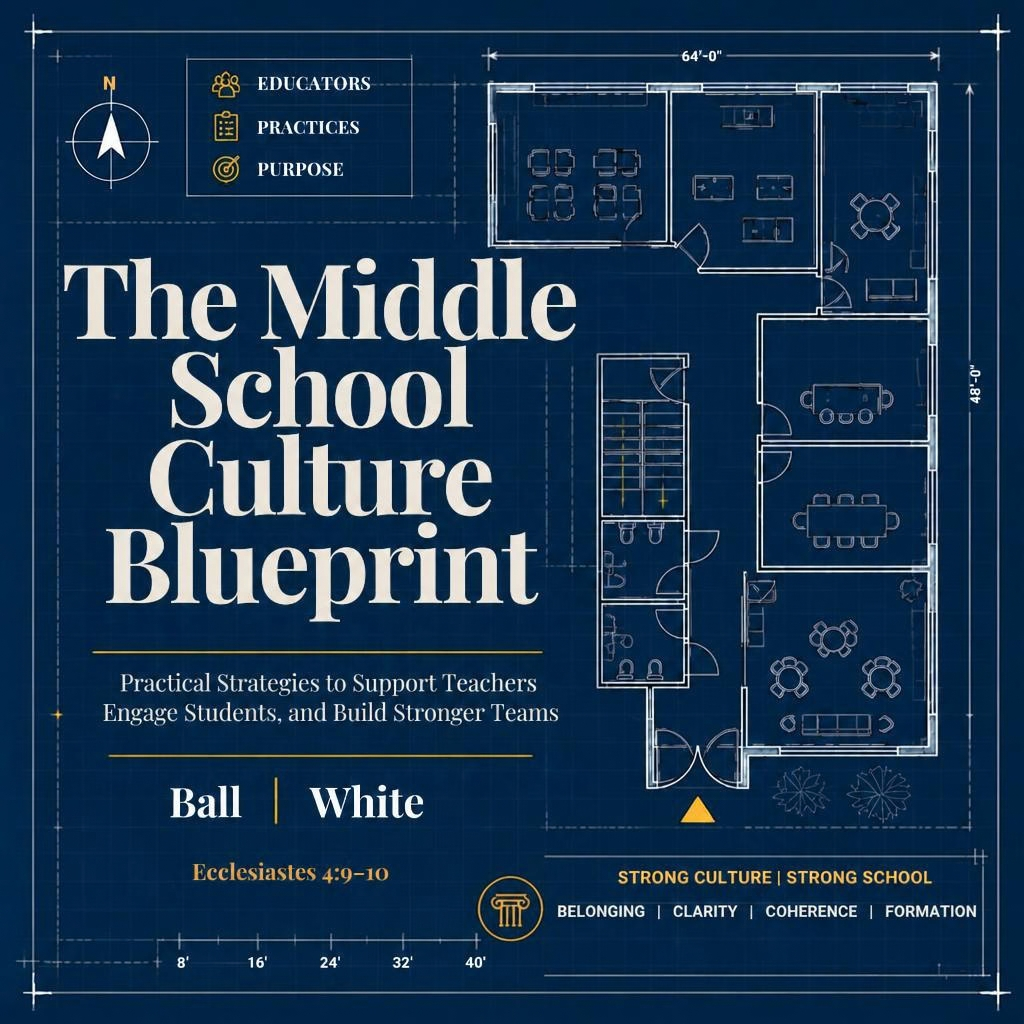
As Dr. LaTonya White and I continue developing The Middle School Culture Blueprint for publication with the National Catholic Educational Association, conversations like this reinforce the importance of our four interconnected pillars:

Belonging: Educators need to know they are seen, valued, respected, and supported as members of their school community.

Clarity: Clear expectations, meaningful communication, and a shared understanding of priorities help educators navigate the demands of their work.

Coherence: When leadership practices, professional learning, and schoolwide priorities are aligned, educators can devote more energy to the work that matters most.

Formation: Our teachers deserve opportunities to continue growing professionally, personally, relationally, and spiritually throughout their careers.

These pillars are not exclusively about students. They are equally important to the adults responsible for creating and sustaining a positive school culture.

If we want our middle school students to thrive, we must also create school cultures where our educators can thrive.
A Thankful Thursday Reflection

As we settle into the rhythm of another school year, I encourage school leaders to consider a few important questions. Are we paying attention to the well-being of our faculty and staff? Are we intentionally building trust among our teams? Are we creating opportunities for laughter, celebration, and meaningful connection? And perhaps most importantly, are we ensuring that our educators know how much we value their service?

Our educators are highly educated professionals who have chosen a meaningful vocation. Their knowledge, experience, commitment, and daily sacrifices deserve our recognition and respect.

We need to SEE them, RESPECT them, SUPPORT them, and THANK them.

I am incredibly grateful to Dr. Nancy Baker, Christine Hinton, and George Milan for freely giving their time to participate in this conversation and contribute their reflections from the field. Their willingness to share their experiences is a gift to our profession.

There is tremendous power in educators learning from educators. On this Thankful Thursday, may we remember that protecting JOY is not an additional task on our already full schedules. It is an essential part of creating and sustaining the school cultures we desire for our students, families, and colleagues.

Let’s continue to see the good, share the good, and create school cultures where everyone can flourish!

I choose JOY!

Denise


Watch Episode 5: Joy, Formation, and Purpose

https://rss.com/podcasts/sharing-the-good-with-dr-denise-ball/3199282

The Middle School Culture Blueprint, coauthored by Dr. Denise M. Ball and Dr. LaTonya White, is forthcoming from the National Catholic Educational Association in spring 2027.
Leave a comment

Filed under Sharing the Good with Dr. Denise Ball, The Middle School Culture-Reflections from the Field Series

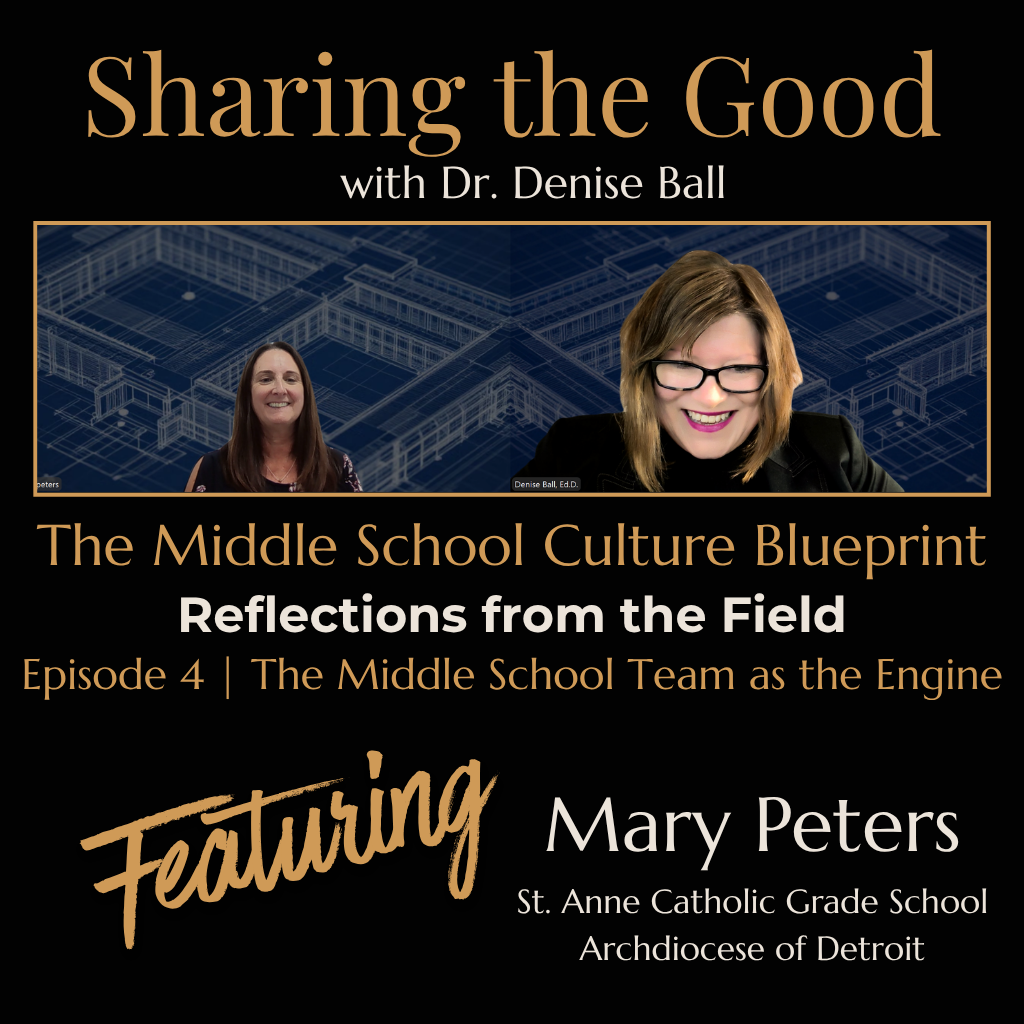
The Middle School Team as the Engine: Building Collaboration That Actually Works 

Middle school students may move through several classrooms and interact with several teachers during a single school day, but they do not experience those classrooms in isolation. Together, those interactions shape a student’s understanding of school culture.

That idea was at the heart of Episode 4 of The Middle School Culture Blueprint: Reflections from the Field. I was blessed to welcome Mary Peters, a veteran middle school educator at St. Anne Catholic Grade School in the Archdiocese of Detroit, for a conversation about what happens when middle school educators intentionally begin thinking and working as a team.

Mary shared a wonderfully practical example from her school: a common middle school assessment template centered on Claim, Evidence, Reasoning (CER). Teachers across the middle school use this common framework when assessing student learning. Think about what that can mean for a young adolescent moving from one content area to another. The subject matter changes, the teacher changes, and the learning experience changes. However, there is a familiar framework helping the student understand how to communicate thinking and demonstrate learning. This is so powerful! That is coherence, a Middle School Culture Blueprint pillar in action.

It is also an important reminder that consistency does not require uniformity. We do not want every teacher or classroom to look exactly the same. Great educators bring their own gifts, personalities, content expertise, and creativity to their classrooms. Shared frameworks can provide enough clarity and consistency to help students successfully navigate those different environments.

Mary also shared that this year her middle school team is meeting monthly as a professional learning community )PLC), with a shared middle school vision serving as a focus for their work. I love the intentionality behind this practice. A vision should not simply be words written on a document. It can become a framework for conversation: Who are we as a middle school? What do we want our students to experience? What do we believe about teaching and learning? Where do we need greater consistency, and how can we better support one another?

As Dr. LaTonya White and I continue developing The Middle School Culture Blueprint, our work is framed around four interconnected pillars: Belonging, Clarity, Coherence, and Formation.

Mary reflected during our conversation that all four are essential to creating and maintaining a positive school culture. I think her examples demonstrate why. Belonging reminds us that students and adults need to know they are seen, valued, and part of a community. Clarity helps everyone understand expectations and what success looks like. Coherence connects classrooms, practices, language, and expectations so that students experience a community rather than a collection of unrelated classrooms. Formation recognizes that we are continually helping students, and one another, grow academically, professionally, personally, and spiritually. One of the most important lessons from this conversation is that building a strong middle school culture does not always require another large initiative. Sometimes it begins with a shared assessment framework. A monthly conversation. A common expectation. A team willing to ask, “What do we want our students to experience, and educators willing to move from “my students” to “our students.”

When middle school teachers work as a true team, collaboration becomes more than another meeting on the calendar. It becomes part of the culture. When Belonging, Clarity, Coherence, and Formation begin working together, we create environments where both students and educators have greater opportunities to thrive!

Thank you to Mary Peters for sharing the wisdom that comes from years of serving middle school students and to my co-author, Dr. LaTonya White, for continuing this important work alongside me.

There is so much good happening in our Catholic schools. Let’s continue to see it, learn from it, and share it.

All are welcome to join the conversation:

Sharing the Good with Dr. Denise Ball YouTube Channel

Sharing the Good with Dr. Denise Ball on Spotify

May we continue to seek knowledge in all things,

Denise

Leave a comment

Filed under Sharing the Good with Dr. Denise Ball, The Middle School Culture-Reflections from the Field Series

Through a University Lens: Preparing and Supporting Middle School Educators

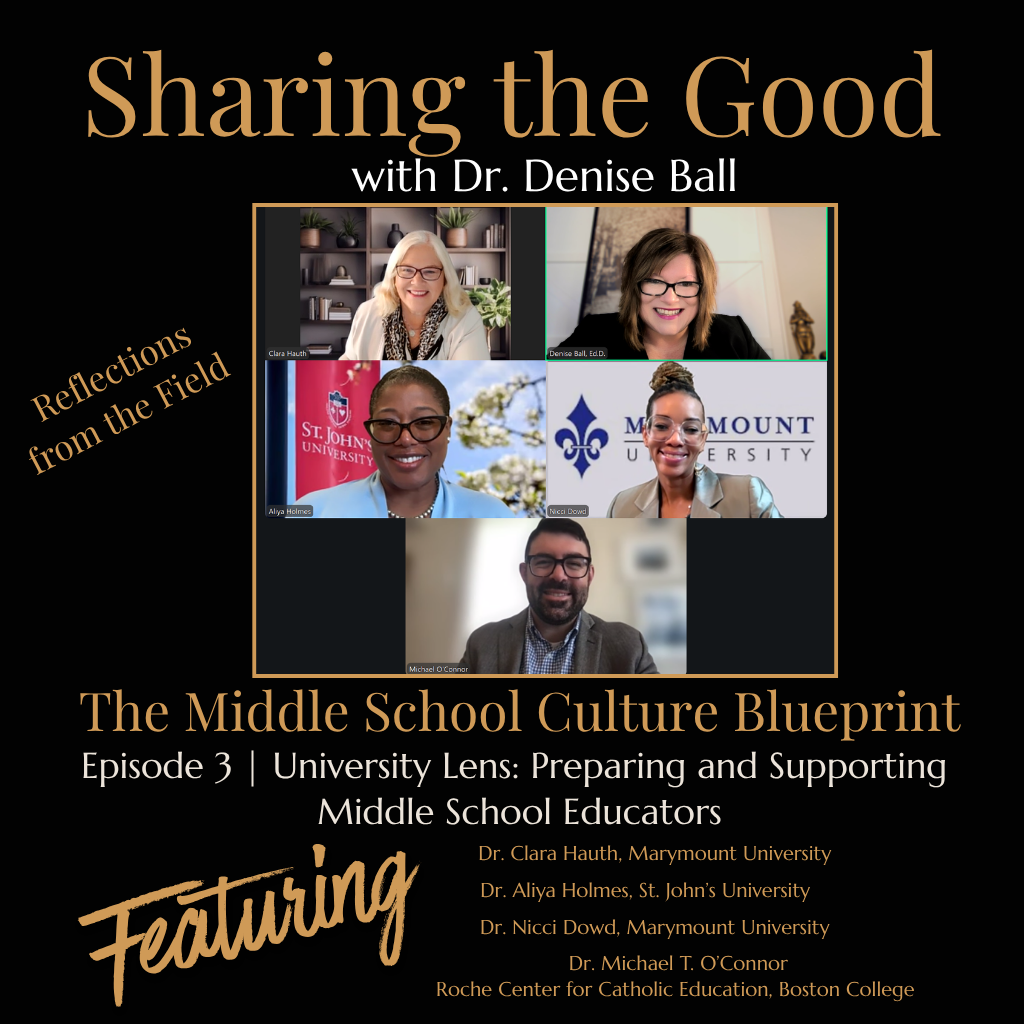
There was something particularly meaningful about Episode 3 of The Middle School Culture Blueprint: Reflections from the Field. Four university leaders, representing the Roche Center for Catholic Education, Boston College, Marymount University, and St. John’s University, came together around a shared question:

How can universities better prepare, support, and walk alongside the educators and leaders serving our Catholic schools?

Dr. Michael O’Connor, Dr. Nicci Dowd, Dr. Aliya Holmes, and Dr. Clara Hauth each brought a different lens to the conversation, including professional learning, teacher preparation, innovation and partnership, and educational leadership. Yet throughout the discussion, a common message emerged. Higher education has an important opportunity not simply to prepare people before they enter schools, but to remain connected to the field, listen to its needs, and continue learning alongside the educators doing the work each day.

The Middle School Culture Blueprint: Reflections from the Field

Episode 3 | University Lens: Preparing and Supporting Middle School Educators

That spirit of partnership matters! Our teachers and school leaders are navigating increasingly complex responsibilities while remaining focused on the students and families entrusted to their care. Universities can be important partners in that work through relevant professional learning, leadership development, research, teacher preparation, and meaningful school-university partnerships. The strongest partnerships, however, are not built around universities deciding what schools need. They begin with listening. They invite practitioners into the conversation, connect research with classroom realities, and recognize that knowledge flows in both directions. Universities have much to offer schools, but schools also have much to teach universities.

Perhaps the most powerful moment came as each panelist offered a final word of encouragement to educators. Dr. Michael O’Connor reminded them, “You are not alone. Lean on Christ and those in your orbit.” Dr. Nicci Dowd encouraged educators to “Design for possibilities, not limitations.” Dr. Aliya Holmes reminded us to lean on God and community and to recognize the importance of the small things. Dr. Clara Hauth encouraged educators to “Give yourself grace, and ask questions…advocate for yourself and others.” Different words, yet a common thread that community, relationships, and formation all essential, and that none of us was meant to do this important work alone.

As Dr. LaTonya White and I continue preparing The Middle School Culture Blueprint for publication with the National Catholic Educational Association in spring 2027, I am increasingly grateful for the voices entering these Reflections from the Field conversations. Teachers, principals, diocesan leaders, pastors, and university colleagues are reminding us that strong middle school cultures are built when people are willing to listen, share what they have learned, and contribute their gifts for the good of others.

Michael, Nicci, Aliya, and Clara are blessings to the universities they serve, and their willingness to invest in the formation and support of educators is a beautiful example of educational community in action. This is what it looks like when we stop thinking in silos and begin asking what we can accomplish together!

Please be encouraged to listen, engage, and join the conversation.

We can do more–together!

May we continue to seek knowledge in all things,

Denise

Denise Ball, Ed.D.

Retired Catholic Education Leader | Author | Researcher | Consultant
Marymount University | Assistant Professor

Join the conversation

LinkedIn: linkedin.com/in/deniseballedu 

Instagram: deniseball_edu

YouTube: www.youtube.com/@SharingTheGoodwithDrDeniseBall

Facebook: https://www.facebook.com/SharingTheGoodWithDrDeniseBall

Blog: www.unlocktheteacher.org

Sharing the Good is also available wherever podcasts are enjoyed!

Leave a comment

Filed under The Middle School Culture-Reflections from the Field Series

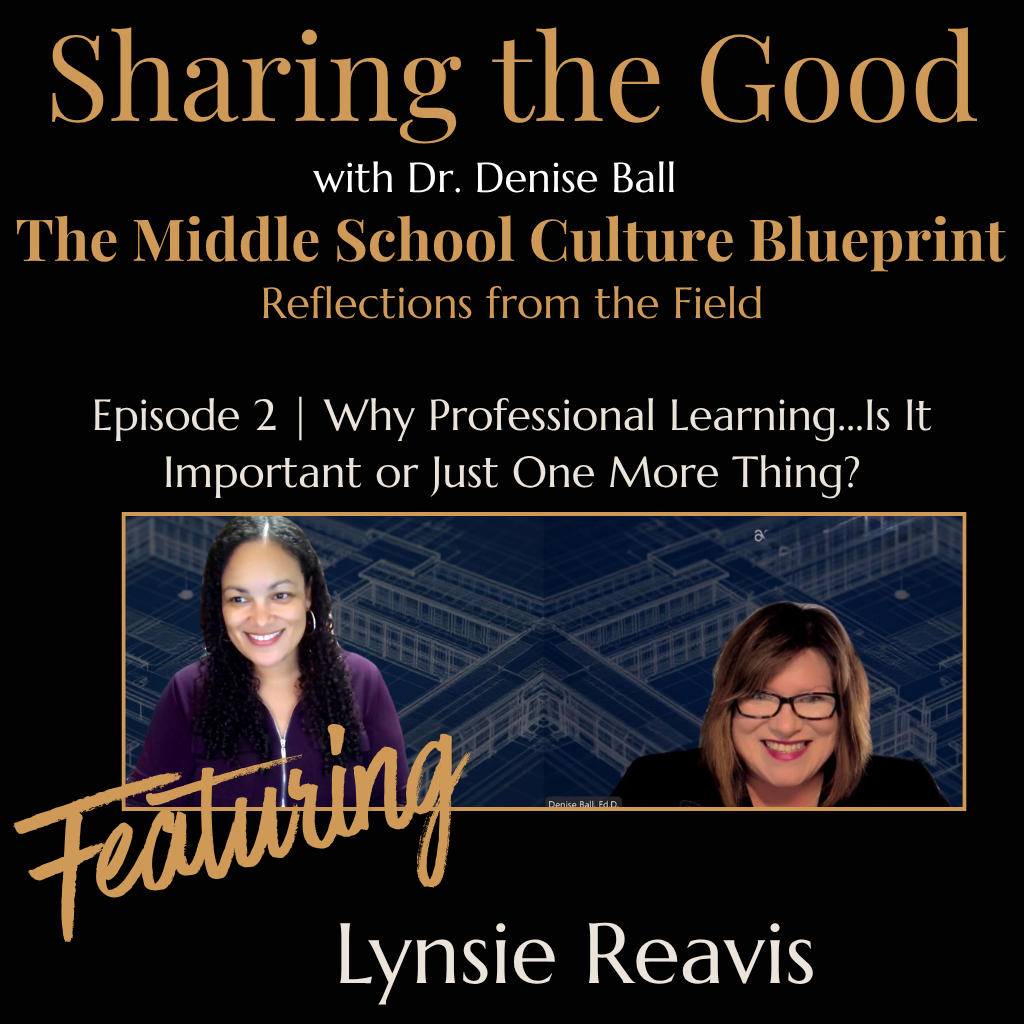
Why Professional Learning…Is it Important or Just One More Thing?

Professional learning is intended to help educators grow, strengthen their practice, and ultimately better serve students. Yet for teachers carrying increasingly full plates, even well-intentioned professional learning can sometimes feel like “one more thing.” That tension became the starting point for Episode 2 of The Middle School Culture Blueprint: Reflections from the Field, where I had the opportunity to talk with Lynsie Reavis, Director for Educational Programs for the Archdiocese of Washington. Our conversation offered an important reminder for those of us who lead and design professional learning: honoring teachers’ time, capacity, and experience must be part of the planning process.

One of Lynsie’s recommendations was beautifully practical…to choose one or two meaningful initiatives each year and avoid exceeding three. Teachers wear many hats, and meaningful implementation requires time. Rather than expecting every educator to embrace a new initiative at the same pace, Lynsie encouraged leaders to begin with those who are ready and willing. These educators can become “initiative ambassadors,” sharing authentically with colleagues how a new practice is influencing teaching and learning. Growth can often spread more effectively through trusted relationships and visible impact than through another mandate. That same relational approach shaped Lynsie’s own middle school teaching. She spoke about creating challenges and friendly competition to make learning collaborative and enjoyable and reflected on the familiar instructional progression of “I do, we do, you do.”

Our conversation also reinforced how professional learning can strengthen the culture of an entire middle school. Lynsie emphasized giving teams time to develop shared expectations around practices such as weekly assessment schedules, bell work, and family communication. These conversations require compromise, openness, and time, but the resulting coherence matters. Middle school students move among multiple teachers and classrooms each day, and, as Lynsie reminded us, they are always watching the dynamics and structures around them. Greater consistency among adults can create greater clarity and security for students. Professional learning, then, becomes more than the transfer of information. It becomes an opportunity to strengthen relationships, shared language, teamwork, and culture.

Click HERE to listen to episode 2 and available anywhere podcasts are enjoyed.

For educators interested in exploring this area further, Deans for Impact’s free The Science of Learning resource offers an accessible, research-informed look at how cognitive science can inform everyday instructional decisions. 

https://www.deansforimpact.org/files/assets/thescienceoflearning.pdf?

Perhaps one of the most important themes of our discussion was reflection. Lynsie highlighted brain-based teaching and learning and reminded us that the instructional decisions educators make influence how students experience and process learning. That makes reflection essential, not optional. As Dr. LaTonya White and I continue our work on The Middle School Culture Blueprint (NCEA, 2027), these conversations continue to reinforce the interconnected nature of Belonging, Clarity, Coherence, and Formation, our middle school culture blueprint. Professional learning can contribute to each of these pillars when it is thoughtful, relevant, and connected to the actual work of teachers. And through all of the strategies, structures, initiatives, and demands of education, Lynsie left us with a simple reminder worth carrying with us, “Always remember your why!”

May we continue to seek knowledge in all things,

Denise

Denise M. Ball, Ed.D.

Retired Catholic Education Leader | Author | Researcher | Consultant

Assistant Professor | Marymount University

Join the conversation

LinkedIn: linkedin.com/in/deniseballedu 

Instagram: deniseball_edu

YouTube: www.youtube.com/@SharingTheGoodwithDrDeniseBall

Facebook: https://www.facebook.com/SharingTheGoodWithDrDeniseBall

Blog: www.unlocktheteacher.org

Leave a comment

Filed under The Middle School Culture-Reflections from the Field Series