Category Archives: Sharing the Good

JOY of the Work- A Conversation with Dr. Anita Harkins-Mehsling

As we bring our three-part summer series, Belonging, School Culture, and the Joy of the Work, to a close, I find myself filled with gratitude.
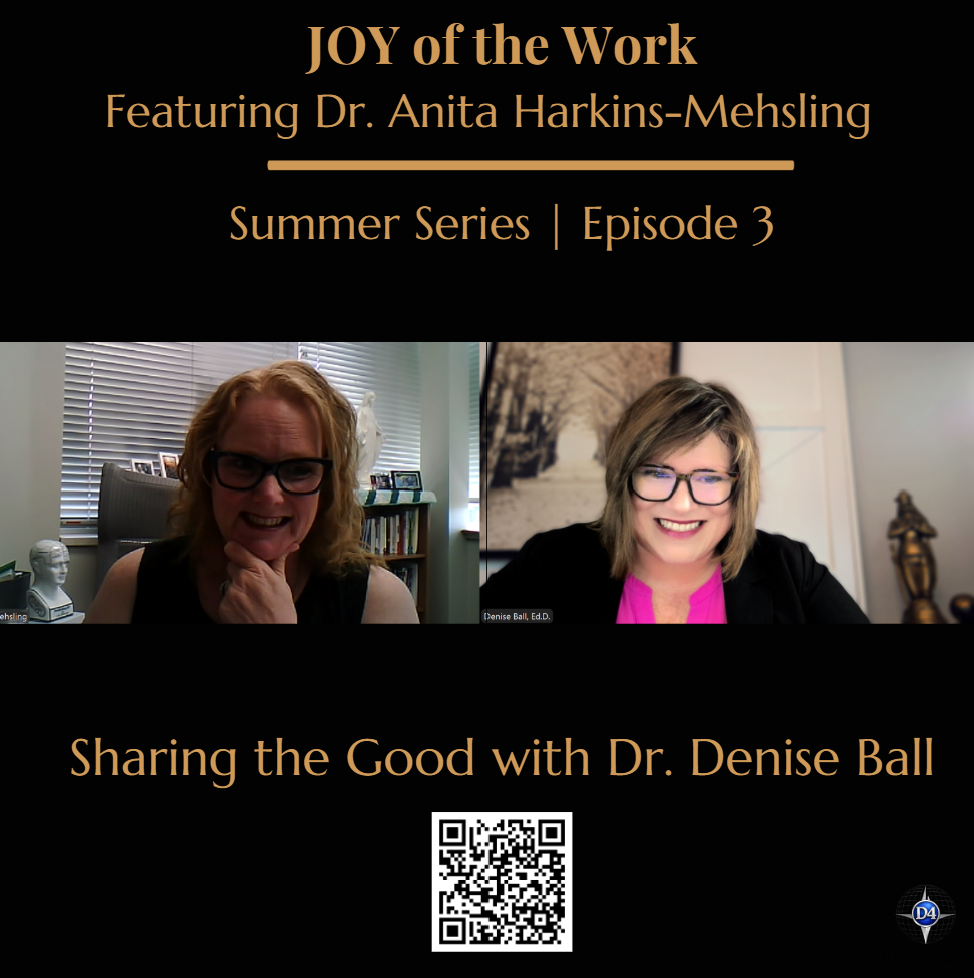
I am deeply grateful to Dr. Anita Harkins-Mehsling for generously sharing her research, leadership experience, wisdom, and heart throughout these conversations. Anita helped us pause and consider what it truly means for people to experience belonging within a school community.

Belonging is more than entering a building, attending a meeting, or being included on a faculty list. It is the experience of being seen, known, valued, supported, and connected to something meaningful.

Throughout this series, Anita reminded us that belonging does not happen by accident. It is cultivated through INTENTIONAL leadership, authentic listening, trust, communication, presence, and relationships.

In our first conversation, we explored why belonging matters, and in our second, we reflected on the important role leaders play in creating and sustaining cultures where people feel welcome, heard, and valued. In our final conversation, we connected belonging to joy, teacher retention, school stability, and the overall health of a school community. It felt especially important to end this series with joy.

Joy is not an extra benefit of a healthy school culture. Joy is part of what helps sustain the people who serve within it. Joy is synergistic! Joy does not mean that every day is easy. It does not mean that challenges disappear, difficult conversations are avoided, or the demands of leadership become lighter.

A joyful school community is not a perfect school community.

It is a community where people continue to notice the good, name the good, and carry the good forward together, even during demanding seasons. Joy grows when people know they are not alone. As a school team, exercising the muscle of gratitude can be transformational!

Joy within a school community grows when faculty and staff feel connected to one another and to the school’s mission. It becomes visible when people are encouraged to share their gifts, when contributions are recognized, and when leaders create space for gratitude, celebration, reflection, and genuine connection.

Joy is strengthened when it is shared. This is why I believe joy must be more than something we hope people eventually experience. Joy can become the first step we use in leading others.

Before beginning with the agenda, we can begin by seeing the people in front of us. Before moving immediately to the next task, we can pause to recognize someone’s contribution. Before focusing only on what needs to be corrected, completed, or improved, we can name what is already good and growing. Before assuming the worst, we can choose to see through the eyes of grace. Leading with joy does not ignore reality. It helps us face reality with hope, gratitude, courage, and a renewed sense of purpose.

As leaders prepare for the 2026-27 school year, there will be calendars to finalize, meetings to plan, classrooms to prepare, new employees to welcome, and many decisions to make. Within all of that important work, we can also ask:

How will people experience belonging here? [a leadership opportunity]

How will faculty and staff know they are valued? [essential building block for trust]

How will we listen to one another? [a powerful visual that you are being present]

How will we help new members of the community feel supported? [essential reflection question]

How will we keep joy visible when the year becomes busy? [because it will]

How will we notice and share the good? [my favorite]

The answers do not always require complicated programs or large initiatives. Belonging and joy are often strengthened through small, sincere, and consistent practices.

A handwritten note, a meaningful check-in, or a moment of gratitude at the beginning of a faculty meeting can really help build and maintain a positive school culture.

A celebration of a small victory, or a question asked with genuine care, demonstrates a leader who listens and follows through.

One small practice, offered consistently and sincerely, can become part of the building blocks for a joyful school campus.

My gratitude to Anita for helping us all reflect more deeply on the cultures we are called to build and sustain. I want to thank her for reminding us that belonging is experienced through both our words and our actions. Through this summer series, we are reminded that when people feel seen, known, valued, and connected, joy has room to grow and THRIVE!

As this summer series closes, I hope each of us will carry one invitation into the new school year:

Let joy be the first step. Let it shape how we welcome and guide our listening and communication with others.

May we continue to seek to see the people behind the work.

As school leaders or teachers, let us seek joy and let it help us build communities where educators, students, and families know they belong.

As a sharing the good community, let us continue to train our eyes to see the good, because when we do, amazing things happen.

Stay tuned…

Sharing the Good with Dr. Denise Ball is honored to welcome Dr. Christina Mendez-Hall on August 13 as we continue the conversation about joy, why it is so important, and how leaders and teachers can allow joy to become the first step as they enter the 2026-27 school year.
Sharing the Good with Dr. Denise Ball is now available on Spotify, Apple Podcasts, and iHeartRadio.

What began with the simple hope of encouraging at least one person is growing into a space where stories, faith, reflection, research, and practical wisdom can be shared.

I feel deeply honored to help notice and share some of the good happening in our schools, communities, churches, families, and the world.

Thank you to everyone who has listened, subscribed, encouraged me, and prayed for me on this journey. Scan the QR code for your preferred platform and join me as we continue Sharing the Good.
Until then, pause, exhale, reflect, and keep sharing the good.

May we continue to seek knowledge in all things,

Denise

Leave a comment

Filed under Educational Resources, Sharing the Good, Sharing the Good in Education, Sharing the Good with Dr. Denise Ball, Summer Series 2026 Podcast on Beloning, School Culture and the Joy in the Work, teacher retention, Team Building/Positive Work Environments

Engage, Explore, Elect: Non-Partisan Classroom Activities on the Voting Process for K-8

Figure 1: Created by Denise Ball in Collaboration with Dall-E, 2024.

A positive learning environment contributes to improved academic performance, and greater student engagement (Aldridge & McChesney, 2018). It is an essential reminder that as K-12 educators, we are called to develop the minds of students, helping build a framework to embrace critical thinking and learn how to focus inquiry and imagination to solve problems that just one day might help the betterment of mankind. As educators, we develop classrooms to foster creative thought and model in word and action what it looks like to be kind, to show tolerance, compassion, forgiveness, and mercy. What an awesome responsibility we take on when we choose to make a difference in the classroom for the students placed in our care.

In a world that can often promote chaos, our classroom and school environments must be one of safety and peace. Classrooms that prioritize emotional safety and inclusion help students build resilience and improve their academic skills (Ryzin, Roseth, & Biglan, 2020). Classroom environments that are supportive and structured promote not only academic success but also social and emotional development in students Quinn, 2017). As we walk through the presidential voting season, we must remember that parents are the first teachers of their children. The political season can be one of intense emotion. However, as educators, we do not embrace the emotion or give in to the chaos of the world. Instead, we focus on creating and modeling positive learning environments for our students, parents, and co-workers. Teachers who create a positive classroom environment by fostering respect, collaboration, and support tend to see higher levels of student engagement and achievement (Havik & Westergard, 2020).

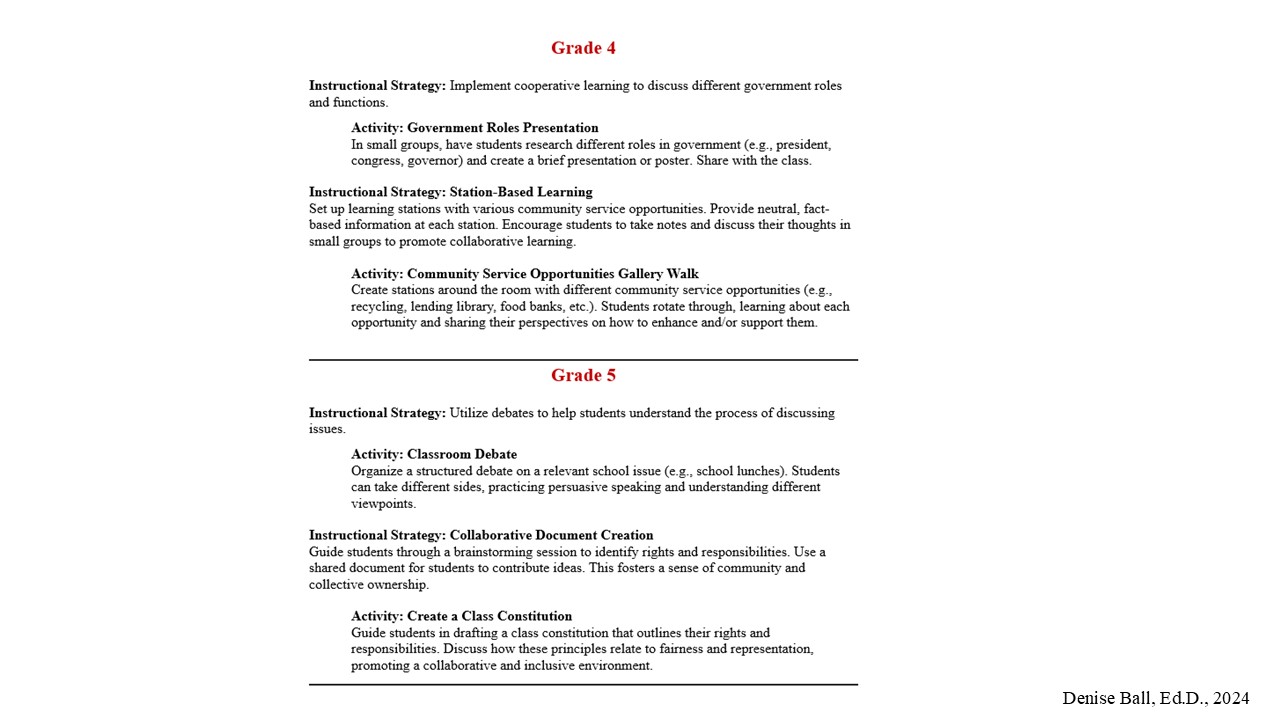
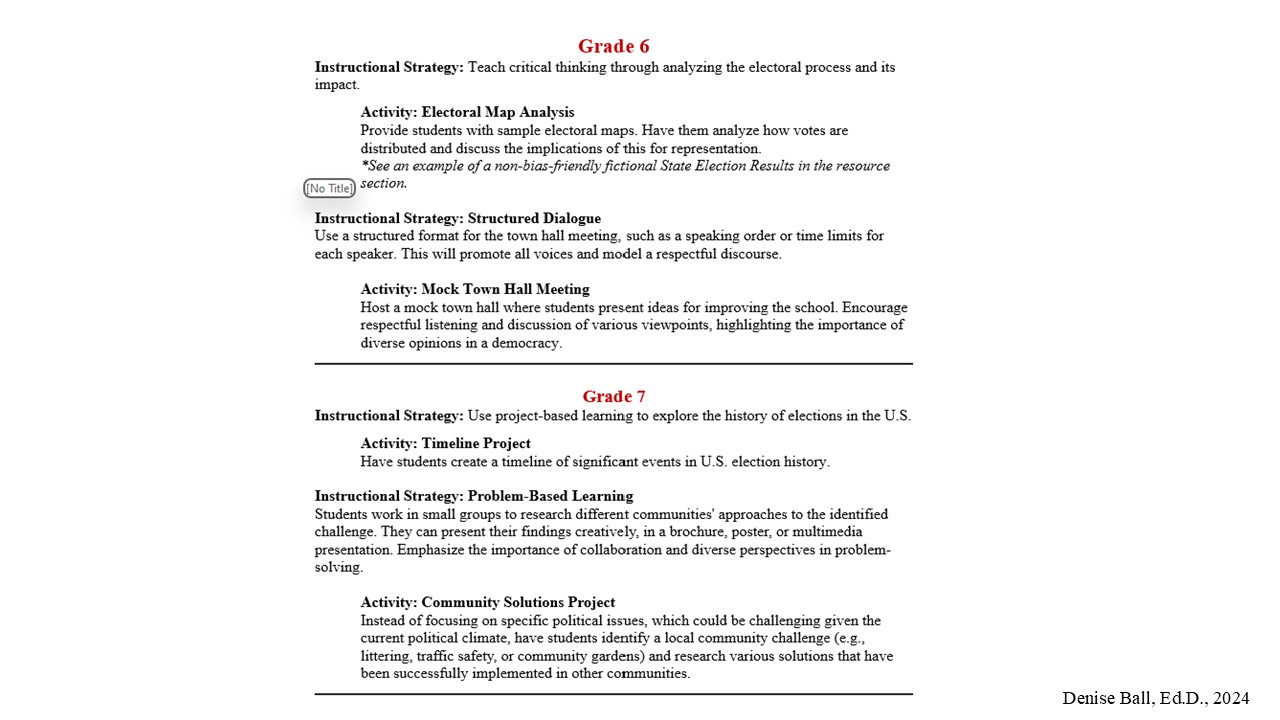
I have provided below some recommended non-partisan activities for students to help develop and promote critical thinking, and engage in learning about the electoral process while fostering a sense of civic responsibility without the emotional weight of real-world politics.

For all those who have chosen education as a career, thank you. You make a difference!

May we continue to seek knowledge in all things,

Denise

References

Aldridge, J. M., & McChesney, K. (2018). The relationships between school climate and adolescent mental health and wellbeing: A systematic literature review. International Journal of Educational Research, 88, 121-145.

Havik, T., & Westergard, E. (2020). Do teachers matter? students’ perceptions of classroom interactions and student engagement. Scandinavian Journal of Educational Research, 64(4), 488-507.

Quin, D. (2017). Longitudinal and contextual associations between teacher-student relationships and student engagement: A systematic review. Review of Educational Research, 87(2), 345-387.

Van Ryzin, M. J., Roseth, C. J., & Biglan, A. (2020). Mediators of effects of cooperative learning on prosocial behavior in middle school. Journal of Applied Developmental Psychology, 66, 101084.

Leave a comment

Filed under Creating a Positive School Culture, Curriculum Resources, Educational Resources, Educational Websites and Resources, Positive School Culture, Principals and Administrator Tools, Sharing the Good, Sharing the Good in Education

Engaging with Data: Key Takeaways from Thought-Provoking Sessions at the 5th Annual Ferguson Institute

I believe in sharing the good; words have power. There were so many words of wisdom shared over the last few days, I took pen to paper to capture a few words that spoke to me. I hope they inspire you or encourage reflection as you wrap up the 2023-24 school year. Please refer to the recommended resources for the names of some of the speakers who lit my fuse of curiosity this week. Never forget that to teach is a choice. To lead in education is a choice. The work you choose to do matters! Thank you for saying yes to the call to serve in education…

I found this week so engaging that I needed to pause and reflect to process the many data insights supported by research shared this week. There was such a dynamic cadre of national educational leaders that gathered in Dallas for this well planned and executed event. Many opportunities were provided to listen and discuss data and how to use data to inform decisions that effect student learning outcomes. I have a notebook of takeaways that I will spend some time with over the summer to unpack from attending the Curriculum Associates 5th Annual Ferguson Institute.

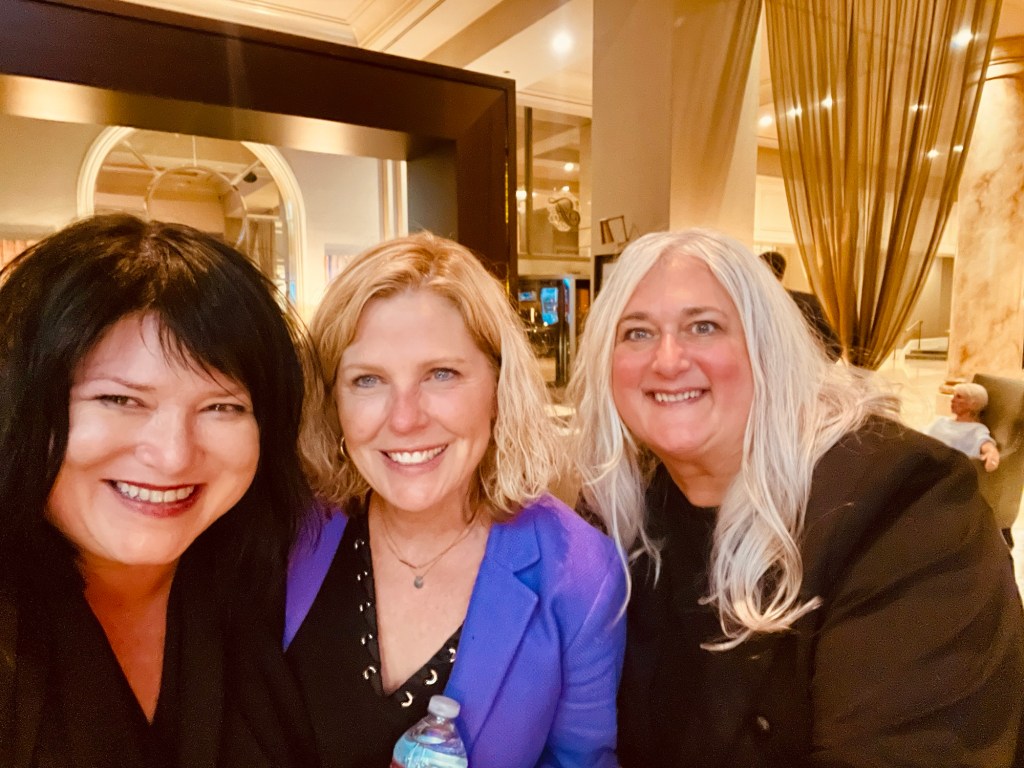
Denise Ball, Assistant Superintendent for Teaching and Learning/Lori Chaney, Curriculum Associates, Director of Sales, Mid-Atlantic/Kelly Branaman, Secretary for Catholic Schools and Superintendent of Schools

Key Takeaways:

1. It is important to come together; educating students takes a community.

The power of collaboration in education was a resounding theme at the Ferguson Institute. The diverse perspectives and experiences shared among those present served as a powerful reminder that the education of our students is a collective endeavor, not an individual one.

2. As educational leaders, we need to ensure we are providing teachers with opportunities to create environments where students feel “invited” to learn and that we are embracing and using data across all grade levels.

Creating inviting learning environments is crucial. By leveraging data, we can tailor these environments to meet the needs of every student, fostering an inclusive and supportive atmosphere that encourages engagement and learning.

Hattie, John. “Foster a Learning Culture.” 2024. What Brings You Joy. 5th Annual Ferguson Institute.

3. Remember never to underestimate a student’s potential and that every child is a capable mathematical thinker. Wouldn’t it be amazing if all students believed they were capable mathematical thinkers? Expecting excellence will transform a school culture!

At the heart of our educational mission is the belief in the untapped potential of every student. By fostering a culture of high expectations and support, we can empower our students to see themselves as capable mathematical thinkers, thereby transforming the overall school culture. Embracing this thought process might also require some professional development to ensure your faculty sees a capable mathematical thinker in every student. Let us enter the conversation…

4. Continue to seek to be inspired, encourage one another and the students placed in your care. Do not edit out the innovation; create environments for students and teachers that promote curiosity and inquiry.

Innovation should be at the heart of our educational practices. By nurturing curiosity and inquiry, we can create dynamic learning environments that inspire both teachers and students to explore, experiment, and grow.

Hattie, John. “Students are Engaged in their Learning.” 2024. What Brings You Joy. 5th Annual Ferguson Institute.

5. Building capacity through teaching inference and evaluating the impact is essential.

Teaching inference is essential for developing critical thinking skills. Evaluating the impact of our teaching practices ensures that we are effectively building these capacities in our students and continually improving our methods.

6. Hearing school districts share their data story was inspirational and provided opportunities for rich data dialogue. Hearing that achievement is up half a grade level equivalent in one year was simply a testament that the i-Ready curriculum and assessment resources make a difference!

The success stories shared by various school districts were both inspiring and affirming. The significant improvements in student achievement underscore the effectiveness of the i-Ready curriculum and assessment resources in enhancing educational outcomes.

Sullivan, Mark. Birmingham City Schools. 2024.

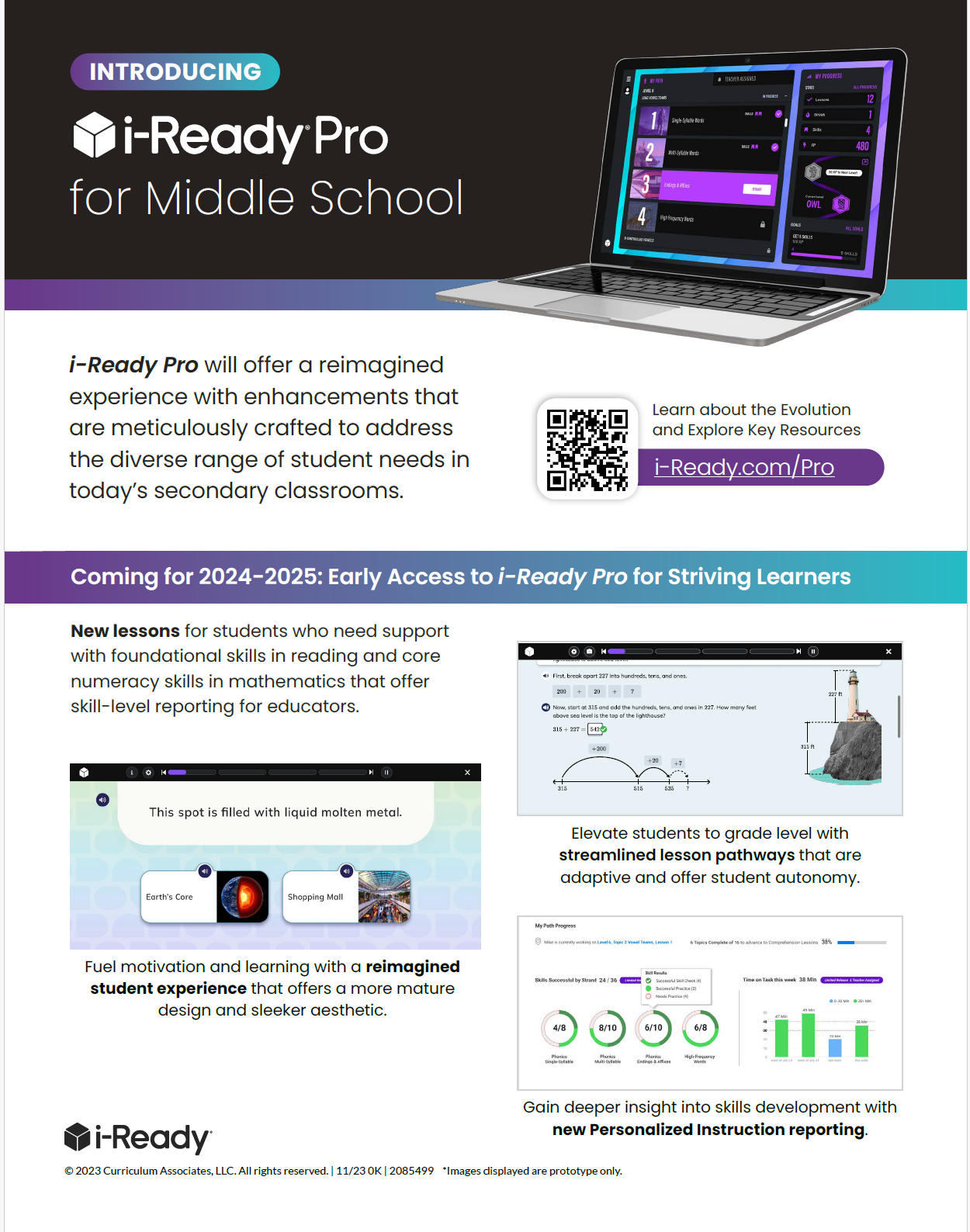
7. Curriculum Associates stimulates inquiry…always growing and improving through research and collaboration where speech recognition, Algebra I, and i-Ready Pro initiatives will be student game changers.

Curriculum Associates’ commitment to continuous growth and improvement through research and collaboration is evident in their innovative initiatives. These advancements promise to be transformative for students, particularly in areas like speech recognition and Algebra I.

8. One gold nugget that is life-affirming is to embrace the errors. No one says no to better!

Embracing errors as opportunities for growth is a powerful mindset. It reminds us that continuous improvement is always possible, and every mistake is a step towards betterment.

The world is chaotic, and we are called to be a positive light for the students and parents in our care. We must have courage, and as reflective practitioners, we must remember to reflect often on what brings us joy. Nothing great happens in the absence of enthusiasm. Build that playlist this summer, sing aloud and dance. Get energized to develop a personal and professional framework for greatness for the 2024-25 school year.

I am leaving Dallas and headed back to D.C. with the clear understanding that Curriculum Associates is an organization where everyone believes that every child deserves to be on grade level. It has been an exceptional week, enriched with data discussions with passionate school and district leaders committed to making a difference in a child’s life. I look forward to continuing to unpack all that I learned with my team and the school leaders I serve, strengthening the relationships developed and lessons learned while engaging with data at the 5th Annual Ferguson Institute.

Whitepaper: Culturally Responsive Mathematics Teaching (curriculumassociates.com)

School Readiness for Young Students Post-Pandemic (curriculumassociates.com)

Rethinking Middle School Math Acceleration (curriculumassociates.com)

Student-Focused AI Capabilities

Leave a comment

Filed under Blogs that Inspire Us, Curriculum Resources, Education Leadership Conferences, Educational Websites and Resources, Inspiration, Interesting Topics, Sharing the Good, Sharing the Good in Education

Thank You…Over 1 Million Views

As of June 2023, this blog has had over 1 million views, thank you! I am in the final stages of conducting my research for my dissertation and I appreciate the kind messages of inspiration sent. This platform was created in 2012 to share the good in education. Please feel free to share what inspired you this year. Sharing the good is synergistic and good for us all!

May we continue to seek knowledge in all things~

Denise

August 2020

Thank you to the 580K+ visitors to this blog. This blog is a creative way I use to share the good I see and find. Once I defend my dissertation and earn my doctorate, I hope to spend more time sharing the best practices that readers share with me. I appreciate the teachers and educational leaders that share tips and recommendations they find helpful in the classroom, school or district they serve. Thank you to the parents who leave comments and suggestions too.

When we train our eyes to see the good, we can do ANYTHING!

May we continue to seek knowledge in all things-

Denise

Leave a comment

Filed under Curriculum Resources, educational leadership, Educational Resources, Inspiration, Our Statistics, Sharing the Good, Sharing the Good in Education, Team Building/Positive Work Environments

Words of Wisdom

Seeing and sharing the good as I find it!
This was in a bathroom in a fun Grand Rapids establishment.

1 Comment

Filed under Curriculum Resources, Sharing the Good

An Innovative Program for Helping Students Succeed…Sharing the Good in Education

One school’s approach to ensure educational resources are available for students.

St. Regis Educare – An Innovative Program for Helping Students Succeed

St. Regis Educare (SRE) is a newly created program serving the students of St. Regis Catholic Elementary and Academy, in Bloomfield Hills, Michigan. The SRE program is staffed by three certified teachers who are dedicated to supporting the varied needs of St. Regis students. Based on the premise that each student has unique gifts and talents, with different learning styles and academic abilities, SRE supports teachers in providing differentiated instruction within and outside the classroom.

In keeping with the St. Regis mission: Respect, Educate, Give, Inspire, and Support, SRE is dedicated to respecting individual students’ needs and supporting and inspiring them to reach their fullest academic potential.

The service provided in this program is more than a library of resources for teachers and parents. It is more than a place where students can come for help with their homework. It is a professionally staffed center for learning, where students attend workshops, join literature circles, compete in Math competitions, and follow academic plans designed specifically to meet their individual needs.

SRE Services

St. Regis Educare provides three different types of assistance/enrichment for students. They work with individuals and small groups needing assistance or enrichment in academic subject areas. They  provide workshops to help students with concepts such as grammar or study skills, and  work with individuals and small groups on specific skills such as comprehension strategies or counting money. In order to make the concepts they are enhancing engaging, they  integrate technology, and utilize manipulatives, hands-on activities, and use modeling to help students achieve their goals.

With all this, they also provide the following benefits for teachers: assessments, which they will design and/or administer upon request; a central repository for teacher resources and reference books; and documented processes and forms to make using our services less complicated. To help bridge the ever widening need between parent and school, they provide a central repository for parent resources, and are in the process of planning workshops for parents, so they can learn new ways to help their children succeed in school.

Development of the Program

This school year, St. Regis Educare has evolved from an idea and an empty office, into a focal point of learning for students in need of assistance or enrichment, as well as a central location for student, teacher, and parent resources.

Some highlights include:

  • A room that is now both inviting and functional for assisting students
  • Resource materials, games, technology, and manipulatives that are arranged by subject matter on labeled shelves for easy access
  • Documented processes and forms that are based on research of best practices and collaboration with professionals both in and outside the school
  • An extensive list of services designed to meet the varied needs of our students

As of this writing, at least one student or group from every grade, is being serviced by SRE, and they have had an abundance of positive comments from students, parents, and teachers who are grateful for the expertise and supportive of this team’s efforts. It is too soon in the development of the program to provide concrete results; however, I plan to monitor this program’s progress …stay tuned!

If your school or community is doing something great to help students, teachers or parents, please share.  It is in the collaborative model that we all rise to the level in which we have the potential to be.

May we all continue to seek knowledge in all things~

Denise

Leave a comment

Filed under Educational Resources, Sharing the Good, Sharing the Good in Education

Science, Social Studies and Brain Building Sites to Enhance Classroom Instruction

The sites below were given by a 3rd grade teacher at St. Regis Catholic School, when asked what were some sites she utilized in the classroom to enhance instruction.  These sites are user-friendly, age appropriate for a variety of ages and can be used at home too!  Please enjoy and if you have a favorite site that you use within your classroom or at home, please share…together we can make a difference!
Science Links
EARTH SCIENCE
Interactive Weather Maker
Earth’s Physical Features Games
Water Cycle Animation
EPA: Water Cycle Interactive Learning Experience
EPA: Tour a Drinking Water Treatment Plant
LIFE SCIENCE
Kid’s Health: How the Body Works Videos and More!
Ed Heads: Simple Machine Interactive Learning Experience
SPACE / TECHNOLOGY SCIENCE
As the Earth Turns: Causes of Day and Night: Interactive Learning Experience
Earth in Motion: Causes of Seasons: Interactive Learning Experience
Earth’s Revolution Around the Sun and Seasons Interactive Animation
NASA Kids’ Club
Night Sky Observer: Moon Page
Moon Phases Interactive Learning Experience
Star Hopping Guide with Animations: Finding Constellations
Kid Astronomy: Facts about Planets, Moons, and other Objects in Space
Current News and Information on Viewing the Night Sky
Social Studies Links
Information on Michigan’s Native American Tribes
Jamestown Interactive Online Adventure
National Geographic for Kids: On the Trail of Captain John Smith Online Adventure
Information on the Civil War
Interactive Civil War Battle Map
Economics: Lemonade Stand Game
Economics: Coffee Shop Game
Brain Builder Links
Logic Puzzles to Play Online or Print Out!
Educational Videos, Lessons, and Games: Covering all Subject Areas: Grades K-12
Kids Konnect: A Safe Internet Gateway for Kids
Sports Illustrated for Kids
Cool Games for Kids: Searchable by Grade K-8
Games covering a Wide Variety of Subject Areas
May we continue to seek knowledge in all things,
Denise

Leave a comment

Filed under Science and Social Studies Websites for Kids, Sharing the Good, Student or Industry

Making Science Fun with Science Competitions that Promote “Out-of-the-Box” Thinking

Science is FUN!

It is almost January, and educators and parents start the “Science Fair” discussion with children and students.  This year, there are some cool science contests out there and Google Science tops my list.

Regardless if Science was your thing or not, if asked, we all could probably pull forward one science fair memory from the recesses of our minds. Volcano eruptions, eye ball blinks, inertia, plant growth with various musical tunes you name it, science fair time can be an exciting time of discovery or a mad dash to finish a deadline imposed by the ominous science teacher.

The Important Role of the Science Teacher
Given the teacher and they way material is presented, science can be fun! The world of science can open many doors for children. Doors to worlds that can increase awareness of saving our planet, living a healthy life, or even saving a life one day, by creating a cancer-saving cure…imagine. Many children in this country have limitations on travel and are limited to specific environments and economic resources. However, science is that one area where it is “cool” to recycle, utilize imagination and create! Memories of utilizing paper towel and toilet roll holders to demonstrate magnetic pull, keeps bubbling up to remind me that in science, the sky is the limit on creativity and ingenuity.

Science Fair Contests

*Google Science Fair 2012

  1. Children must be 13-18 years old
  2. Individual or groups allowed; groups can consist of two or three teams only
  3. Children “Scientists” must create a Google account and submit a Sign-Up form online
  4. Once confirmation is given, plan, execute and cite results, remembering to follow directions given and complete all sections outlined on the Google Section Submission Site
  5. A two minute video or 20 page slide presentation giving an overview of project are required to enter contest…entries are due by April 4th with submission form

This is a great contest that can allow educators to collaborate from various schools to come together with “Science Teams”, churches and or youth groups to utilize science as a way to spark the imagination of our children and enhancing team building while instilling (hopefully) a love of science.

*International Online Science Contest

The International Online Science Contest website has a wealth of resources for teachers and parents. This site offers a variety of science contest that run all year. Students can visit this site to view other science projects and read judging tips to get an overall appreciation for the “Science Fair” process. Parents can visit site to read and download a Parent Guide that provides step-by-step instructions, parent testimonials and defines the roles of parents throughout the “Science Fair” process. This is a one-stop shop for learning all about Science Fairs and a great resource for classroom teachers as well.

Science Buddies

Science Buddies website is an all encompassing site that provides its reader with a list of various science competitions. Competitions are broken down by grade levels, format, eligibility and if teams are allowed. This is a great site for young people who might be interested at ages eight or nine in science and can watch some “advanced” science fair project videos on various projects to plant a seed for the future. For schools who do not have a “gifted” or advanced science program, this might be the site for you.

“Out of the Box” Teaching

A school, with a very creative, “out of the box” science teacher, could utilize the contest found here or at any of the mentioned websites, and take students who demonstrate an aptitude for science to the next level. Teachers who are looking to collaborate or parents who want to take more of an active role in this process can find science community blogs as well at http://www.sciencebuddies.org to glean insight and support throughout the Science Fair process or to even supplement or increase the love of science in the life of a child.

Science Fair Project Ideas

Happy creating and for additional science fair project ideas, check out the following sites to ignite the imagination:

Imagine if we could ignite the imagination, plant a love of learning for science via writing, creating, utilizing music, labs, nature and utilize all the other multiple intelligences, there is nothing we could not accomplish or overcome.

May we seek knowledge in all things,

Denise
Leave a comment

Filed under Science, Science Fair Projects, Sharing the Good, Student or Industry

6th Grade Teacher Makes Science Fun with Cell Process Cartoons

Who said science wasn’t fun?
While in a school today (St. Mary School Royal Oak, Michigan), I stopped to look at these fabulous displays of creativity.  Not only was this hallway display colorful and creative, it was educational and funny!


We would love to share your classroom Best Practices with our readers. It is in this collaborative process, that we all grow as educators…as parents…as a society!  Good ideas are meant to be shared.  We try to share them as often as we can!


May we continue to seek knowledge in all things,
Denise


Leave a comment

Filed under Best Practices from Awesome Educators, Science, Sharing the Good

We Have Found an Amazing 7 Year-Old Writer and Her Mom Writes Too…Check out Her Blog

In one of our Writing Workshops in May, I was thrilled to spend time with Amy Foret.  She is a young mom who is a wife and a mother of two. Her articulate and well-read daughter is 7 and she has an amazing son who is 5.

Her daughter started reading when she was only 3 1/2, and has been writing stories since she started kindergarten. Now she is in second grade. She reads about a book a night, and writes at least one short story a week.

Please check out and welcome these new writers to WordPress and the writing arena.

For all of our readers who love to get great ideas on books to utilize in classroom or read to your child, we highly recommend Amy’s blog MY Garden Patch of Books.

Please check it our and share your thoughts here on your great reading finds 🙂

I am on my way to VA to meet with Trisha and conduct some Unlock the Teacher LLC “How to ePublish” Workshops…

Stay tuned as the next Katie’s Adventure eBook is almost ready to hit Barnes and Noble.com.  The OLQM first graders who wrote and illustrated the book did an amazing job!

You learn something every day if you pay attention.  ~Ray LeBlond

May we seek knowledge in all things,

Denise

Leave a comment

Filed under Blogs that Inspire Us, Educational Websites and Resources, Favorite Sites, Learning is Fun Lessons/Activities, Recommended Books to Read, to Learn, to Inspire, Recommended Learning Blogs, Sharing the Good