Category Archives: Teacher Retention and Recruitment

Strengthening Schools Through Partnership: The Role of Universities in Teacher Retention

Across the country, school leaders are navigating one of the most persistent challenges in education today: retaining talented, mission-driven educators. While much of the conversation centers on compensation, workload, and policy, one of the most underutilized and high-impact resources sits right beside our schools…our university partners.

I always enjoy hearing and sharing the good with Boston College Roche Center educational leaders.

Institutions like Marymount University, Boston College, and St. John’s University are not only preparing future educators, they are increasingly listening, adapting, and responding to the real-time needs of school leaders and teachers. When leveraged intentionally, these partnerships can become a cornerstone strategy in addressing the teacher retention challenge.

At their best, university-school partnerships move beyond transactional relationships and become transformational. They create shared responsibility for developing, supporting, and sustaining educators across the full arc of their careers.

St. John’s University edTech Summit—a think tank session!

What This Looks Like in Practice

Educational leaders can take intentional steps to deepen these partnerships in ways that directly impact teacher retention:

Enhancing School-Based Opportunities Through Strategic Partnership

Professional learning is most effective when it is grounded in the context of the school and led by those closest to the work. I find there is value in leaning on university partners as thought partners. These relationships bring research, frameworks, and support that strengthen intentionally designed opportunities (Desimone & Garet, 2015).

Marymount University Regional Catholic School Leadership Conference

Creating Leadership Pathways

Retention is closely tied to growth. Universities can partner with school systems to build leadership pipelines, offering graduate programs, certifications, and cohort models that empower teachers to see a future within the profession. When educators can envision their next step, they are more likely to stay (Ingersoll et al., 2018).

Embedding Research into Practice

Strong partnerships allow schools to serve as living laboratories where research informs practice and practice refines research. Whether through action research, dissertation collaboration, or pilot programs, teachers feel valued when their experiences contribute to broader learning and improvement (Coburn & Penuel, 2016).

Expanding the Teacher Pipeline with Purpose

Through intentional clinical experiences, residency models, and targeted recruitment efforts, universities can help schools attract candidates who are not only qualified but mission-aligned. This alignment is essential across all educational governance models, where purpose plays a central role in retention (Guha et al., 2016).

Supporting Educator Well-Being and Belonging

Teachers stay where they feel seen, supported, and connected. Universities can contribute by integrating social-emotional learning, reflective practice, and community-building strategies into both pre-service and in-service programming. Research consistently shows that school culture, trust, and collective efficacy are key drivers of teacher retention (Kraft et al., 2016). I am very passionate about this topic and my research highlights the central role of school climate, leadership, and relational trust in shaping teachers’ decisions to remain in the profession (Ball, 2023).

The most impactful university partnerships are grounded in a shared belief: that supporting teachers is not the responsibility of one institution, but a collective commitment.

When school systems and universities work together with intention, we begin to see action to impact. Professional learning becomes more meaningful, leadership becomes more distributed, and culture becomes more supportive. Most importantly, teachers begin to experience what so many are seeking: a sense of purpose, growth, and belonging within their schools.

For educational leaders, the invitation is clear: lean into these partnerships. Invite universities to the table not just as providers, but as collaborators. Share your challenges openly, co-create solutions, and build meaningful and impactful frameworks not one-time supports.

When we strengthen the bridge between universities and schools, we are not just preparing teachers, we are sustaining them.

At the heart of this work is a simple but powerful truth…we can do more for our teachers when we do it together. The challenges facing education today call us to think beyond traditional structures and lean into the strength of collective impact. By partnering with universities and trusted vendor partners, we open the door to innovative, responsive solutions that better meet the needs of our educators. More importantly, these partnerships allow us to visibly and authentically demonstrate our gratitude for teachers, thankful for their dedication, their resilience, and their daily commitment to shaping the lives of the students entrusted to their care.

When educators feel supported not just by their school, but by a broader community working on their behalf, we move closer to building the kind of sustainable, mission-driven environments where teachers choose to stay and thrive.

References 

Ball, D. M. (2023). Improving teacher retention within Archdiocese of Washington schools (Doctoral dissertation, Liberty University). https://digitalcommons.liberty.edu/doctoral/5006  

Coburn, C. E., & Penuel, W. R. (2016). Research–practice partnerships in education: Outcomes, dynamics, and open questions. Educational Researcher, 45(1), 48–54. https://doi.org/10.3102/0013189X16631750

Desimone, L. M., & Garet, M. S. (2015). Best practices in teachers’ professional development in the United States. Psychology, Society, & Education, 7(3), 252–263. https://doi.org/10.25115/psye.v7i3.515

Guha, R., Hyler, M. E., & Darling-Hammond, L. (2016). The teacher residency: An innovative model for preparing teachers. Learning Policy Institute.

Ingersoll, R. M., Merrill, L., Stuckey, D., & Collins, G. (2018). Seven trends: The transformation of the teaching force. Consortium for Policy Research in Education.

Ingersoll, R. M., & Strong, M. (2011). The impact of induction and mentoring programs for beginning teachers: A critical review of the research. Review of Educational Research, 81(2), 201–233. https://doi.org/10.3102/003465431140

Leave a comment

Filed under Educational Resources, Hot Topics in Education, Inspiration, Positive School Culture, Sharing the Good in Education, teacher retention, Teacher Retention and Recruitment, University Partners

Be a Distributor of Joy and Change the Teacher Attrition Rate

Blackaby (2015) reminds us that a positive school culture begins with a service-oriented mindset. Leaders must build a clear vision of the kind of school environment they want to cultivate for teachers, students, and families. Building a strong team and a positive school culture requires shared leadership, collaboration, and a focus on teacher well-being.

School leaders must be present and care enough to listen and enter the difficult conversation(s). Joy must be modeled by the school leader in both word and action…it is synergistic and transformative for a school team and a school campus/community. At the heart of teacher retention lies a simple but profound truth—joy!

As educational leaders, we must be builders and distributors of joy, creating school cultures where educators are not just sustained but inspired. Joy is not just an outcome of a thriving school environment, it is the very foundation upon which leadership, professional learning, culture, and a positive school team interconnect and strengthen one another.

When leaders cultivate environments where teachers feel valued, when professional learning is meaningful and collaborative, when school culture is intentionally shaped with positivity and respect, and when teams work together with a shared purpose, joy emerges.

The discussion on teacher retention was important pre-COVID and is essential post the pandemic when many teachers are still struggling. Teachers need to pause and take the time to reflect and acknowledge the work it took to walk through that period, celebrate the amazing things that occurred due to their hard work and service to others, so they can close the chapter and get back to the joy of education that attracted them to the profession in the first place.

The conversation on teacher retention and the importance of school leadership and a positive school culture continues…

May we continue to seek knowledge in all things,

Denise

1 Comment

Filed under Curriculum Resources, Teacher Retention and Recruitment

Listening, Learning, and Leading: A Conversation on Teacher Retention


Teacher retention is not just a policy issue, it is  a deeply personal one. Behind every statistic is a teacher who has dedicated their time, energy, and heart to shaping the next generation. The reasons educators stay or leave are complex, intertwined with school culture, leadership, and professional fulfillment. The most effective way to address teacher retention is simple yet profound: we must listen.


As school leaders, we have an obligation to understand the realities our teachers face, to hear their challenges, and to amplify their successes. Listening is not just a courtesy, it is  a leadership strategy. When teachers feel valued, heard, and supported, they are more likely to stay and thrive.


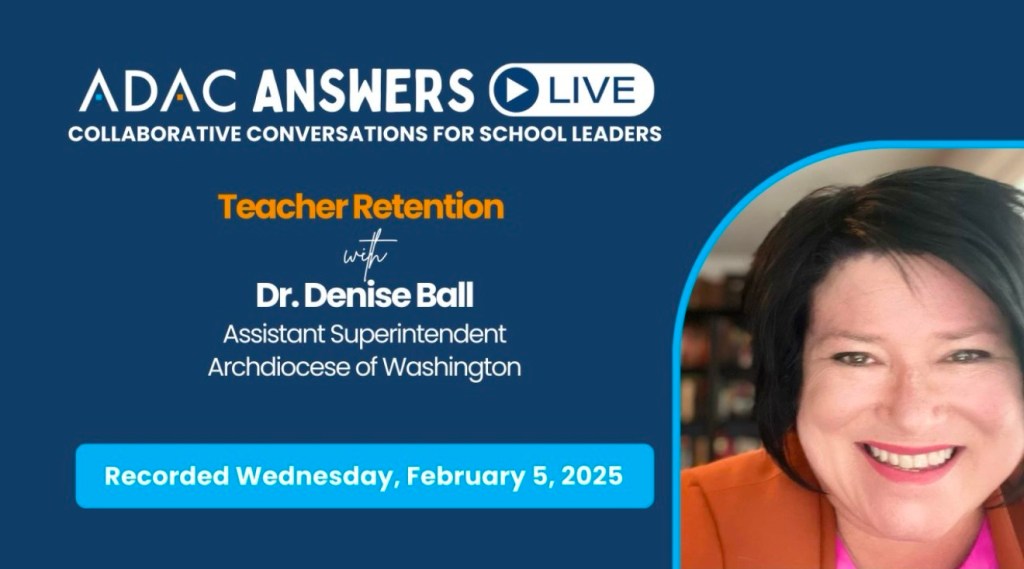
It was an incredible honor to be invited to lead a discussion on teacher retention as part of the ADAC Answers series. With over 240 school leaders from 40 states and the District of Columbia, registered and representing public, private, faith-based, and international schools. These leaders represented approximately 34,000 teachers and 370,000 students. This conversation reflects a national and global commitment to addressing one of the most pressing challenges in education today.


Bringing together diverse voices across governance models allows us to see the common threads in teacher retention and explore meaningful, research-based solutions. Whether it is mentorship programs, school climate initiatives, or leadership development, the strategies we discussed are not just theories, they are actionable pathways to strengthening our schools from within.


I am grateful for the opportunity to engage in this dialogue and to learn from the experiences of so many dedicated leaders. The work of teacher retention is ongoing, but together, through thoughtful leadership and a commitment to listening, we can make a lasting impact.

If you were unable to join yesterday, you can watch the full recording on ADAC’s Video Resources page.


https://loom.ly/1yvAmBo

May we continue to seek knowledge in all things,

Denise

2 Comments

Filed under Curriculum Resources, teacher retention, Teacher Retention and Recruitment

Top Five Recommended “Musts” to Ensure Teachers Feel Valued Before the Summer Pause

It is an exciting time, but this season of transition can be chaotic and often stressful for faculty, staff, students, and parents. A little bit of grace this time of year goes a long way.

When I was a school leader, I used to tell my staff that the end of the year was a time for putting on the “red shoes”…making sure to leave home needs at home and embracing each day with purpose; we are called to be the difference. Retention data shows that it is important now more than ever to ensure that all stakeholders end the year on a high note.

A school climate affects teacher satisfaction, morale, and expectations about staying in the profession (Garcia & Weiss, 2019). A high percentage of teachers do not feel appreciated, and this feeling can have an impact on their choice of staying or leaving the classroom. It would be beneficial for society to remember that teaching remains an extraordinarily noble profession with intrinsic rewards that few other disciplines experience (Vocke & Foran, 2017). There are many ways to show teachers support. Below are my five recommended “musts” to finish the school year strong, ensuring teachers feel valued.

Top Five Recommended “Musts” to Ensure Teachers Feel Valued Before the Summer Pause

  1. Handwritten Thank-You Notes: Write personalized notes to each teacher, highlighting specific contributions and expressing sincere gratitude. Encourage faculty and staff to write anonymous notes to one another. Positive energy is synergistic!
  2. Public Acknowledgment: Use school newsletters, social media, and assemblies to publicly recognize and celebrate teachers’ achievements and dedication. Use these last few weeks of school to promote and share the good that has happened on your school campus. Sharing the good can change a school’s culture.
  3. Classroom Resources: Provide teachers with additional resources or gift cards for classroom supplies as a token of appreciation and to ease their financial burden as they begin to plan this summer for the upcoming school year.
  4. Professional Development Stipends: Offer a stipend or provide a gift card for summer professional development courses, or educational reading materials, indicating investment in their continued growth.
  5. End-of-Year Celebration: Host a celebratory event to honor teachers’ hard work and achievements throughout the year. Include awards or small gifts to show appreciation. Have a discussion on the theme for the upcoming school year to help give direction (which will reduce stress) in helping teachers plan over the summer.

Give your team permission to put an “out of office” message on their email for a period of time to spend with family and friends, recharging so they can be all they are called to be for the upcoming school year. Building in a “time to pause” into one’s daily schedule, will allow teachers to come back to campus more creative, energized, and ready to accomplish team initiatives for the new school year.

Photo Credit: Anna Quattrone, Director of Marketing and Enrollment

Ultimately, it is essential to never underestimate the importance on greeting your faculty and staff as they begin the school day, providing an encouraging word or smile, and making sure your team members feel seen and heard. Teachers choose to serve in schools where they feel welcomed and appreciated.

Regardless of the time of year, it is always a good idea to thank a teacher for choosing to teach!

May the last few weeks of school be filled with joy and peace!

Denise

Denise Ball, Ed.D.

Recommended Reading

Carver-Thomas, D., & Darling-Hammond, L. (2019). “The Trouble with Teacher Turnover: How Teacher Attrition Affects Students and Schools.” Education Policy Analysis Archives, 27(36).

Kraft, M. A., Papay, J. P., Charner-Laird, M., Johnson, S. M., Ng, M., & Reinhorn, S. K. (2020). “Educator Work Environments and Teacher Effectiveness: A Two-Year Longitudinal Study of Teaching Assignments.” Educational Evaluation and Policy Analysis, 42(3), 436-460.

Podolsky, A., Kini, T., Bishop, J., & Darling-Hammond, L. (2019). “Strategies for Attracting and Retaining Educators: What Does the Evidence Say?” Education Policy Analysis Archives, 27(38).

Leave a comment

Filed under Curriculum Resources, Teacher Retention and Recruitment