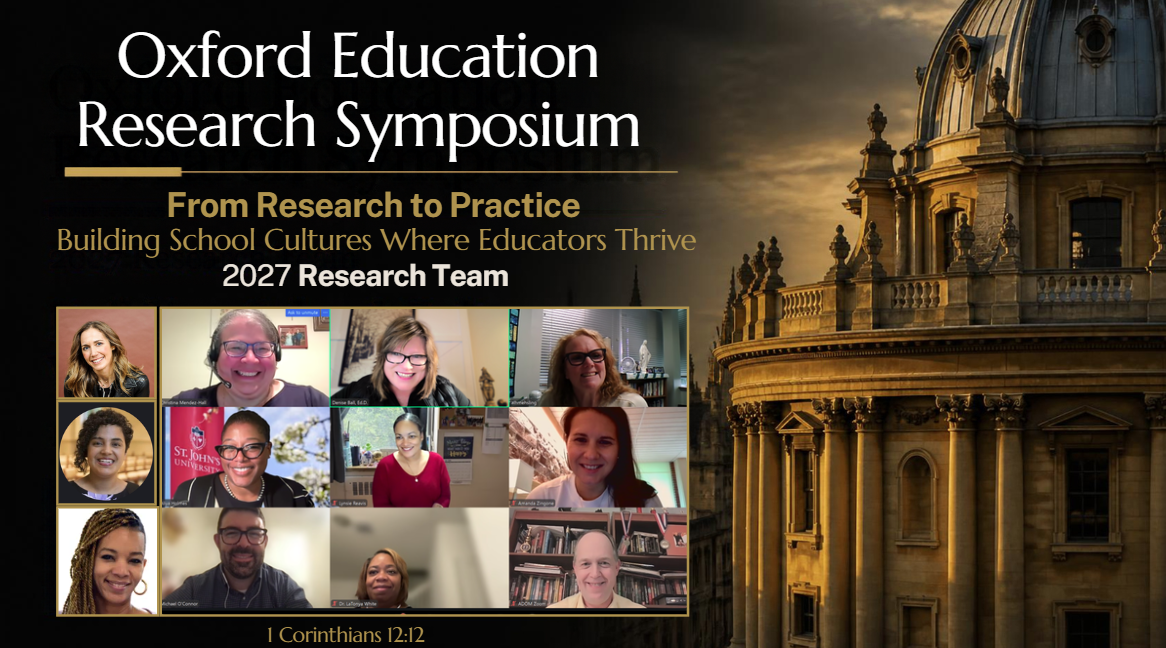
Today our 2027 Research Team came together to officially begin the next phase of our work. Today marks the launch of the culminating year of a three-year research journey focused on leadership, professional learning, school culture, and teacher retention.
This meaningful work draws on a strong framework of diverse experience, perspective, and expertise around the table. As 1 Corinthians 12:12 reminds us, many members form one body. In the same way, many voices can strengthen the work and help us see more clearly what PK-12 school leaders and educators need.
Over the coming months, our work will move forward in two connected ways. We will continue gathering, analyzing, and integrating research as we prepare our study for presentation and peer review at the Oxford Education Research Symposium in March 2027. At the same time, we will begin translating that evidence into a manuscript designed to provide school leaders with practical strategies, examples, reflection, and guidance for intentionally creating and sustaining positive school cultures.
I am grateful for the wisdom, experience, and commitment this team brings to the work, and I am excited about where this research may lead as we seek to contribute something both scholarly and useful to Catholic school leaders and the educators they serve.
Oxford Education Research Symposium | 2027 Research Team
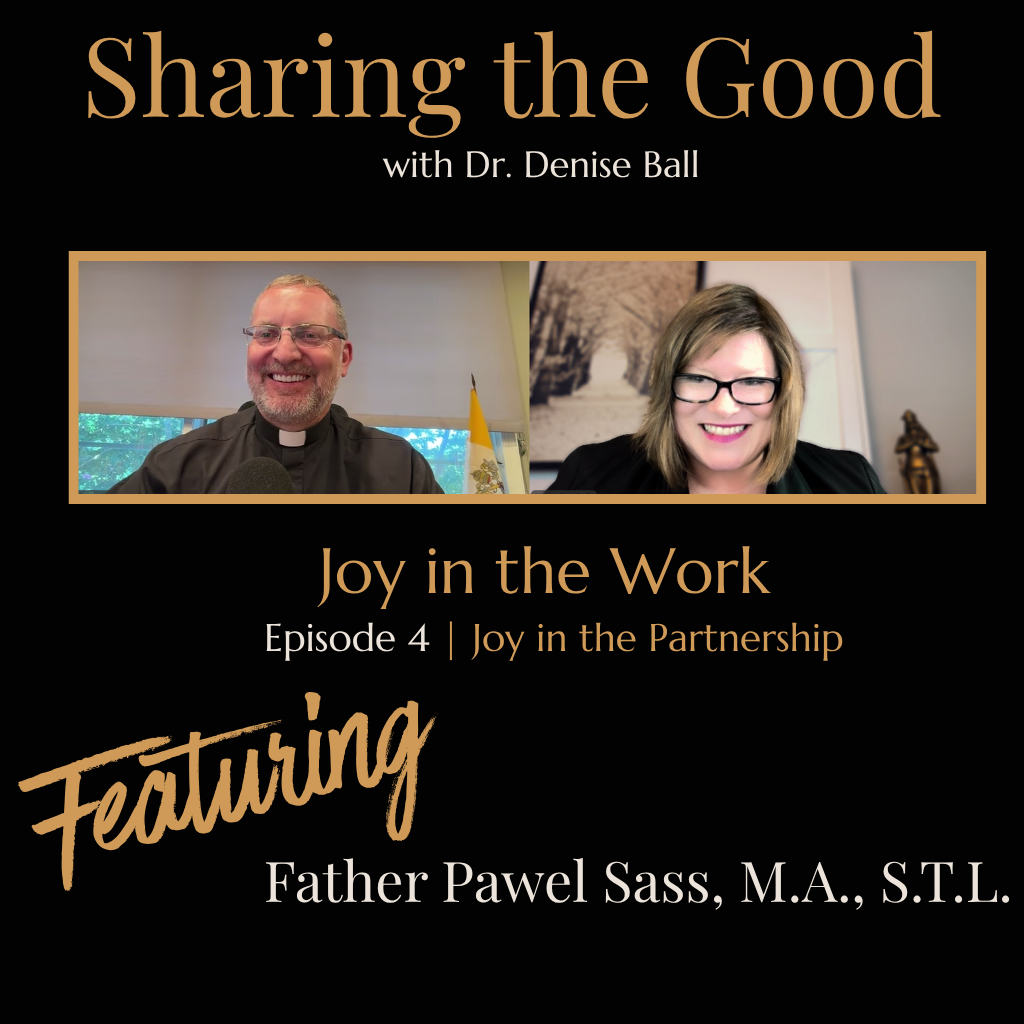
Joy in the Work | Episode 4 | A Conversation with Father Pawel Sass, M.A., S.T.L.
What becomes possible in our Catholic schools when pastors and principals see their partnership not simply as a responsibility, but as a gift?
That is the question I have been carrying with me since my recent conversation with Father Pawel Sass, Pastor of the Shrine of Saint Jude in Rockville, Maryland, for Episode 4 of the Joy in the Work series.
When we talk about strengthening Catholic schools, we rightfully talk about teachers, principals, students, families, curriculum, instruction, faith formation, and school culture. However, there is another relationship that I believe deserves much more of our attention: The pastor-principal partnership.
The pastor and principal have distinct roles and responsibilities, but they share something extraordinary: responsibility for advancing the mission of a Catholic school community. When that partnership is healthy, collaborative, prayerful, and rooted in mutual respect, the effects can extend far beyond the two people involved.
Teachers and students notice and experience it, and the school families and parishioners take notice and experience it. This partnership has a huge impact on a Catholic school culture.
Partnership Has Shaped My Own Leadership Lens
Throughout my years serving Catholic education, I have been blessed to work alongside wonderful priests and to learn from spiritual leaders who modeled a positive approach to Catholic schools. Msgr. Chuck Kosanke in the Archdiocese of Detroit and Father John Williamson in the Archdiocese of Baltimore are two priests whose mentorship and example helped shape my own understanding of partnership.
They helped me see that the relationship between pastor and principal does not need to be defined by hierarchy, territoriality, or uncertainty about who controls what.
At its best, it can be characterized by trust, communication, shared mission, respect for one another’s expertise, prayer, laughter, and a genuine belief that we are better when we serve together.
At one point in our conversation, Father Pawel offered a wonderfully simple reminder:
“We are too blessed to be stressed.” (Sass, 2026)
It made me smile. Of course, leadership can be stressful. Catholic school leaders and pastors carry real responsibilities, difficult decisions, competing priorities, and the needs of many people. Father Pawel was not suggesting otherwise. What I heard in his words was an invitation to remember the blessings while carrying the burdens.
Leadership can become so consumed by what needs fixing that we forget to notice what is flourishing:
The student who finally understands. The teacher who stayed a few extra minutes to help. The family who expresses gratitude. The colleague who makes us laugh or put up a bulletin board. The parishioner who quietly supports the school. The opportunity to celebrate Mass together. The privilege of accompanying children as they grow in faith and knowledge, and the people God has placed beside us.
There will always be another problem to solve, but there will also always be something for which to give thanks. Perhaps part of sustaining joy in the work is learning to hold both realities at once.
Another image Father Pawel shared has stayed with me.
“Clean the cup.”
His reflection was that we need to clean the cup so we can be filled by the Holy Spirit and then empty ourselves again in service to others (Sass, 2026).
What a beautiful image for leadership. Those of us who serve others spend much of our lives pouring out. We give attention. We give encouragement, time, we solve problems and we listen. We teach, lead and we accompany others on this journey of life. But we cannot continually pour from a cup we never allow God to refill.
Prayer, reflection, rest, gratitude, community, and time with God are not distractions from leadership. They help prepare us for it.
Perhaps the question is not simply, “How much more can I give?”
Perhaps sometimes the better question is:
“What do I need to release so there is room for the Spirit to fill me again?”…Clean the cup, be filled, be poured out in service, return, and allow God to fill it again! There is a rhythm of vocation in that image that I find beautiful.
One of the most practical parts of my conversation with Father Pawel centered on conflict. Healthy partnerships are not partnerships without disagreement. Pastors and principals will disagree. Teachers and administrators will disagree. Colleagues will misunderstand one another. We are human beings doing important work together, so conflict will happen.
The question is not whether disagreement will occur. The question is what we do when it does.
Father Pawel offered three practices that are beautifully simple and profoundly useful.
1. Begin With Quiet, Personal Prayer
Before responding, reacting, emailing, calling, or entering the difficult conversation: Pray.
Not necessarily publicly, not performatively, but quietly and personally. Bring the situation to God before bringing it back to the other person. Prayer creates space between the emotion we are experiencing and the response we choose to make.
It invites us to ask: Am I listening? Am I seeking understanding? Is pride influencing my response? What might I be missing? Holy Spirit, how are You asking me to enter this conversation?
For Catholic leaders, perhaps prayer should not simply open our meetings. Perhaps it should also precede our disagreements.
2. Practice “Table Fellowship”
Father Pawel’s second recommendation may be my favorite:
Enjoy table fellowship. (Sass, 2026)
Sit down together, share a meal, have coffee, break bread, and just talk.
Father Pawel reminds us that there is something deeply human, and deeply Christian, about gathering around a table. The person across from us can become very easy to misunderstand when our interaction is reduced to an email, a disagreement, a meeting agenda, or a problem that needs solving. The table changes the posture. At the table, we remember the person. We listen differently. We tell stories. We laugh. We learn about one another, and we discover what we have in common.
I think sometimes the disagreement that seemed enormous becomes easier to navigate once the relationship returns to the center. There is wisdom in table fellowship that extends far beyond the pastor-principal relationship. What might change in our leadership teams, faculties, departments, and school communities if we spent a little more time breaking bread together?
3. Assume the Good
Father Pawel’s third piece of wisdom may be the most challenging:
Assume the good.
When someone says something that frustrates us, assume the good. When a decision surprises us, assume the good. When communication is imperfect, assume the good. When we disagree about the path forward, begin with the belief that the other person also cares about the mission.
Assuming the good does not mean avoiding accountability or pretending harmful behavior is acceptable. It means resisting the temptation to assign negative motives before we have taken the time to understand.
Imagine beginning a difficult pastor-principal conversation from this posture:
“I know you care about our school and our mission. Help me understand how you are seeing this.”
That is very different from beginning with:
“Why would you do this?”
One posture opens a door and the other may close it before the conversation even begins.
I keep returning to Father Pawel’s three practices:
Pray
Table Fellowship
Assume the good
They require no new program, no strategic plan, no committee, or budget. They require intentionality. I think this is one of the lessons emerging throughout this entire Joy in the Work series. Positive culture is often built through seemingly small, repeated relational practices.
How we enter the room, how we listen, how we choose to respond to mistakes, how we welcome people, how we handle a disagreement is important to the partnership.
How we recognize another person’s gifts, how we repair a relationship, and how we choose to begin again can build trust and a strong foundation for the partnership.
As shared in earlier episodes, small moments, repeated consistently, have a way of becoming culture.
A healthy pastor-principal partnership does not require the pastor to become the principal or the principal to become the pastor. Their roles are distinct, their gifts are different, and areas of expertise vary. That is not a weakness in the partnership, and it may be one of its greatest strengths.
Partnership asks us to recognize: You bring something to this mission that I cannot bring alone. In Catholic education, that recognition carries particular significance. The pastor brings spiritual leadership, sacramental life, theological formation, and pastoral care. The principal brings educational leadership, instructional expertise, organizational leadership, and the daily stewardship of the school community. Together, they can help ensure that Catholic identity is not simply something written in a mission statement, but becomes something people experience.
As the Joy in the Work series continues, another piece of the larger picture is becoming clearer to me.
Dr. Christina Mendez-Hall invited us to Lead with Joy,
Dr. Nicci Dowd encouraged us to Make Room for Joy,
Dr. Joy Roberts helped us explore Joy, Belonging, and the Power of Community, and
Father Pawel Sass reminds us that there can also be Joy in the Partnership.
We do not have to carry the mission alone, and that in itself is a source of joy. There is someone beside us. Someone with different gifts. Someone who sees things we may not see. Someone with whom we can pray, and can break bread together. Someone with whom we can disagree and begin again. Someone who can remind us, on the difficult days, why we said yes to this work in the first place.
I left my conversation with Father Pawel inspired and grateful.
The Shrine of Saint Jude and St. Jude Catholic School in Rockville, Maryland, are blessed to have a pastor who so clearly values Catholic education and recognizes the importance of collaboration.
Our conversation has me reflecting on…
What becomes possible in our Catholic schools when pastors and principals see their partnership not simply as a responsibility, but as a gift?
Perhaps we create stronger relationships, and we navigate conflict with greater grace. Perhaps our teachers feel more supported, and families experience greater unity. Perhaps students encounter a more authentic witness of Christian community, and perhaps we make a little more room for joy.
I am grateful to Father Pawel Sass for sharing his faith, wisdom, humor, and JOY in Episode 4 of the Joy in the Work series:
Joy in the Partnership: The Pastor-Principal Relationship and the Culture We Create
Join the conversation on YouTube:https://youtu.be/BqIdg4uuwCUor listen wherever you enjoy your favorite podcasts.
Maybe the next time conflict finds its way into our work, we can remember Father Pawel’s simple wisdom:
Pray, enjoy table fellowship, and assume the good! Maybe, every once in a while, remind ourselves: “We are too blessed to be stressed.” (Sass, 2026)
When we train our eyes to see the good, amazing things happen!
Reference
Ball, D. M. (2026). Joy in the partnership: The pastor-principal relationship and the culture we create [https://youtu.be/BqIdg4uuwCU]. Sharing the Good with Dr. Denise Ball.
There are moments in life when we are given the gift of seeing something familiar through a different lens.
This week has been one of those gifts for me.
I have had the privilege of spending several days with my mother- and father-in-law, who have been married for 65 years. I came into this week simply hoping to lend a helping hand. Instead, I have found myself deeply moved by what I have been allowed to witness. Sixty-five years of marriage…sixty-five years of building a life together.
Children, grandchildren, great-grandchildren, joy and disappointment, laughter and probably a few tears, seasons of abundance and seasons of uncertainty. There has been sacrifice, moments of forgiveness, examples of faith. They have walked through moments of illness, celebration, and ordinary days that, when woven together, become an extraordinary life…and through it all, words.
Words spoken across kitchen tables and during long car rides. Words exchanged while raising 7 children and navigating the challenges of life. Words of encouragement during difficult seasons. Words of forgiveness, words of prayer, and words that communicated, in countless ways, I am here. I love you. We are in this together and let us share our joys and sorrows as grandpa taught us.
This week, I have had the honor of hearing some of those words.
I have listened as prayers were offered for children, their spouses, grandchildren, and great-grandchildren by name. I have heard gratitude expressed for the men and women their children have become. I have witnessed love and devotion that have been cultivated over more than six decades. Somewhere along the way, I realized that I wasn’t simply listening to words.
I was witnessing their legacy. That realization has stayed with me.
It has caused me to look at my own words differently and to ask a question I have not been able to shake: What will be the legacy of my words?
The Words We Leave Behind
When we hear the word legacy, we may think about accomplishments, careers, possessions, awards, organizations built, books written, or things passed from one generation to another.
However, perhaps some of the most important parts of our legacy will never appear on a résumé or hang on a wall. Perhaps our legacy also lives in the words other people carry because of us. Think for a moment about the people who have shaped your life.
Can you still hear some of their words? Maybe a parent told you, I’m proud of you. Maybe a teacher saw something in you before you could see it in yourself. Maybe a coach said, Try again. You’ve got this.
Maybe a friend sat beside you during a difficult season and reminded you that you did not have to walk through it alone. Sometimes a sentence spoken in seconds lives within another person for decades. Unfortunately, the opposite can also be true.
Words can discourage, words can diminish, words can divide, and words spoken carelessly in a moment can remain in someone’s heart long after the person who spoke them has forgotten the conversation entirely.
We don’t have to look far to see examples of words being used to tear down rather than build up. Our public discourse, social media feeds, workplaces, schools, communities, and sometimes even our homes can become filled with language that wounds rather than heals.
We may not be able to control all the words filling the world around us.
BUT we can decide what words enter the world through us!
For Educators: What Will Our Students Carry With Them?
As another school year begins, this question feels particularly important for educators.
Soon, classrooms will once again be filled with young people bringing their gifts, questions, hopes, insecurities, experiences, and possibilities through our doors.
They will learn countless lessons this year. They will solve equations, read stories, conduct experiments, study history, create art, collaborate, make mistakes, ask questions, and discover new things about themselves and the world around them.
They will forget some of what we teach, but what words might they carry with them?
What words will my students carry after they leave my classroom?
Did I tell them they were capable?
Did I cultivate curiosity rather than a fear of being wrong?
Did I encourage their sense of wonder?
Did my words communicate, I see something in you?
Did I help a young person recognize a gift or talent they had not yet discovered for themselves?
Educators are entrusted with an extraordinary opportunity. Sometimes a sentence that takes us five seconds to speak becomes part of the internal voice a young person carries for years.
What an incredible privilege, and what an incredible responsibility!
For Leaders: What Do People Experience in Our Presence?
The same reflection applies to leadership. Leadership inevitably involves words. We encourage, redirect, question, challenge, explain, listen, coach, correct, celebrate, and sometimes enter conversations we would rather avoid.
So I have been reflecting:
What words do people associate with being in my presence?
Did my words invite collaboration?
Did they make difficult conversations safer and more productive?
Did I listen with a genuine desire to understand?
Did I ask questions before making assumptions?
Have my words preserved another person’s dignity, even when disagreement was necessary?
Positive words do not require us to avoid difficult truths.
We can disagree without diminishing. We can correct without humiliating. We can hold someone accountable while still honoring their dignity. We can speak truth and remain kind. Sometimes the legacy of our leadership may be found not in the decisions we made, but in how people experienced themselves while making those decisions alongside us.
For Families: What Are We Handing to the Next Generation?
Perhaps this is the question that has touched me most deeply this week.
What language are we handing from one generation to the next through the words we choose today?
After 65 years of marriage, my mother- and father-in-law have created far more than a shared history. They have created a vocabulary of family…
Words of faith,
Words of prayer,
Words of gratitude, and
Words spoken over children who eventually became adults, spouses, parents, and grandparents themselves.
Some of those words are being carried forward into another generation.
It makes me think about the words I choose with my own husband, my adult children, family members, and friends. What language am I helping to make part of our family’s story? What will they remember when I am no longer in the room? What will they repeat? What will they pass along? What words of mine might someday come back to them when they need encouragement, peace, courage, or hope?
Sometimes the Legacy Is in the Words We Choose Not to Say
This week has also reminded me that the legacy of our words isn’t only about what we say. Sometimes it is about the words we choose not to say:
The angry response we decide not to send,
The criticism that serves no constructive purpose, or
The last word we decide we don’t need to have.
Sometimes our legacy is found in the words we finally find the courage to say.
I was wrong,
I am sorry,
Please forgive me,
Help me understand,
I forgive you, and
Let’s begin again!
There is tremendous power in an apology finally offered, a difficult conversation courageously entered, or grace extended when someone else’s words have hurt us.
Forgiveness has a language, too. So does humility, and so does GRACE.
The Language of Our Lives
As I have reflected this week, I have also thought about phrases that have become part of my own vocabulary over the years:
Calm your spirit,
Thankful Thursday,
Sharing the Good, and
When we train our eyes to see the good, amazing things happen.
They are simple words, but over time, repeated words can become invitations to a way of seeing.
This relfection led me to another question that reached my heart:
What phrases have I repeated so often that the people I love might someday hear them even when I am no longer in the room?
Perhaps that is one measure of a life well lived. Not simply: What did I accomplish? But: How did people feel after being in my presence?
Did my words give others courage?
Did they spark inquiry and curiosity?
Did they strengthen someone’s sense of belonging?
Did they bring peace into a difficult moment?
Did they point toward hope?
Did they help another person recognize the good within themselves?
If These Words Were Remembered…
I began this week hoping to be helpful. Instead, I feel as though I have been given a gift.
I have been given the opportunity to slow down, to listen, to observe, and to look through a different lens at a life and marriage built over 65 years.
There has been something sacred about witnessing love expressed not through grand gestures, but through presence, care, prayer, devotion, and words spoken faithfully over a lifetime.
I am grateful to have walked through this week looking through this lens, and perhaps that is why this reflection feels so important to share, because someone will carry something we say today:
A child,
A spouse,
A colleague,
A friend,
A student,
A family member, or
Perhaps even a stranger.
We may never know which sentence stays with them.
So as we begin a new school year and step into another day filled with opportunities to encounter one another, perhaps we can pause before we speak, teach, correct, post, email, lead, or respond and ask:
If these words were remembered, would I be grateful they were mine?
Maybe we can ask one another another reflection question, too:
What words have stayed with you because someone believed in you, encouraged you, or helped you see something in yourself that you couldn’t yet see?
Those remembered words remind us that what we say today can become part of someone else’s tomorrow.
Choose words that encourage,
Choose words that invite wonder,
Choose words that heal,
Choose words that forgive,
Choose words that strengthen,
Choose words that preserve dignity,
Choose words that remind another person of their worth, and
Choose words that help us see the good.
Because long after a conversation ends, our words may continue living in another person’s heart.
So, I leave you with the question that has accompanied me throughout this extraordinary week:
There is something calming about the summer weeks in education. The pace shifts, the calendar breathes, and the noise of the school year begins to quiet just enough for leaders, teachers, and all those who serve school communities to pause and remember why the work matters. Why we CHOOSE to serve in education.
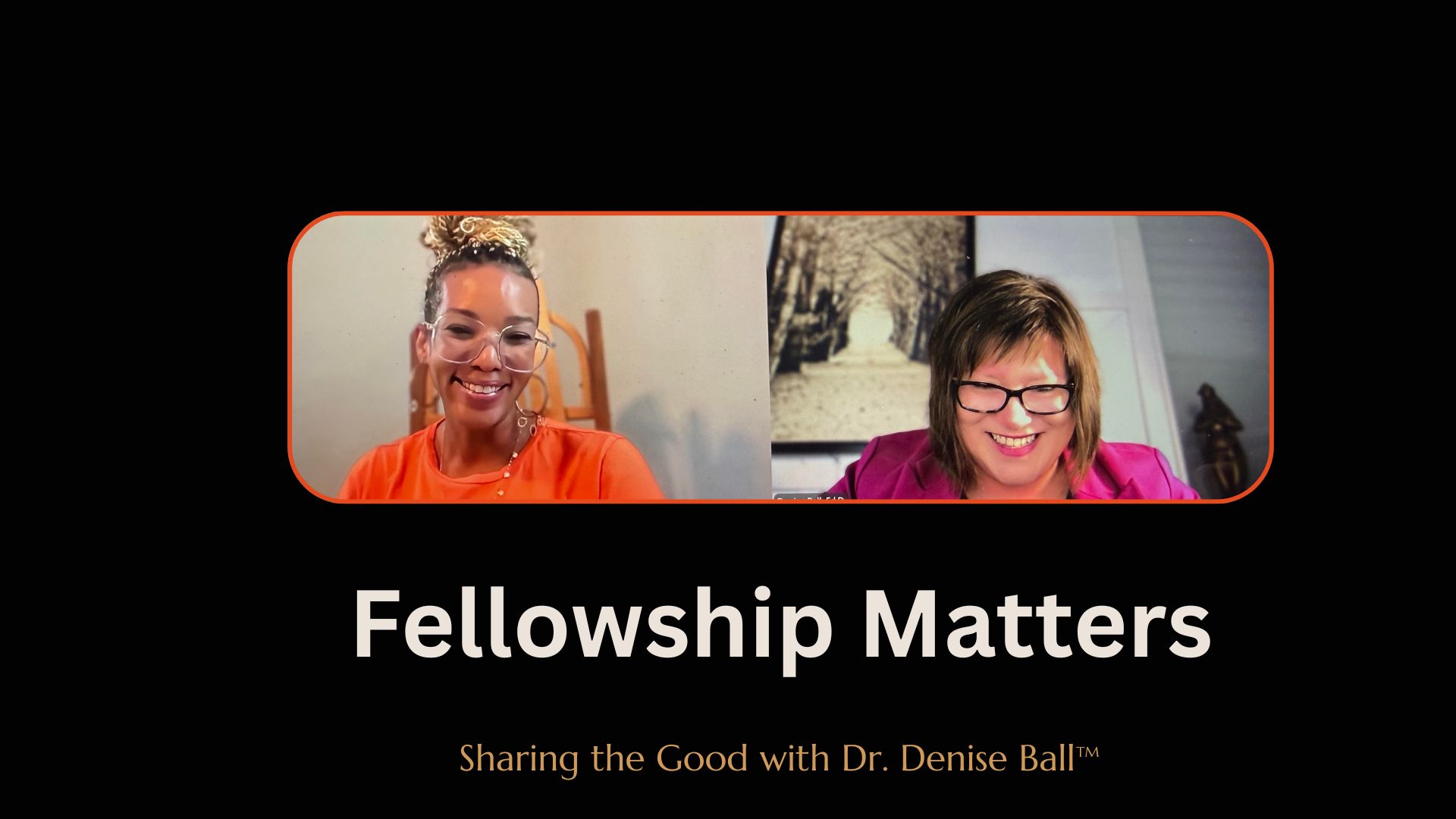
In my recent Sharing the Good with Dr. Denise Ball conversation, Dr. Nicci Dowd offered a beautiful reflection on the gift of fellowship and the importance of walking alongside others in faith, service, and community. Her words were a gentle reminder that fellowship is not simply about being with others. It is about being known, encouraged, strengthened, and reminded that we are not meant to do this work alone. Serving in education is a ministry (Dowd, 2026). [Dr. Nicci Dowd]
Educational leadership can be deeply meaningful, but it can also be lonely. Leaders are often called to hold the vision, solve the problems, support the team, manage the unexpected, and remain steady for others. Research on educational leaders’ well-being reminds us that positive relationships, purpose, engagement, health, and meaning are important dimensions of flourishing in leadership (Doyle Fosco, 2022). In other words, leaders do not thrive by carrying the work alone. They thrive when they are connected to people, purpose, and practices that restore them. Sometimes it might be easier to withdraw during these summer months, but I encourage you to reach out to a colleague or friend you have not talked with in a while and listen, share, and take joy from the fellowship.
Fellowship is one of those restoring gifts. It creates space for honest conversation, shared wisdom, prayerful encouragement, and the quiet reminder that someone else understands the road we are walking. For educational leaders, fellowship may come through a trusted colleague, a mentor, a faith-filled friend, a professional learning community, or a simple summer conversation over coffee. These moments may seem small, but they can become anchors of belonging. My quick and random chat with Nicci today was an instant bucket filler and reminded me of just how important these brief moments of fellowship are to spark inspiration and creativity.
Belonging matters because school communities are relational communities. Research continues to affirm that educator well-being is shaped not only by individual habits, but also by the relational and organizational conditions of the school community (Cann et al., 2022). When educators feel supported, respected, encouraged, and connected to a shared mission, the culture of the school is strengthened. When leaders model that same need for connection, they give others permission to seek support as well.
This is especially important for school leaders who are constantly pouring into others. Emotionally supportive leadership has been linked to educator well-being, especially during seasons of challenge and change (Floman et al., 2023). Leaders who listen, encourage, regulate their own emotions, and offer meaningful support help create healthier school environments. Yet leaders also need spaces where they can receive that same encouragement. Fellowship reminds us that the encourager also needs encouragement.
Summer offers a natural invitation to renew these connections. It is a time to step back from the constant urgency of the school year and ask a few important questions:
Who helped me carry the work this year?
Who might need to hear from me?
Who reminds me of the good?
Who helps me reconnect with faith, purpose, and joy?
Who can I encourage this week?
These questions are simple, but they are powerful. A text message, a phone call, a walk with a friend, a handwritten note, or an invitation to meet for coffee, jump on a quick Zoom (thank you, Nicci) can become a moment of grace. In a profession where so many people give so much of themselves, reaching out is not one more task but an act of caring for ourselves and others.
For those of us called to serve in education, fellowship also strengthens mission. Research on teacher retention highlights the importance of collegial support, trust, shared purpose, recognition, and leadership practices that build relationships within the school community (Ball, 2023 & Lochmiller et al., 2024). When leaders cultivate belonging, they help create communities where people are more likely to feel valued and more willing to remain committed to the work.
I encourage those who serve in education to view the summer not as a retreat from the mission but as preparation to return to it with a renewed heart. We pause so we can listen. We reflect so we can learn. We reconnect so we can remember that the work of education is not meant to be carried out in isolation.
Hebrews reminds us to “rouse one another to love and good works” and to encourage one another (Hebrews 10:24). That encouragement is not accidental but a muscle meant to be practiced. It is a choice and a service to others. It is part of building communities where faith, service, and joy can take root.
So, during these summer weeks, reach out. Call the colleague who lifted your spirit this year. Send a message to the friend who always helps you see the good. Thank the mentor who helped you keep going. Invite someone into conversation. Make room for fellowship. I jam every day on praise and worship. I try to share a link to a song at least once or twice a week with those who come to mind as I pray through song. Please be encouraged to share how you stay connected. This is a blog for learning!
We are better when we walk together…
When we train our eyes to see the good, amazing things happen.
May we continue to seek knowledge in all things,
Denise
References
Cann, R. F., Sinnema, C., Daly, A. J., Rodway, J., & Liou, Y.-H. (2022). The power of school conditions: Individual, relational, and organizational influences on educator wellbeing. Frontiers in Psychology, 13, Article 775614. https://doi.org/10.3389/fpsyg.2022.775614
Floman, J. L., Ponnock, A., Jain, J., & Brackett, M. A. (2023). Emotionally intelligent school leadership predicts educator well-being before and during a crisis. Frontiers in Psychology, 14, Article 1159382. https://doi.org/10.3389/fpsyg.2023.1159382
Lochmiller, C. R., Perrone, F., & Finley, C. (2024). Understanding school leadership’s influence on teacher retention in high-poverty settings: An exploratory study in the U.S. Education Sciences, 14(5), Article 545. https://doi.org/10.3390/educsci140505
Vendor Partner Middle School Mindset Portfolio of Services
The Middle School Mindset Portfolio of Services represents a unique national collaboration between: ADAC | William H. Sadlier | Friendzy | Archangel Education & Technology. An à la carte portfolio of resources.
ADAC, Inc.
ADAC partners with PK–12 schools, systems, and networks nationwide to help educators and leaders confidently meet the needs of every student.
Friendzy, Co.
An effective curriculum that teaches a new generation of students character development skills.
Curriculum Associates
Together with one million educators, we’re connecting every part of learning—from assessment to instruction, data to discovery—to empower classrooms and communities to thrive.
Archangel Education & Technology
Archangel brings a human touch to technology, blending passion, deep expertise, and a strong community focus to enrich educational experiences.
William H. Sadlier
Core and supplemental math programs teach the essentials students will use the rest of their academic and professional lives.
National Standards in Gifted and Talented Education
Standards provide a foundation for the policies, rules, and procedures necessary to deliver high-quality, systematic programs and services for high-ability students. Guidance and framework resources.
Standards and Assessments
Raising academic standards for all students and measuring student achievement to hold schools accountable for educational progress are central strategies for promoting educational excellence and equity in our Nation’s schools.
Odyssey of the Mind
An international educational program that provides creative problem-solving opportunities for students from kindergarten through college.
Math Chimps
Great online math games aligned to the Common Core State Standards~for ages 4-16
Team Building and Problem-Solving Strategies for the Classroom
Odyssey of the Mind
An international educational program that provides creative problem-solving opportunities for students from kindergarten through college.
Websites with Games and Activities Created by Authors
Oceanhouse Media
Great educational book apps and so much more. Check out often for FREE downloads to help your child learn letters, phonics & math!