Tag Archives: learning

Engage, Explore, Elect: Non-Partisan Classroom Activities on the Voting Process for K-8

Figure 1: Created by Denise Ball in Collaboration with Dall-E, 2024.

A positive learning environment contributes to improved academic performance, and greater student engagement (Aldridge & McChesney, 2018). It is an essential reminder that as K-12 educators, we are called to develop the minds of students, helping build a framework to embrace critical thinking and learn how to focus inquiry and imagination to solve problems that just one day might help the betterment of mankind. As educators, we develop classrooms to foster creative thought and model in word and action what it looks like to be kind, to show tolerance, compassion, forgiveness, and mercy. What an awesome responsibility we take on when we choose to make a difference in the classroom for the students placed in our care.

In a world that can often promote chaos, our classroom and school environments must be one of safety and peace. Classrooms that prioritize emotional safety and inclusion help students build resilience and improve their academic skills (Ryzin, Roseth, & Biglan, 2020). Classroom environments that are supportive and structured promote not only academic success but also social and emotional development in students Quinn, 2017). As we walk through the presidential voting season, we must remember that parents are the first teachers of their children. The political season can be one of intense emotion. However, as educators, we do not embrace the emotion or give in to the chaos of the world. Instead, we focus on creating and modeling positive learning environments for our students, parents, and co-workers. Teachers who create a positive classroom environment by fostering respect, collaboration, and support tend to see higher levels of student engagement and achievement (Havik & Westergard, 2020).

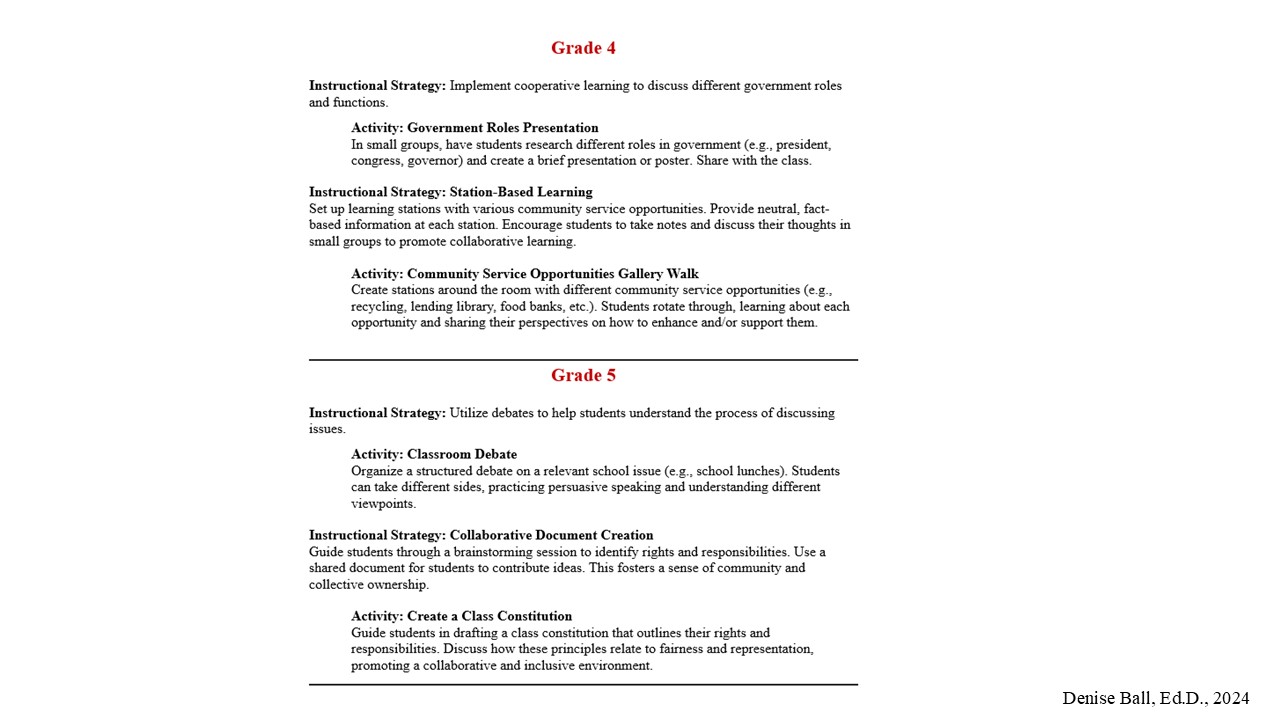
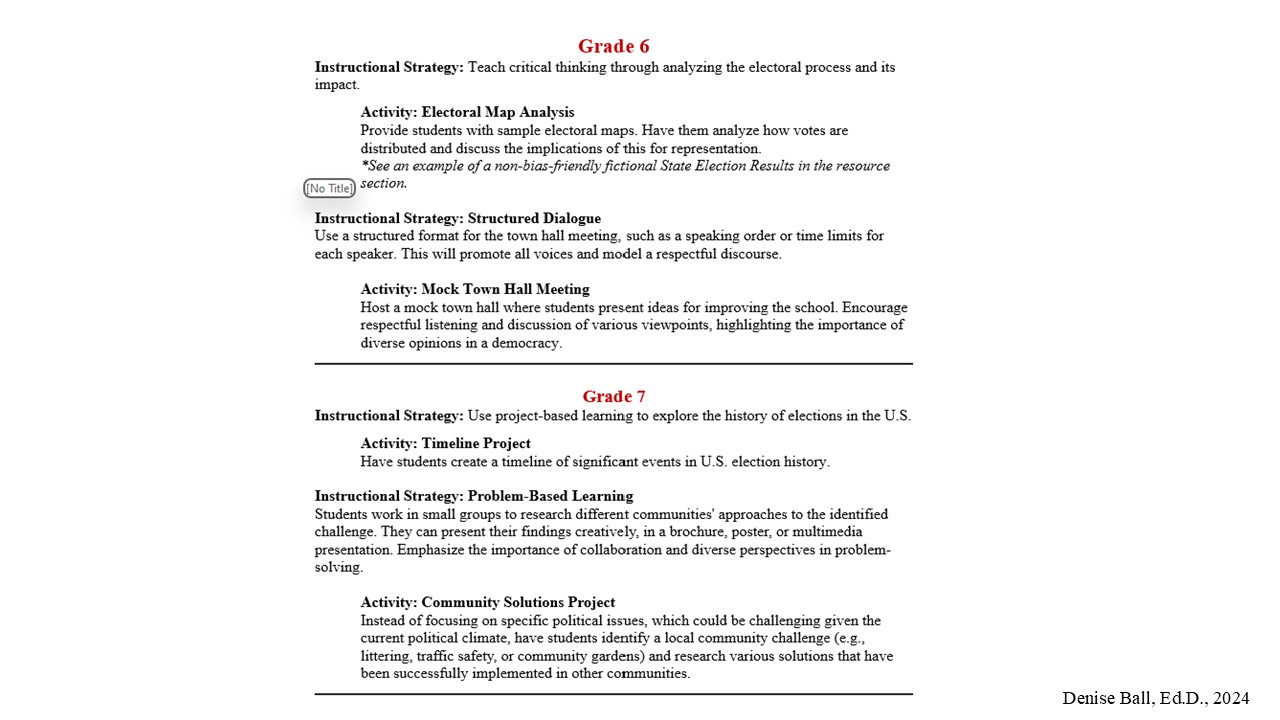
I have provided below some recommended non-partisan activities for students to help develop and promote critical thinking, and engage in learning about the electoral process while fostering a sense of civic responsibility without the emotional weight of real-world politics.

For all those who have chosen education as a career, thank you. You make a difference!

May we continue to seek knowledge in all things,

Denise

References

Aldridge, J. M., & McChesney, K. (2018). The relationships between school climate and adolescent mental health and wellbeing: A systematic literature review. International Journal of Educational Research, 88, 121-145.

Havik, T., & Westergard, E. (2020). Do teachers matter? students’ perceptions of classroom interactions and student engagement. Scandinavian Journal of Educational Research, 64(4), 488-507.

Quin, D. (2017). Longitudinal and contextual associations between teacher-student relationships and student engagement: A systematic review. Review of Educational Research, 87(2), 345-387.

Van Ryzin, M. J., Roseth, C. J., & Biglan, A. (2020). Mediators of effects of cooperative learning on prosocial behavior in middle school. Journal of Applied Developmental Psychology, 66, 101084.

Leave a comment

Filed under Creating a Positive School Culture, Curriculum Resources, Educational Resources, Educational Websites and Resources, Positive School Culture, Principals and Administrator Tools, Sharing the Good, Sharing the Good in Education

Engaging with Data: Key Takeaways from Thought-Provoking Sessions at the 5th Annual Ferguson Institute

I believe in sharing the good; words have power. There were so many words of wisdom shared over the last few days, I took pen to paper to capture a few words that spoke to me. I hope they inspire you or encourage reflection as you wrap up the 2023-24 school year. Please refer to the recommended resources for the names of some of the speakers who lit my fuse of curiosity this week. Never forget that to teach is a choice. To lead in education is a choice. The work you choose to do matters! Thank you for saying yes to the call to serve in education…

I found this week so engaging that I needed to pause and reflect to process the many data insights supported by research shared this week. There was such a dynamic cadre of national educational leaders that gathered in Dallas for this well planned and executed event. Many opportunities were provided to listen and discuss data and how to use data to inform decisions that effect student learning outcomes. I have a notebook of takeaways that I will spend some time with over the summer to unpack from attending the Curriculum Associates 5th Annual Ferguson Institute.

Denise Ball, Assistant Superintendent for Teaching and Learning/Lori Chaney, Curriculum Associates, Director of Sales, Mid-Atlantic/Kelly Branaman, Secretary for Catholic Schools and Superintendent of Schools

Key Takeaways:

1. It is important to come together; educating students takes a community.

The power of collaboration in education was a resounding theme at the Ferguson Institute. The diverse perspectives and experiences shared among those present served as a powerful reminder that the education of our students is a collective endeavor, not an individual one.

2. As educational leaders, we need to ensure we are providing teachers with opportunities to create environments where students feel “invited” to learn and that we are embracing and using data across all grade levels.

Creating inviting learning environments is crucial. By leveraging data, we can tailor these environments to meet the needs of every student, fostering an inclusive and supportive atmosphere that encourages engagement and learning.

Hattie, John. “Foster a Learning Culture.” 2024. What Brings You Joy. 5th Annual Ferguson Institute.

3. Remember never to underestimate a student’s potential and that every child is a capable mathematical thinker. Wouldn’t it be amazing if all students believed they were capable mathematical thinkers? Expecting excellence will transform a school culture!

At the heart of our educational mission is the belief in the untapped potential of every student. By fostering a culture of high expectations and support, we can empower our students to see themselves as capable mathematical thinkers, thereby transforming the overall school culture. Embracing this thought process might also require some professional development to ensure your faculty sees a capable mathematical thinker in every student. Let us enter the conversation…

4. Continue to seek to be inspired, encourage one another and the students placed in your care. Do not edit out the innovation; create environments for students and teachers that promote curiosity and inquiry.

Innovation should be at the heart of our educational practices. By nurturing curiosity and inquiry, we can create dynamic learning environments that inspire both teachers and students to explore, experiment, and grow.

Hattie, John. “Students are Engaged in their Learning.” 2024. What Brings You Joy. 5th Annual Ferguson Institute.

5. Building capacity through teaching inference and evaluating the impact is essential.

Teaching inference is essential for developing critical thinking skills. Evaluating the impact of our teaching practices ensures that we are effectively building these capacities in our students and continually improving our methods.

6. Hearing school districts share their data story was inspirational and provided opportunities for rich data dialogue. Hearing that achievement is up half a grade level equivalent in one year was simply a testament that the i-Ready curriculum and assessment resources make a difference!

The success stories shared by various school districts were both inspiring and affirming. The significant improvements in student achievement underscore the effectiveness of the i-Ready curriculum and assessment resources in enhancing educational outcomes.

Sullivan, Mark. Birmingham City Schools. 2024.

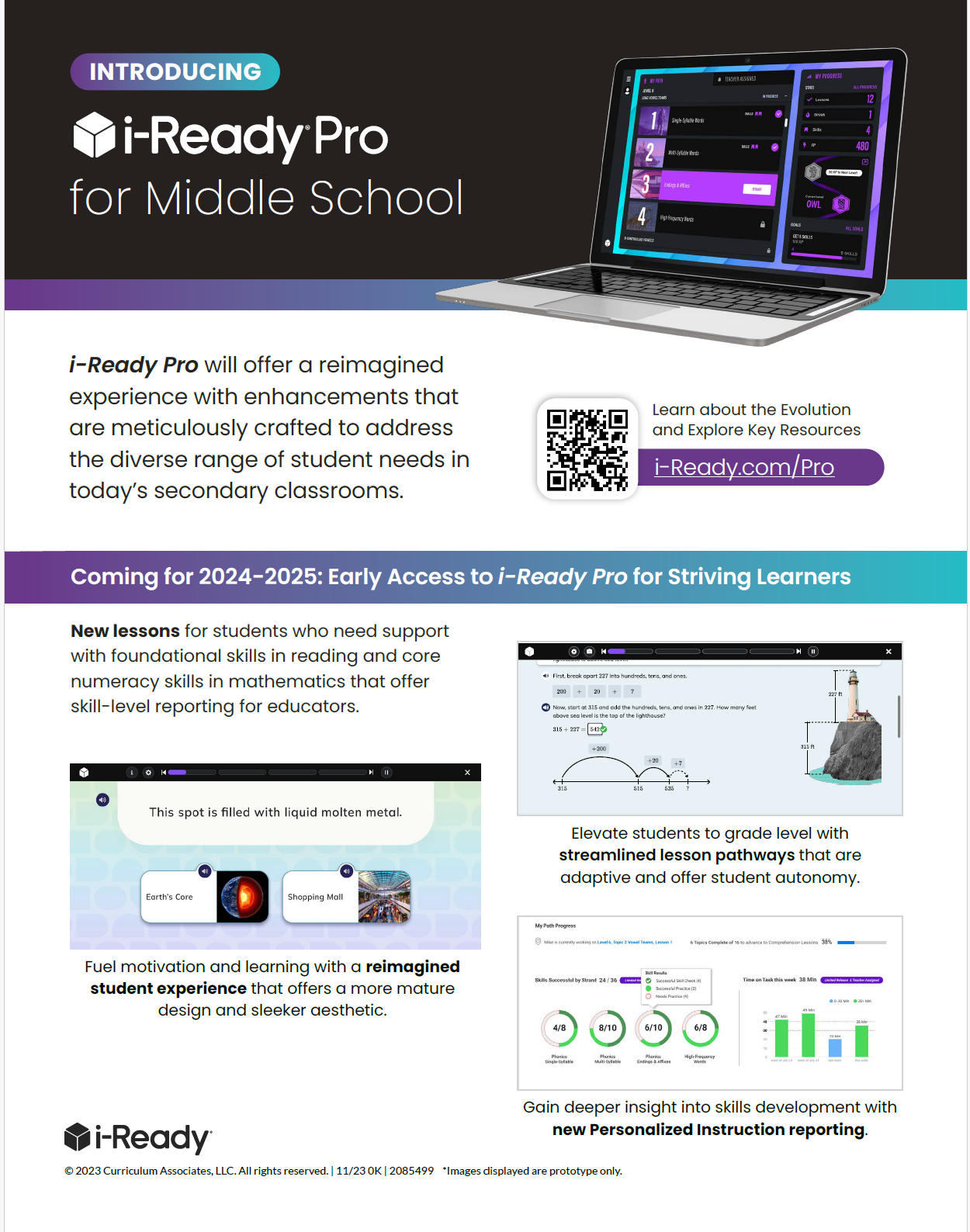
7. Curriculum Associates stimulates inquiry…always growing and improving through research and collaboration where speech recognition, Algebra I, and i-Ready Pro initiatives will be student game changers.

Curriculum Associates’ commitment to continuous growth and improvement through research and collaboration is evident in their innovative initiatives. These advancements promise to be transformative for students, particularly in areas like speech recognition and Algebra I.

8. One gold nugget that is life-affirming is to embrace the errors. No one says no to better!

Embracing errors as opportunities for growth is a powerful mindset. It reminds us that continuous improvement is always possible, and every mistake is a step towards betterment.

The world is chaotic, and we are called to be a positive light for the students and parents in our care. We must have courage, and as reflective practitioners, we must remember to reflect often on what brings us joy. Nothing great happens in the absence of enthusiasm. Build that playlist this summer, sing aloud and dance. Get energized to develop a personal and professional framework for greatness for the 2024-25 school year.

I am leaving Dallas and headed back to D.C. with the clear understanding that Curriculum Associates is an organization where everyone believes that every child deserves to be on grade level. It has been an exceptional week, enriched with data discussions with passionate school and district leaders committed to making a difference in a child’s life. I look forward to continuing to unpack all that I learned with my team and the school leaders I serve, strengthening the relationships developed and lessons learned while engaging with data at the 5th Annual Ferguson Institute.

Whitepaper: Culturally Responsive Mathematics Teaching (curriculumassociates.com)

School Readiness for Young Students Post-Pandemic (curriculumassociates.com)

Rethinking Middle School Math Acceleration (curriculumassociates.com)

Student-Focused AI Capabilities

Leave a comment

Filed under Blogs that Inspire Us, Curriculum Resources, Education Leadership Conferences, Educational Websites and Resources, Inspiration, Interesting Topics, Sharing the Good, Sharing the Good in Education

Top Five Recommended “Musts” to Ensure Teachers Feel Valued Before the Summer Pause

It is an exciting time, but this season of transition can be chaotic and often stressful for faculty, staff, students, and parents. A little bit of grace this time of year goes a long way.

When I was a school leader, I used to tell my staff that the end of the year was a time for putting on the “red shoes”…making sure to leave home needs at home and embracing each day with purpose; we are called to be the difference. Retention data shows that it is important now more than ever to ensure that all stakeholders end the year on a high note.

A school climate affects teacher satisfaction, morale, and expectations about staying in the profession (Garcia & Weiss, 2019). A high percentage of teachers do not feel appreciated, and this feeling can have an impact on their choice of staying or leaving the classroom. It would be beneficial for society to remember that teaching remains an extraordinarily noble profession with intrinsic rewards that few other disciplines experience (Vocke & Foran, 2017). There are many ways to show teachers support. Below are my five recommended “musts” to finish the school year strong, ensuring teachers feel valued.

Top Five Recommended “Musts” to Ensure Teachers Feel Valued Before the Summer Pause

  1. Handwritten Thank-You Notes: Write personalized notes to each teacher, highlighting specific contributions and expressing sincere gratitude. Encourage faculty and staff to write anonymous notes to one another. Positive energy is synergistic!
  2. Public Acknowledgment: Use school newsletters, social media, and assemblies to publicly recognize and celebrate teachers’ achievements and dedication. Use these last few weeks of school to promote and share the good that has happened on your school campus. Sharing the good can change a school’s culture.
  3. Classroom Resources: Provide teachers with additional resources or gift cards for classroom supplies as a token of appreciation and to ease their financial burden as they begin to plan this summer for the upcoming school year.
  4. Professional Development Stipends: Offer a stipend or provide a gift card for summer professional development courses, or educational reading materials, indicating investment in their continued growth.
  5. End-of-Year Celebration: Host a celebratory event to honor teachers’ hard work and achievements throughout the year. Include awards or small gifts to show appreciation. Have a discussion on the theme for the upcoming school year to help give direction (which will reduce stress) in helping teachers plan over the summer.

Give your team permission to put an “out of office” message on their email for a period of time to spend with family and friends, recharging so they can be all they are called to be for the upcoming school year. Building in a “time to pause” into one’s daily schedule, will allow teachers to come back to campus more creative, energized, and ready to accomplish team initiatives for the new school year.

Photo Credit: Anna Quattrone, Director of Marketing and Enrollment

Ultimately, it is essential to never underestimate the importance on greeting your faculty and staff as they begin the school day, providing an encouraging word or smile, and making sure your team members feel seen and heard. Teachers choose to serve in schools where they feel welcomed and appreciated.

Regardless of the time of year, it is always a good idea to thank a teacher for choosing to teach!

May the last few weeks of school be filled with joy and peace!

Denise

Denise Ball, Ed.D.

Recommended Reading

Carver-Thomas, D., & Darling-Hammond, L. (2019). “The Trouble with Teacher Turnover: How Teacher Attrition Affects Students and Schools.” Education Policy Analysis Archives, 27(36).

Kraft, M. A., Papay, J. P., Charner-Laird, M., Johnson, S. M., Ng, M., & Reinhorn, S. K. (2020). “Educator Work Environments and Teacher Effectiveness: A Two-Year Longitudinal Study of Teaching Assignments.” Educational Evaluation and Policy Analysis, 42(3), 436-460.

Podolsky, A., Kini, T., Bishop, J., & Darling-Hammond, L. (2019). “Strategies for Attracting and Retaining Educators: What Does the Evidence Say?” Education Policy Analysis Archives, 27(38).

Leave a comment

Filed under Curriculum Resources, Teacher Retention and Recruitment

Never Underestimate the Power of Believing in a Child

As educators, we have been blessed with an awesome responsibility to educate the whole child to become productive citizens and leaders of tomorrow.

As an administrator, one of the blessings of my job is to help my faculty and staff be the best they can be in the lives of those placed in their care.

Simple reminders:

*to greet students at the door and actually “see” them each day

*to remember that as an educator, we are the rational adult called to model behaviors for our students…forgiveness, flexibility, humor, compassion etc.

*it is okay for students to know that mistakes have been made or something is not “known” …demonstrate how to build the muscle of “recovery” and “collaboration”

Never underestimate the power we have in lifting up our students to new heights…if you BELIEVE they will ACHIEVE!


May we continue to seek knowledge in all things~

Denise

image

Leave a comment

Filed under Blogs that Inspire Us, Curriculum Resources, Inspiration, Team Building/Positive Work Environments

Summer is a Time for Learning through Play-Carpe Diem

During the school year, we reflect on summers past and the next one to come and we remember treasured times of relaxation.  However, sometimes we get so caught up in our scheduling and planning of events, that we forget to just pause, relax and allow our children…and ourselves to play.

If you find upon reflection that you and your family fit into the latter category this summer, I want to encourage you to pause, choose two good books to read and “schedule” some time into you weeks ahead to just “be”…to allow your children to play with some containers and a water hose in the yard, to research finger foods online and allow your children to make dinner for the adults in the house one night…they will have so much fun and you will be amazed at how much they have grown. 🙂

Our team has collected some helpful tips to ensure that summer is indeed a time of relaxing and learning, for you and the child(ren) in your life.

Moms who Think

Moms who Think, is a great site for recipes, diet and nutrition, holiday and celebration ideas and so much more.

Kid Recipes

Easy and Kid-Friendly Recipes from Kraft Foods

Kid-Friendly Recipes

Rachel Ray Everyday …a great family website!

Rachel Ray’s Kid-Friendly Recipes

Martha Stewart and Summer Activities for Kids~We like the summer housekeeping and garden in a jar 🙂

60 Activities for Kids this Summer

Great Schools, Involved Parents, Successful Kids is an amazing website!

Ten Ways to Keep your Child Learning this Summer

Given that we like to promote the good in education, we would like to share the Department of Education’s Office of Educational Research and Improvement‘s recommendation for parent/child involvement this summer:

Every Day…

  • Give your child a hug and say “I love you.” Do not forget to look them in the eye, to ensure that you make that special connection with them.
  • Praise your child. We all like to hear that we are doing a good job…it is o.k. and encouraged to tell your child(ren) often.
  • Talk with your child. I encourage you to not only talk with your child, but read the same book they are reading independently, specifically if your child is 7-18.  This will always give you something to talk about with them…a common ground.
  • Read and write with your child for at least 30 minutes every day. My children keep journals and we write and share about what we are passionate about. (When children are little, pictures in journals versus words are just as good…let your child explain their pictures to you.)
  • With your child, make a dictionary of new words and add to it every day. Studies have shown that the more words we learn, the higher our IQ…make it a family activity to choose a word or few words a week and have some fun at the dinner table using these words.
  • Count with your child. Math is everywhere, in the grocery store on labels, on the road as we drive…make it a fun exercise to play Eye Spy math or numbers with your child.  The more that children can be exposed to numbers in their world and what they are utilized for, the more understanding they will have for math.
  • Listen to music with your child. There are many positive studies on why this is important. Studies have shown, that memory retention and learning is enhanced while studying and listening to classical music.

May your summer, or what is left of it, be a time of renewal and rejuvenation for both you and the child in your life. Learning can indeed be fun and relaxing, it just might take a bit of planning.  We encourage everyone to live in the moment and choose to be the difference in the life of your child.

Please share your tips and favorite websites with us and we will post it here for all of our readers.  Together we can make a difference!

May we continue to seek knowledge in all things~

Denise

1 Comment

Filed under Summer Learning Tips

Suggested Summer Reading for Teachers and those who Play a Role in the Life of a Child

Having written my thesis on phonics, I found this book a good and reflective read. I am still a believer in the importance of phonics in the classroom and at home but I am and feel we as educators must be, open to others views and opinions. I learned a lot from this book and highly recommend it for your summer “must read” list.

“The Great Reading Disaster: Reclaiming Our Educational Birthright” by Mona McNee and Alice Coleman

Amazon’s Book Description:


“By the late 1980s half the nation’s children were receiving eleven years of progressivism schooling that failed to give them even the elementary basis of education that was completed by the age of seven in earlier days. This great reading disaster was caused by the ?look?say? method of teaching, which presented whole words not individual letters. This book explains the causes and provides the solution to this problem. In 2006, the Secretary of State for Education and Skills has ordered schools to use the phonic method but there seems little evidence that its implications are properly understood or that any serious re-training program for teachers is being put in place. The authors believe their explanations and recommendations in this book are thus needed just as much as ever.”


The next book is an excellent read and has sat in my office on my book shelve for a couple of years now. I have lent it out many times now in hopes that it might inspire those who read it to refuse to give into the easy path and CHOOSE to be the difference in the life of our children…our future! Our Unlock the Teacher team has talked on this before on how we feel ALL children are capable of learning. I know many have heard me tell the story of when I taught in the city and I was told that my students could not or would never understand Shakespeare, so I should not waste my time. Well, not only did my 8th grade English/Literature students learn all about Shakespeare, The Tempest became one of their favorite reads that year. Much of how our students respond in our classrooms or buildings depends most on how we choose to approach our environment and communicate learning expectations. I highly recommend this book for all educational staff and parents too!


“Dumbing Down Our Kids: Why American Children Feel Good About Themselves but Can’t Read, Write, or Add”


Amazon’s Book Description:


Dumbing Down Our Kids is a searing indictment of America’s secondary schools one that every parent and teacher should read.
Dumbing Down Our Kids offers a full-scale investigation of the new educational fad, sometimes called “Outcome Based Education” the latest in a long series of “reforms” that has eroded our schools.
-Why our kids rank to, or at the bottom of international tests in math and science

-Why “self-esteem” has supplanted grades and genuine achievements

-How the educational establishment lowers standards and quality in our schools-while continuing to raise their budgets and our school taxes

-The dumbing down of the curriculum so everyone can pass-but no one excel

-How parents, students, and teachers can evaluate schools and restore quality learning.


If you have a good book to recommend or your staff has chosen a book to read as a team, please share and together we can learn from each other. It is in the collaborative process that we will make a difference for our children of today and the future of tomorrow.


May we continue to seek knowledge in all things,


Denise


1 Comment

Filed under Best Practices from Awesome Educators, Curriculum Resources, Recommended Books to Read, to Learn, to Inspire

Educational Websites to Utilize in the Classroom for Grades 4-12

At a recent principal’s meeting, the Web 2.0 presenter showcased some fabulous online resources that any 21st century educator could utilize to enhance classroom instruction.

www.qwiki.com

This site includes multimedia components and visual displays for presentations.  *Very user-friendly.

www.lessonstream.org

Present information to students integrating a multimedia format.

www.vocabahead.com

Identify real-life connections between words and their use.  *This is a great tool…words with videos!

www.khanacademy.org

This is a site where students can retell stories to demonstrate an understanding of concepts.

www.bitstrips.com

This is an A-M-A-Z-I-N-G site for teachers to utilize really grades 2 on up.  Students can create animated cartoon strips by utilizing a combination of drawing, dictating and writing to narrate a single event or several loosely linked events. This site also has a homework component…great vocabulary builder and speaks to the visual learner.

www.60secondrecap.com

Compare and contrast two or more characters, settings or events in a story or drama. *neat site

www.visuwords.com

Demonstrate understanding of figurative language, word relationships and nuances in word meanings.

www.owl.emglish.purdue.edu

Demonstrate command of the conventions of standard English capitalization, punctuation, and spelling when writing.

www.froguts.com

Great virtual dissects to utilize in class with students.

www.jeapardylabs.com

Draw on information from multiple print or digital sources to locate an answer to a question quickly or to solve a problem efficiently.

www.storybird.com

Add drawings to displays and stories.

This is just a few of the many resources available online. 


May we continue to seek knowledge in all things,

Denise

Leave a comment

Filed under Curriculum Resources, Educational Websites and Resources, Educational Websites that are FREE

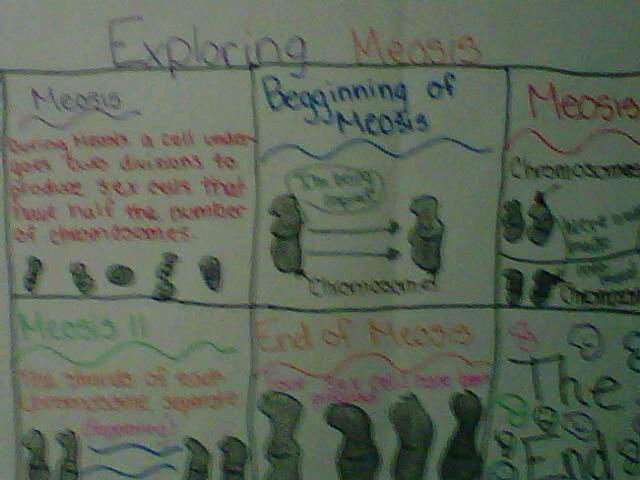
6th Grade Teacher Makes Science Fun with Cell Process Cartoons

Who said science wasn’t fun?
While in a school today (St. Mary School Royal Oak, Michigan), I stopped to look at these fabulous displays of creativity.  Not only was this hallway display colorful and creative, it was educational and funny!


We would love to share your classroom Best Practices with our readers. It is in this collaborative process, that we all grow as educators…as parents…as a society!  Good ideas are meant to be shared.  We try to share them as often as we can!


May we continue to seek knowledge in all things,
Denise


Leave a comment

Filed under Best Practices from Awesome Educators, Science, Sharing the Good

From Basic Math Facts to Fractions…Online Learning Math Resources

BASIC FACTS

A+Math

Online flashcards and games for math practice.

Cool Math Games
Fun math games.

Funbrain.com-Math Baseball

Fun game teaches addition, subtraction, multiplication, division, and elementary algebra.

Math Fact Cafe-Flashcards

Online flashcards for the elementary grades.  *** I really like this one!

Math Magician Games

More online flashcards, but in a timed setting and a progress report can be printed when finished.

Factor Game

Play this online version of the “Factor Captor” game in 5th Grade Everyday Mathematics.

F-R-A-C-T-I-O-N-S

AAA Math 

Covers all fraction topics.  NOTE:  I think this is a fabulous site for scaffolding the learning process for all things fractions!

FUNBRAIN-Fresh Baked Fractions

A game for simplifying fractions.

Learning Planet.com-Fraction Frenzy

Use a game to practice matching equivalent fractions.

Visual Fractions

Practice identifying fractions and operating with fractions. 

These are some great math sites I found while conducting research this morning.  The fractions sites are so good, that I had to share.  I hope these websites help make the learning process fun for your math learner!

May we seek knowledge in all things,

Denise

1 Comment

Filed under Educational Websites and Resources, Educational Websites that are FREE, Learning is Fun Lessons/Activities, Student or Industry

Reading/Literacy Grant Sources Part II…Our Recommendation=Have a Grant Writing Party Once a Month

  1. A.     Target

Early Childhood Reading Grants

Reading is essential to a child’s learning process. That’s why Target awards grants to schools, libraries and nonprofit organizations to support programs such as after-school reading events and weekend book clubs. Together we’re fostering a love of reading and encouraging children, preschool through third grade, to read together with their families.

Early childhood reading grants are $2,000. Grant applications are typically accepted between March 1 and April 30 each year, with grant notifications delivered in September.  Submit application online: www.target.com/grants    

  1. B.     AASL Collaborative School Library Media Award

This award recognizes and hopes to encourage collaboration and partnerships between school library media specialists and teachers in meeting educational goals outlined in Information Power: Building Partnerships for Learning through joint planning of a program, unit, or event in support of the curriculum and using media center resources. www.ala.org

  1. C.    AASL Innovative Reading Grant

Established in 2006, the $2,500 AASL Innovative Reading Grant supports the planning and implementation of a unique and innovative program for children which motivates and encourages reading, especially with struggling readers. www.ala.org

  1. D.    Adopt-A-Classroom Grants

Teachers who register at the Adopt-a-Classroom web site can be adopted by an individual, a business, or a foundation. Once adopted, teachers will receive $500 worth of credit to purchase items that enrich the learning environment, including classroom technology. Teachers help solicit their own sponsors by downloading and distributing fliers within their community or by sending out a personalized, pre-written email from the Adopt-a-Classroom web site. Every donor receives information about the classroom it has adopted, including an itemized list of what teachers bought so donors can see the impact of their donation. (This sounds SO cool!) www.adoptaclassroom.org

  1. E.     Braitmayer Foundation Grants

The Braitmayer Foundation supports programs that enhance the education of K-12 students through curricular and school reform initiatives, professional development for teachers, and local community efforts. Its grants, which range in size up to $35,000, are to be used as seed money, challenge grants, or to match other grants to the recipient organization. www.braitmayerfoundation.org

  1. F.     Cable’s Leaders in Learning Awards

To honor innovative individuals who have made major contributions to transform K-12 learning in and out of the classroom, the cable industry\’s education foundation has launched the Cable\’s Leaders in Learning Awards. The competition is open to any individual working in U.S. communities who can demonstrate innovative practices or policies that have had an impact on K-12 education. Twelve winners will be selected in four categories. The nomination period opens Oct. 1. 2011  www.leadersinlearningawards.org (This organization is on break for 2010, but their site is a good resource to pick from when writing other grants.)

  1. G.    Computers for Learning

Through its Computers for Learning program, the federal government has placed hundreds of thousands of surplus computers in schools across the country on a needs-first basis. Schools register and request equipment on the Computers for Learning web site, and federal agencies match their surplus equipment to schools with those needs. Most, but not all, of the available computers are Windows-based PCs rather than computers made by Apple. Most of the donated machines are older models, but as the government continues to upgrade its computer systems, the number of surplus Pentium computers will sharply increase. www.computersforlearning.gov

Thank you for all you do in the life of a child!

May we continue to seek knowledge in all things!

Denise

Leave a comment

Filed under Grants and Funding Resources, Hot Topics in Education