Tag Archives: School Climate

A Reflection for Leaders this Season…the Gift of Being Present!

Denise Ball, Ed.D.

This time of year brings both joy and complexity for teams across all industries. Research consistently shows that workplace stress, emotional fatigue, and decreased attentional capacity tend to rise during the winter months, particularly during the holiday season when competing demands intensify for employees at all levels (American Psychological Association, 2024).

Given this, leaders play a uniquely important role in setting the emotional temperature of their organizations. When leaders intentionally “tune in” …listening deeply, being present in conversations, and noticing subtle shifts in team dynamics, they build trust and psychological safety. These conditions not only support employee well-being but also increase engagement and organizational resilience.

Presence Sets the Tone for Culture

Our words and actions create a cultural ripple effect. Decades of organizational research confirm that when leaders model behaviors such as pausing, unplugging, and expressing gratitude, teams experience boosts in creativity, problem-solving, and productivity (Fritz et al., 2011). A leader’s ability to slow down, notice the good, and encourage moments of reflection signals to employees that rest is not a reward…it is a strategic imperative for sustained excellence.

Encouraging teams to pause, breathe, and “see” the good around them begins at the top.

When leaders embrace presence, the positive emotional contagion can be transformational. It builds cultures where affirmation outpaces anxiety, where collaboration thrives, and where people feel supported, valued, and energized to contribute their best.

Training Our Eyes to See the Good

There is so much good in this world. When we train our eyes to see the good, amazing things happen (Ball, 2025). This simple but profound shift in perspective changes how we lead, how we treat others, and how we interpret the moments unfolding around us.

In seasons where work accelerates and expectations multiply, choosing to notice goodness requires intention. If leaders can tune in and be present, it pays dividends in hope, clarity, and renewed purpose for those they lead.

The Gift and Responsibility of Leadership

It is a gift to lead. It is essential to remember the profound impact we have on those we choose to serve. Leadership is not merely a set of tasks or strategies; it is embodied influence.

People feel our presence before they hear our message.

They notice our pace before they follow our direction.

As we enter this season, may we be reminded that our teams do not need perfection from us, they need presence. They need leaders who model steadiness, gratitude, and attention to what matters.

They need leaders who see the good and call it forth in others.

When leaders are present, cultures strengthen. When leaders slow down, teams rise…and when leaders choose to see the good, amazing things truly happen.

References

American Psychological Association. (2024). Psychological safety in the changing workplace: Work in America 2024 report. https://www.apa.org

Ball, D. (2025). Strengthening schools from within: The impact of leadership and culture on teacher retention [Conference presentation]. Oxford University Educational Research Symposium, Oxford, United Kingdom.

Fritz, C., Lam, C. F., & Spreitzer, G. M. (2011). It’s the little things that matter: An examination of knowledge workers’ recovery experiences. Academy of Management Journal, 54(4), 835–855. https://doi.org/10.5465/amj.2011.0486

Leave a comment

Filed under leadership

Be a Distributor of Joy and Change the Teacher Attrition Rate

Blackaby (2015) reminds us that a positive school culture begins with a service-oriented mindset. Leaders must build a clear vision of the kind of school environment they want to cultivate for teachers, students, and families. Building a strong team and a positive school culture requires shared leadership, collaboration, and a focus on teacher well-being.

School leaders must be present and care enough to listen and enter the difficult conversation(s). Joy must be modeled by the school leader in both word and action…it is synergistic and transformative for a school team and a school campus/community. At the heart of teacher retention lies a simple but profound truth—joy!

As educational leaders, we must be builders and distributors of joy, creating school cultures where educators are not just sustained but inspired. Joy is not just an outcome of a thriving school environment, it is the very foundation upon which leadership, professional learning, culture, and a positive school team interconnect and strengthen one another.

When leaders cultivate environments where teachers feel valued, when professional learning is meaningful and collaborative, when school culture is intentionally shaped with positivity and respect, and when teams work together with a shared purpose, joy emerges.

The discussion on teacher retention was important pre-COVID and is essential post the pandemic when many teachers are still struggling. Teachers need to pause and take the time to reflect and acknowledge the work it took to walk through that period, celebrate the amazing things that occurred due to their hard work and service to others, so they can close the chapter and get back to the joy of education that attracted them to the profession in the first place.

The conversation on teacher retention and the importance of school leadership and a positive school culture continues…

May we continue to seek knowledge in all things,

Denise

1 Comment

Filed under Curriculum Resources, Teacher Retention and Recruitment

Listening, Learning, and Leading: A Conversation on Teacher Retention


Teacher retention is not just a policy issue, it is  a deeply personal one. Behind every statistic is a teacher who has dedicated their time, energy, and heart to shaping the next generation. The reasons educators stay or leave are complex, intertwined with school culture, leadership, and professional fulfillment. The most effective way to address teacher retention is simple yet profound: we must listen.


As school leaders, we have an obligation to understand the realities our teachers face, to hear their challenges, and to amplify their successes. Listening is not just a courtesy, it is  a leadership strategy. When teachers feel valued, heard, and supported, they are more likely to stay and thrive.


It was an incredible honor to be invited to lead a discussion on teacher retention as part of the ADAC Answers series. With over 240 school leaders from 40 states and the District of Columbia, registered and representing public, private, faith-based, and international schools. These leaders represented approximately 34,000 teachers and 370,000 students. This conversation reflects a national and global commitment to addressing one of the most pressing challenges in education today.


Bringing together diverse voices across governance models allows us to see the common threads in teacher retention and explore meaningful, research-based solutions. Whether it is mentorship programs, school climate initiatives, or leadership development, the strategies we discussed are not just theories, they are actionable pathways to strengthening our schools from within.


I am grateful for the opportunity to engage in this dialogue and to learn from the experiences of so many dedicated leaders. The work of teacher retention is ongoing, but together, through thoughtful leadership and a commitment to listening, we can make a lasting impact.

If you were unable to join yesterday, you can watch the full recording on ADAC’s Video Resources page.


https://loom.ly/1yvAmBo

May we continue to seek knowledge in all things,

Denise

Leave a comment

Filed under Curriculum Resources, teacher retention, Teacher Retention and Recruitment

Top Five Recommended “Musts” to Ensure Teachers Feel Valued Before the Summer Pause

It is an exciting time, but this season of transition can be chaotic and often stressful for faculty, staff, students, and parents. A little bit of grace this time of year goes a long way.

When I was a school leader, I used to tell my staff that the end of the year was a time for putting on the “red shoes”…making sure to leave home needs at home and embracing each day with purpose; we are called to be the difference. Retention data shows that it is important now more than ever to ensure that all stakeholders end the year on a high note.

A school climate affects teacher satisfaction, morale, and expectations about staying in the profession (Garcia & Weiss, 2019). A high percentage of teachers do not feel appreciated, and this feeling can have an impact on their choice of staying or leaving the classroom. It would be beneficial for society to remember that teaching remains an extraordinarily noble profession with intrinsic rewards that few other disciplines experience (Vocke & Foran, 2017). There are many ways to show teachers support. Below are my five recommended “musts” to finish the school year strong, ensuring teachers feel valued.

Top Five Recommended “Musts” to Ensure Teachers Feel Valued Before the Summer Pause

  1. Handwritten Thank-You Notes: Write personalized notes to each teacher, highlighting specific contributions and expressing sincere gratitude. Encourage faculty and staff to write anonymous notes to one another. Positive energy is synergistic!
  2. Public Acknowledgment: Use school newsletters, social media, and assemblies to publicly recognize and celebrate teachers’ achievements and dedication. Use these last few weeks of school to promote and share the good that has happened on your school campus. Sharing the good can change a school’s culture.
  3. Classroom Resources: Provide teachers with additional resources or gift cards for classroom supplies as a token of appreciation and to ease their financial burden as they begin to plan this summer for the upcoming school year.
  4. Professional Development Stipends: Offer a stipend or provide a gift card for summer professional development courses, or educational reading materials, indicating investment in their continued growth.
  5. End-of-Year Celebration: Host a celebratory event to honor teachers’ hard work and achievements throughout the year. Include awards or small gifts to show appreciation. Have a discussion on the theme for the upcoming school year to help give direction (which will reduce stress) in helping teachers plan over the summer.

Give your team permission to put an “out of office” message on their email for a period of time to spend with family and friends, recharging so they can be all they are called to be for the upcoming school year. Building in a “time to pause” into one’s daily schedule, will allow teachers to come back to campus more creative, energized, and ready to accomplish team initiatives for the new school year.

Photo Credit: Anna Quattrone, Director of Marketing and Enrollment

Ultimately, it is essential to never underestimate the importance on greeting your faculty and staff as they begin the school day, providing an encouraging word or smile, and making sure your team members feel seen and heard. Teachers choose to serve in schools where they feel welcomed and appreciated.

Regardless of the time of year, it is always a good idea to thank a teacher for choosing to teach!

May the last few weeks of school be filled with joy and peace!

Denise

Denise Ball, Ed.D.

Recommended Reading

Carver-Thomas, D., & Darling-Hammond, L. (2019). “The Trouble with Teacher Turnover: How Teacher Attrition Affects Students and Schools.” Education Policy Analysis Archives, 27(36).

Kraft, M. A., Papay, J. P., Charner-Laird, M., Johnson, S. M., Ng, M., & Reinhorn, S. K. (2020). “Educator Work Environments and Teacher Effectiveness: A Two-Year Longitudinal Study of Teaching Assignments.” Educational Evaluation and Policy Analysis, 42(3), 436-460.

Podolsky, A., Kini, T., Bishop, J., & Darling-Hammond, L. (2019). “Strategies for Attracting and Retaining Educators: What Does the Evidence Say?” Education Policy Analysis Archives, 27(38).

Leave a comment

Filed under Curriculum Resources, Teacher Retention and Recruitment

A Positive School Climate=STRONG Teacher Retention

In the midst of teacher discernment, where educators contemplate the decision to stay or leave the classroom at the end of the school year, the role of school leaders becomes pivotal in shaping the trajectory of teacher retention. Investing time in building and maintaining a positive school culture emerges as a crucial strategy for retaining teachers. The impact of teachers on society is emphasized in research, underscoring the need for schools to promote this message as part of their teacher retention efforts (Dutta & Sahney, 2016). Examining the interconnected dynamics of climate, teacher retention, and the leadership’s role in fostering a positive environment is paramount.

Studies, such as those conducted by Malinen & Savalainen (2016), highlight the significant influence of a teacher’s perceived school climate on job satisfaction, burnout, and self-efficacy. The pervasive issue of teacher stress, compounded by the challenges of the pandemic, further emphasizes the importance of a positive school climate in contributing to teachers’ mental health and overall well-being (Gray et al., 2017; Alexander et al., 2020). As teachers grapple with physical and emotional burnout, creating a supportive and positive work environment becomes imperative for retention and education’s overall effectiveness.

The National School Climate Center (2019) defines a school’s climate as the quality and character of school life, reinforcing the idea that schools are mirrors of the societal landscape (Katz & Donohoo, 2022). In the wake of the COVID-19 pandemic, the American Psychological Association advocates for reflection on the psychological factors at play in education (Bouffard, 2022). Encouraging curiosity and fostering inclusive school climates that respect diverse voices and viewpoints are suggested strategies for school leaders to navigate the complexities teachers face (Bouffard, 2022). As a member of a team that serves in schools, how do you contribute to providing and enhancing the positive energy in your school that is essential for student learning? A smile and a kind word go a long way!

Educational leaders play a pivotal role in improving school climate by maximizing the school team and community attributes (Hu et al., 2019). The polarization and division in society, as evidenced by recent Pew Research Center studies (Dimock & Wike, 2021), contribute to the challenges teachers encounter. Therefore, understanding and addressing these external factors become integral to the school’s overall climate and teacher retention efforts.

As we navigate changes in education, it is crucial for educational leaders to listen attentively to educators’ concerns about their working conditions (Goldstein, 2019). Supporting current educators is not only an immediate necessity but also serves as a vital stopgap in retaining qualified professionals within our schools.

The investment in a positive school culture by school leaders is not merely an option but a strategic imperative for addressing the multifaceted challenges faced by teachers contemplating their continued commitment to remain in the classroom or the profession as a whole. Creating an environment where respect, encouragement, learning, and curiosity are practiced in words and action is synergistic.

When we train our eyes to see the good, amazing things happen…may we strive to CHOOSE to share the good!

May we continue to seek knowledge in all things~

Denise

Author’s Note: This blog post uses direct excerpts from an original dissertation publication in its entirety. Please use the following citation when referencing this work:

Ball, Denise M. (2023). Improving Teacher Retention Within Archdiocese of Washington Schools. Doctoral Dissertations and Projects. 5006. https://digitalcommons.liberty.edu/doctoral/5006

                 Copyright © 2023 Denise Marie Ball

References

Bouffard, S. (2022). Professional learning can lead us to common ground. The Learning

Professional, the Learning Forward Journal. https://doi:learningforward.org/journal/building-community-vided-world/professional-learning-can-lead-us-to-common-ground/

Dimock, M. and Wike, R. (2021). America is exceptional in its political divide. Trust

Magazine. https://DOI:www.pewtrusts.org/en/trust/archive/winter-2021/america-is-

exceptional-in-its-political-divide

Dutta, V. & Sahney, S. (2016), School leadership and its impact on student achievement: The

mediating role of school climate and teacher job satisfaction. International Journal of Education Management, 30(6), 941-958. https://doi.org.ezproxy.liberty.edu/10.1108/IJEM-12-2014-0170

Goldstein, D. (2019). In 13 years of educating reporting, so much has changed. New York Times. https://doi:www.nytimes.com/2019/01/30/reader-center/in-13-years-of-education reporting-so-much-has-change

Gray, C., Wilcox, G., & Nordstokke, D. (2017). Teacher mental health, school climate, inclusive education, and student learning: A review. Canadian Psychology, 58(3), 203-210.

Hu, B., Li, Y., Wang, C, Reynolds, B. & Wang, S. (2019). The relation between school climate and preschool teacher stress: The mediating role of teachers’ self-efficacy. Journal of Educational Administration, 57(6).

Katz, S. & Donohoo, J. (2022). How to achieve collective efficacy in time of division. The

Learning Professional, 43 (2), 20-23

Malinen, O. & Savalainen, H. (2016). The effect of perceived school climate and teacher efficacy in behavior management on job satisfaction and burnout: A longitudinal study. Teaching and Teacher Education, 60, 144-152.

Author’s Note: This blog post uses direct excerpts from an original dissertation publication in its entirety. Please use the following citation when referencing this work:

 Ball, Denise M. (2023). Improving Teacher Retention Within Archdiocese of Washington Schools. Doctoral Dissertations and Projects. 5006. https://digitalcommons.liberty.edu/doctoral/5006

                 Copyright © 2023 Denise Marie Ball

3 Comments

Filed under Blogs that Inspire Us, Creating a Positive School Culture, Curriculum Resources

The Importance of Building a Positive School Culture

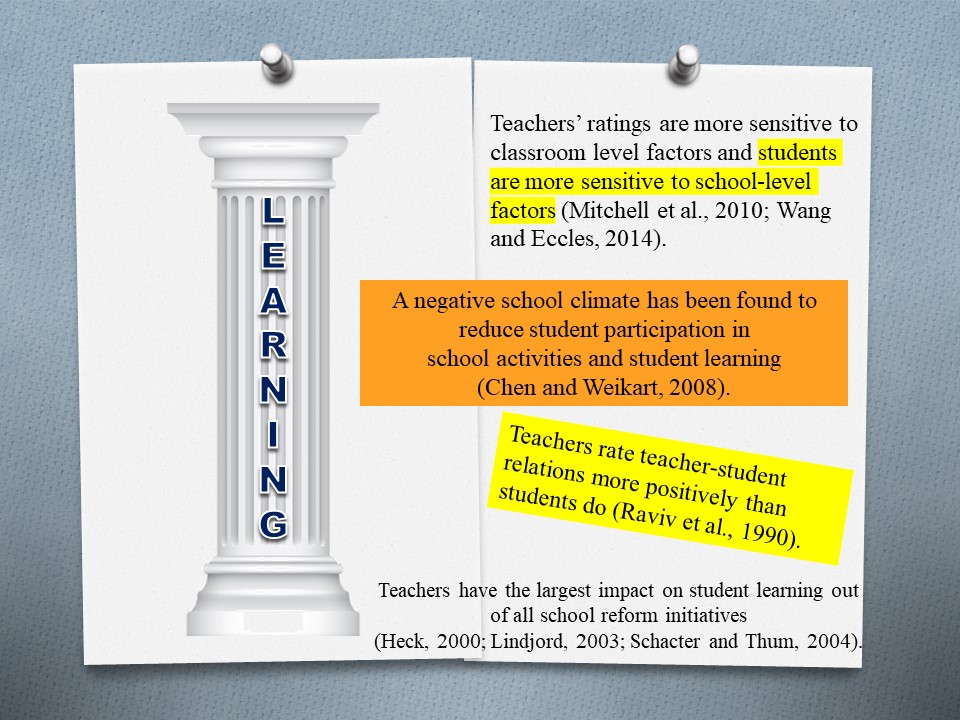
It is a joy for me to serve in education and I wanted to share some slides from one of my latest professional development sessions. As educational leaders, it is essential that we are reflective in practices and take the time to enter the difficult conversations and modeling this for our school teams. A positive school culture can not only make a difference in building a strong educational team and retaining teachers, but studies show that a positive school culture has a direct effect on student learning. Exemplary leaders understand how to create a climate of collaboration, they must determine what the group needs to do their work and build the team around a common purpose with mutual respect (Kouzes, 2017).

As we walk through this pandemic, take the time to invest into the discussion of developing or strengthening your school cultures…it will make ALL the difference!

May we continue to seek knowledge in all things~

Denise

Reference

Kouzes, J. & Posner, B (2017). The leadership challenge-how to make extraordinary things happen in organizations.

Hoboken, New Jersey: John Wiley and Sons, Inc.

1 Comment

Filed under Curriculum Resources