Tag Archives: Educational Resources

The Power of Traditions in a 30-Second World at Home & in the Classroom

We are raising children in a world of scroll, swipe, and sound bites. Information arrives in 30-second clips, fragmented headlines, and algorithm-driven content streams. Research suggests that rapid, high-frequency digital consumption can shorten attention spans and contribute to cognitive overload (Carr, 2010; Ophir et al., 2009). Attention is divided. Moments are rushed. Noise is constant.

In this environment, parents and teachers are called to be architects of pause.

Traditions and routines are not small things. They are anchors. They slow the train. They invite us to stop long enough to see, truly see, the children in our classrooms and the people in our homes.

These pauses do something powerful to the human spirit…

They create predictability in an unpredictable world. They foster emotional safety. They promote a grounded sense of reality, a reminder that life is more than reaction and response; it is relationship and presence. Research consistently links predictable routines with improved emotional regulation, reduced anxiety, and stronger mental and physical health outcomes in children and adolescents (Fiese et al., 2002; Spagnola & Fiese, 2007).

A Situation We Recognize

Imagine a middle school classroom on a Monday morning.

Students arrive buzzing from weekend activity and digital stimulation. Some are anxious about assignments. Others are carrying silent burdens from home. The energy is scattered.

Instead of diving immediately into content, the teacher begins with “Monday Morning Light.” A candle is turned on (battery operated for safety). Soft instrumental music plays for two minutes. Students are invited to write one gratitude and one intention for the week.

The room shifts…

Breathing slows. Shoulders drop. Eye contact increases. Students are no longer fragmented individuals entering from separate worlds, they are a community beginning together!

Over time, this simple ritual becomes a stabilizing force. It lowers stress responses and supports emotional regulation, outcomes that research connects to consistent family and classroom routines (Spagnola & Fiese, 2007).

That two-minute tradition communicates:

You are safe here. You belong here. We begin together.

Traditions do not waste time. They redeem it.

Why Traditions Matter

Traditions:

-Provide emotional security in uncertain times

-Strengthen identity and belonging

-Reinforce shared values

-Reduce stress through predictable rhythms

-Build intergenerational memory and meaning

-Cultivate hope

Traditions remind us of good memories of what was and give us hope for what is to come.

Let us never underestimate the power of hope. Hope strengthens resilience. Hope sustains effort. Hope fuels joy!

Simple Traditions to Begin Today

In the Classroom

1. Gratitude Friday

End every Friday with students naming one win from the week: academic, personal, or relational.

2. “Light the Week” Ritual

Begin Mondays with a short reflection, Scripture, quote, or moment of silence.

3. Celebration Wall

Create a space where students post small victories: kindnesses, perseverance, improvement.

4. Monthly Service Spotlight

Each month highlight a virtue or service theme and celebrate students who model it.

5. Seasonal Reset Days

At the start of each quarter, pause for goal-setting and community-building before diving into content.

At Home

1. Sunday Supper Tradition

Phones away. One question around the table that invites storytelling.

2. Birthday Blessings

Each family member speaks a word of affirmation over the birthday child, regardless of age.

3. First-Day-of-School (First-Day-of Quarter) Breakfast Ritual

Same meal. Same prayer. Same photo spot. Every year/every quarter.

4. Advent or Lent Reflection Nights

Short candle-lit gatherings with reflection and shared intention.

5. Monthly Memory Night

Pull out old photos and tell stories. Children anchor their identity in narrative memory. (Note: my kids are in their twenties and Michael and I still lean in on this tradition a few times a year.)

Intentional Pauses are Essential

Traditions are not elaborate productions. They are intentional pauses.

In a world that accelerates, traditions decelerate.

In a culture that fragments, traditions gather.

In a society that overwhelms, traditions ground.

Children, young and old, do not simply need information. They need formation.

They need rhythms that say:

You belong. You are known. You are part of something lasting.

As parents and teachers, we are not just managing days.

We are shaping memories.

We are cultivating hope.

We are building anchors that will steady our children long after they leave our classrooms and homes.

Let us be people who pause, let us be people who build traditions, and let us be people who carry hope forward.

Stay tuned for more information on making a difference for children and in service to others. When We Train Our Eyes to See the Good—Amazing Things Happen (Ball, 2026) is in one of the final draft phases 😉.

I would love to hear the classroom and home traditions and routines being used—please leave a comment and share with those who follow this blog. This blog has surpassed over 1 million views…thank you for sharing the good!

May we continue to seek knowledge in all things~

Denise

References

Carr, N. (2010). The shallows: What the Internet is doing to our brains. W. W. Norton & Company.

Fiese, B. H., Tomcho, T. J., Douglas, M., Josephs, K., Poltrock, S., & Baker, T. (2002). A review of 50 years of research on naturally occurring family routines and rituals: Cause for celebration? Journal of Family Psychology, 16(4), 381–390. https://doi.org/10.1037/0893-3200.16.4.381

Ophir, E., Nass, C., & Wagner, A. D. (2009). Cognitive control in media multitaskers. Proceedings of the National Academy of Sciences, 106(37), 15583–15587. https://doi.org/10.1073/pnas.0903620106

Spagnola, M., & Fiese, B. H. (2007). Family routines and rituals: A context for development in the lives of young children. Infants & Young Children, 20(4), 284–299. https://doi.org/10.1097/01.IYC.0000290352.32170.5a
Leave a comment

Filed under Creating a Positive School Culture, Inspiration, Positive School Culture, Traditions for Home & the Classroom

Be a Distributor of Joy and Change the Teacher Attrition Rate

Blackaby (2015) reminds us that a positive school culture begins with a service-oriented mindset. Leaders must build a clear vision of the kind of school environment they want to cultivate for teachers, students, and families. Building a strong team and a positive school culture requires shared leadership, collaboration, and a focus on teacher well-being.

School leaders must be present and care enough to listen and enter the difficult conversation(s). Joy must be modeled by the school leader in both word and action…it is synergistic and transformative for a school team and a school campus/community. At the heart of teacher retention lies a simple but profound truth—joy!

As educational leaders, we must be builders and distributors of joy, creating school cultures where educators are not just sustained but inspired. Joy is not just an outcome of a thriving school environment, it is the very foundation upon which leadership, professional learning, culture, and a positive school team interconnect and strengthen one another.

When leaders cultivate environments where teachers feel valued, when professional learning is meaningful and collaborative, when school culture is intentionally shaped with positivity and respect, and when teams work together with a shared purpose, joy emerges.

The discussion on teacher retention was important pre-COVID and is essential post the pandemic when many teachers are still struggling. Teachers need to pause and take the time to reflect and acknowledge the work it took to walk through that period, celebrate the amazing things that occurred due to their hard work and service to others, so they can close the chapter and get back to the joy of education that attracted them to the profession in the first place.

The conversation on teacher retention and the importance of school leadership and a positive school culture continues…

May we continue to seek knowledge in all things,

Denise

1 Comment

Filed under Curriculum Resources, Teacher Retention and Recruitment

Listening, Learning, and Leading: A Conversation on Teacher Retention


Teacher retention is not just a policy issue, it is  a deeply personal one. Behind every statistic is a teacher who has dedicated their time, energy, and heart to shaping the next generation. The reasons educators stay or leave are complex, intertwined with school culture, leadership, and professional fulfillment. The most effective way to address teacher retention is simple yet profound: we must listen.


As school leaders, we have an obligation to understand the realities our teachers face, to hear their challenges, and to amplify their successes. Listening is not just a courtesy, it is  a leadership strategy. When teachers feel valued, heard, and supported, they are more likely to stay and thrive.


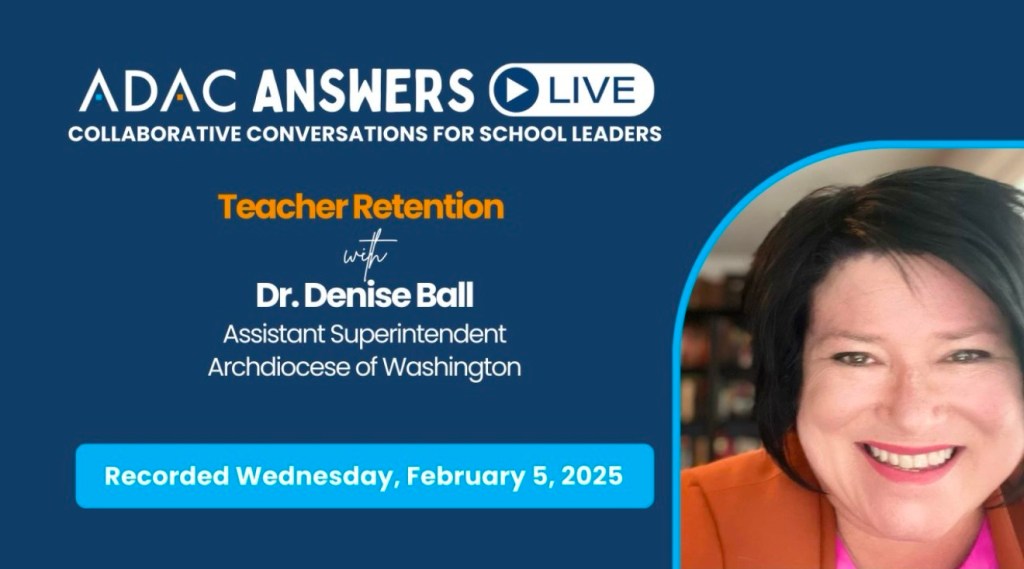
It was an incredible honor to be invited to lead a discussion on teacher retention as part of the ADAC Answers series. With over 240 school leaders from 40 states and the District of Columbia, registered and representing public, private, faith-based, and international schools. These leaders represented approximately 34,000 teachers and 370,000 students. This conversation reflects a national and global commitment to addressing one of the most pressing challenges in education today.


Bringing together diverse voices across governance models allows us to see the common threads in teacher retention and explore meaningful, research-based solutions. Whether it is mentorship programs, school climate initiatives, or leadership development, the strategies we discussed are not just theories, they are actionable pathways to strengthening our schools from within.


I am grateful for the opportunity to engage in this dialogue and to learn from the experiences of so many dedicated leaders. The work of teacher retention is ongoing, but together, through thoughtful leadership and a commitment to listening, we can make a lasting impact.

If you were unable to join yesterday, you can watch the full recording on ADAC’s Video Resources page.


https://loom.ly/1yvAmBo

May we continue to seek knowledge in all things,

Denise

Leave a comment

Filed under Curriculum Resources, teacher retention, Teacher Retention and Recruitment

Thank You…Over 1 Million Views

As of June 2023, this blog has had over 1 million views, thank you! I am in the final stages of conducting my research for my dissertation and I appreciate the kind messages of inspiration sent. This platform was created in 2012 to share the good in education. Please feel free to share what inspired you this year. Sharing the good is synergistic and good for us all!

May we continue to seek knowledge in all things~

Denise

August 2020

Thank you to the 580K+ visitors to this blog. This blog is a creative way I use to share the good I see and find. Once I defend my dissertation and earn my doctorate, I hope to spend more time sharing the best practices that readers share with me. I appreciate the teachers and educational leaders that share tips and recommendations they find helpful in the classroom, school or district they serve. Thank you to the parents who leave comments and suggestions too.

When we train our eyes to see the good, we can do ANYTHING!

May we continue to seek knowledge in all things-

Denise

Leave a comment

Filed under Curriculum Resources, educational leadership, Educational Resources, Inspiration, Our Statistics, Sharing the Good, Sharing the Good in Education, Team Building/Positive Work Environments

Some Great Science Sites just Discovered to Utilize in the Classroom or at Home

Science News for Kids

http://www.sciencenewsforkids.org/

Explore: Atoms and Forces, Earth and Sky, Humans and Health, Life, Tech and Math

On this site, they also provide great problem-solving tips too under the “extra” button.

Science for Kids

http://www.sciencekids.co.nz/

Science topics: Animals, Biology, Chemistry, Physics, Space and Weather

This site also lists many fun science experiment ideas.

ACS Chemistry for Life

Science for Kids…Explore student activity books and science teaching guides for grades K–8

USDA Agricultural Research Service~SCI4Kids

http://www.ars.usda.gov/is/kids/

Offers news about plants, animals, and other life science issues. Also includes pop quizzes, and pictures. Site is available in Spanish.


As teachers, administrators, students and parents are all working on finding the 2012-13 school year groove, we would love to hear about some great sites you have discovered.

When we all come together for the common good, amazing things can happen!

May we all continue to seek knowledge in all things~

Denise

Leave a comment

Filed under Curriculum Resources, Educational Websites and Resources, Science, Science and Social Studies Websites for Kids, Science Fair Projects, Student or Industry

Making Science Fun with Science Competitions that Promote “Out-of-the-Box” Thinking

Science is FUN!

It is almost January, and educators and parents start the “Science Fair” discussion with children and students.  This year, there are some cool science contests out there and Google Science tops my list.

Regardless if Science was your thing or not, if asked, we all could probably pull forward one science fair memory from the recesses of our minds. Volcano eruptions, eye ball blinks, inertia, plant growth with various musical tunes you name it, science fair time can be an exciting time of discovery or a mad dash to finish a deadline imposed by the ominous science teacher.

The Important Role of the Science Teacher
Given the teacher and they way material is presented, science can be fun! The world of science can open many doors for children. Doors to worlds that can increase awareness of saving our planet, living a healthy life, or even saving a life one day, by creating a cancer-saving cure…imagine. Many children in this country have limitations on travel and are limited to specific environments and economic resources. However, science is that one area where it is “cool” to recycle, utilize imagination and create! Memories of utilizing paper towel and toilet roll holders to demonstrate magnetic pull, keeps bubbling up to remind me that in science, the sky is the limit on creativity and ingenuity.

Science Fair Contests

*Google Science Fair 2012

  1. Children must be 13-18 years old
  2. Individual or groups allowed; groups can consist of two or three teams only
  3. Children “Scientists” must create a Google account and submit a Sign-Up form online
  4. Once confirmation is given, plan, execute and cite results, remembering to follow directions given and complete all sections outlined on the Google Section Submission Site
  5. A two minute video or 20 page slide presentation giving an overview of project are required to enter contest…entries are due by April 4th with submission form

This is a great contest that can allow educators to collaborate from various schools to come together with “Science Teams”, churches and or youth groups to utilize science as a way to spark the imagination of our children and enhancing team building while instilling (hopefully) a love of science.

*International Online Science Contest

The International Online Science Contest website has a wealth of resources for teachers and parents. This site offers a variety of science contest that run all year. Students can visit this site to view other science projects and read judging tips to get an overall appreciation for the “Science Fair” process. Parents can visit site to read and download a Parent Guide that provides step-by-step instructions, parent testimonials and defines the roles of parents throughout the “Science Fair” process. This is a one-stop shop for learning all about Science Fairs and a great resource for classroom teachers as well.

Science Buddies

Science Buddies website is an all encompassing site that provides its reader with a list of various science competitions. Competitions are broken down by grade levels, format, eligibility and if teams are allowed. This is a great site for young people who might be interested at ages eight or nine in science and can watch some “advanced” science fair project videos on various projects to plant a seed for the future. For schools who do not have a “gifted” or advanced science program, this might be the site for you.

“Out of the Box” Teaching

A school, with a very creative, “out of the box” science teacher, could utilize the contest found here or at any of the mentioned websites, and take students who demonstrate an aptitude for science to the next level. Teachers who are looking to collaborate or parents who want to take more of an active role in this process can find science community blogs as well at http://www.sciencebuddies.org to glean insight and support throughout the Science Fair process or to even supplement or increase the love of science in the life of a child.

Science Fair Project Ideas

Happy creating and for additional science fair project ideas, check out the following sites to ignite the imagination:

Imagine if we could ignite the imagination, plant a love of learning for science via writing, creating, utilizing music, labs, nature and utilize all the other multiple intelligences, there is nothing we could not accomplish or overcome.

May we seek knowledge in all things,

Denise

Leave a comment

Filed under Science, Science Fair Projects, Sharing the Good, Student or Industry