
I believe in sharing the good; words have power. There were so many words of wisdom shared over the last few days, I took pen to paper to capture a few words that spoke to me. I hope they inspire you or encourage reflection as you wrap up the 2023-24 school year. Please refer to the recommended resources for the names of some of the speakers who lit my fuse of curiosity this week. Never forget that to teach is a choice. To lead in education is a choice. The work you choose to do matters! Thank you for saying yes to the call to serve in education…
I found this week so engaging that I needed to pause and reflect to process the many data insights supported by research shared this week. There was such a dynamic cadre of national educational leaders that gathered in Dallas for this well planned and executed event. Many opportunities were provided to listen and discuss data and how to use data to inform decisions that effect student learning outcomes. I have a notebook of takeaways that I will spend some time with over the summer to unpack from attending the Curriculum Associates 5th Annual Ferguson Institute.

Key Takeaways:
1. It is important to come together; educating students takes a community.
The power of collaboration in education was a resounding theme at the Ferguson Institute. The diverse perspectives and experiences shared among those present served as a powerful reminder that the education of our students is a collective endeavor, not an individual one.
2. As educational leaders, we need to ensure we are providing teachers with opportunities to create environments where students feel “invited” to learn and that we are embracing and using data across all grade levels.
Creating inviting learning environments is crucial. By leveraging data, we can tailor these environments to meet the needs of every student, fostering an inclusive and supportive atmosphere that encourages engagement and learning.

Hattie, John. “Foster a Learning Culture.” 2024. What Brings You Joy. 5th Annual Ferguson Institute.
3. Remember never to underestimate a student’s potential and that every child is a capable mathematical thinker. Wouldn’t it be amazing if all students believed they were capable mathematical thinkers? Expecting excellence will transform a school culture!
At the heart of our educational mission is the belief in the untapped potential of every student. By fostering a culture of high expectations and support, we can empower our students to see themselves as capable mathematical thinkers, thereby transforming the overall school culture. Embracing this thought process might also require some professional development to ensure your faculty sees a capable mathematical thinker in every student. Let us enter the conversation…
4. Continue to seek to be inspired, encourage one another and the students placed in your care. Do not edit out the innovation; create environments for students and teachers that promote curiosity and inquiry.
Innovation should be at the heart of our educational practices. By nurturing curiosity and inquiry, we can create dynamic learning environments that inspire both teachers and students to explore, experiment, and grow.

Hattie, John. “Students are Engaged in their Learning.” 2024. What Brings You Joy. 5th Annual Ferguson Institute.
5. Building capacity through teaching inference and evaluating the impact is essential.
Teaching inference is essential for developing critical thinking skills. Evaluating the impact of our teaching practices ensures that we are effectively building these capacities in our students and continually improving our methods.
6. Hearing school districts share their data story was inspirational and provided opportunities for rich data dialogue. Hearing that achievement is up half a grade level equivalent in one year was simply a testament that the i-Ready curriculum and assessment resources make a difference!
The success stories shared by various school districts were both inspiring and affirming. The significant improvements in student achievement underscore the effectiveness of the i-Ready curriculum and assessment resources in enhancing educational outcomes.

Sullivan, Mark. Birmingham City Schools. 2024.
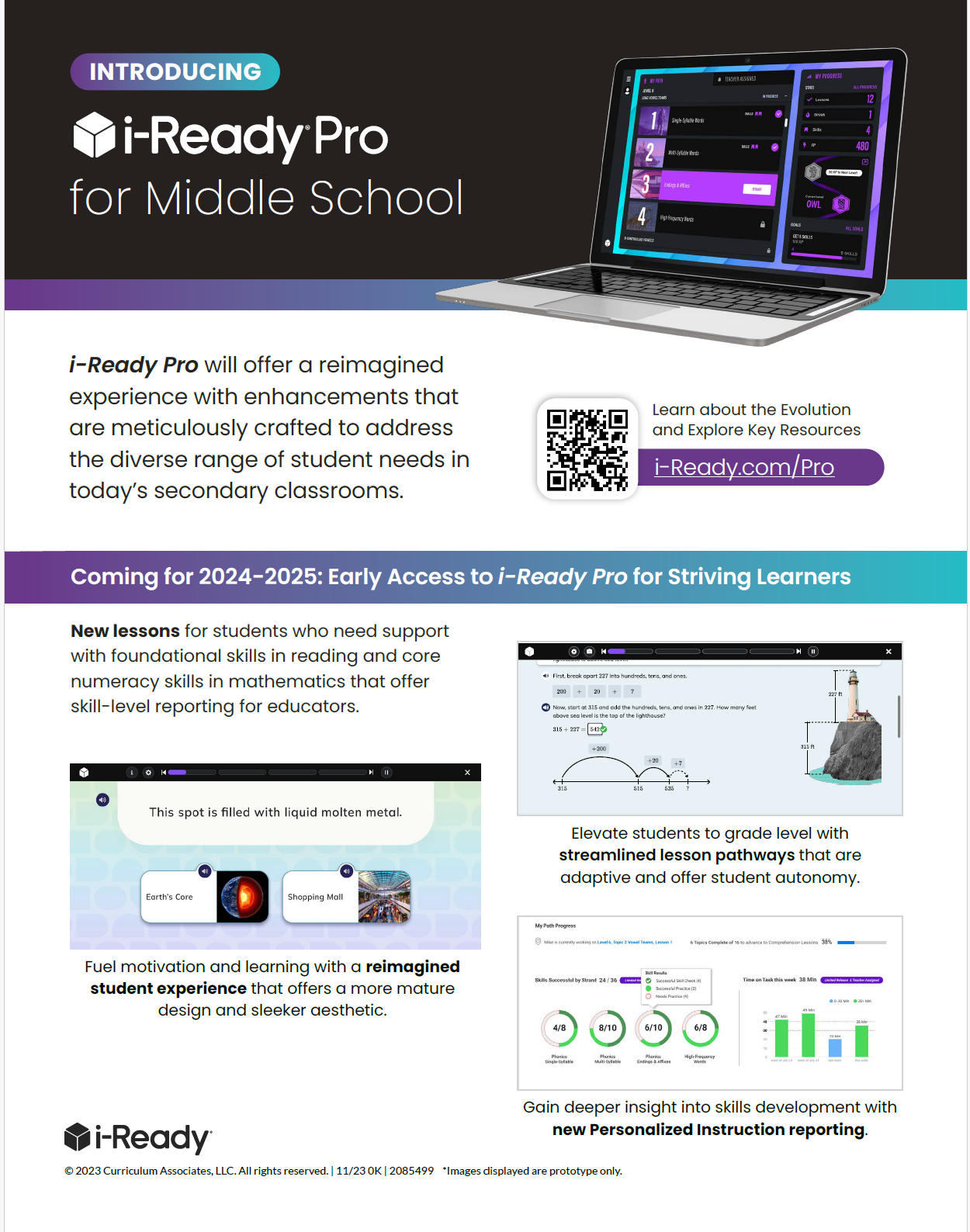
7. Curriculum Associates stimulates inquiry…always growing and improving through research and collaboration where speech recognition, Algebra I, and i-Ready Pro initiatives will be student game changers.
Curriculum Associates’ commitment to continuous growth and improvement through research and collaboration is evident in their innovative initiatives. These advancements promise to be transformative for students, particularly in areas like speech recognition and Algebra I.
8. One gold nugget that is life-affirming is to embrace the errors. No one says no to better!
Embracing errors as opportunities for growth is a powerful mindset. It reminds us that continuous improvement is always possible, and every mistake is a step towards betterment.
The world is chaotic, and we are called to be a positive light for the students and parents in our care. We must have courage, and as reflective practitioners, we must remember to reflect often on what brings us joy. Nothing great happens in the absence of enthusiasm. Build that playlist this summer, sing aloud and dance. Get energized to develop a personal and professional framework for greatness for the 2024-25 school year.
I am leaving Dallas and headed back to D.C. with the clear understanding that Curriculum Associates is an organization where everyone believes that every child deserves to be on grade level. It has been an exceptional week, enriched with data discussions with passionate school and district leaders committed to making a difference in a child’s life. I look forward to continuing to unpack all that I learned with my team and the school leaders I serve, strengthening the relationships developed and lessons learned while engaging with data at the 5th Annual Ferguson Institute.

Inspiring Leaders Making a Difference in Education


Recommended Reading Resources
Whitepaper: Culturally Responsive Mathematics Teaching (curriculumassociates.com)
School Readiness for Young Students Post-Pandemic (curriculumassociates.com)
Rethinking Middle School Math Acceleration (curriculumassociates.com)
Student-Focused AI Capabilities


 Unlock the Teacher